



TL;DR
ChatGPT search considers relevance and reliability, but its public guidance stops short of a complete ranking formula. Diagnose five observations in the product you actually used: crawl access, retrieval, consultation, citation and referral attribution. An API sources list, a bot request and a visible answer link prove different things.
Your server log shows a search bot visiting a product page. Your colleague asks the same buying question again, and a competitor gets the link. Before another rewrite, work out what you actually observed.
A crawler request and a citation belong in different columns. So do a source linked beside an answer and a qualified enquiry on your website. Mixing those records creates confident reports and poor decisions about what to change next.
How does ChatGPT choose sources to cite in 2026?
OpenAI describes search ranking in terms of several factors aimed at relevant, reliable information, without publishing how those factors are weighted or guaranteeing placement. Its current search guidance also says search responses can include citations and warns that those citations can be incorrect or incomplete.
Start with one saved buyer question: open its cited pages and compare their evidence with the relevant passage on your own page. Treat claims about a fixed citation score, mandatory article length or guaranteed inclusion as hypotheses requiring their own evidence. A vendor's observed correlation doesn't disclose the platform's decision rules.
The five observations below are our diagnostic framework. They're not a diagram of OpenAI's internal architecture, and you won't necessarily be able to see every observation for a consumer conversation.
Record an unavailable measurement as unknown. Don't fill it with a crawler count because that number is easier to obtain.
| Observation | Evidence to retain | What it does not establish |
|---|---|---|
| Crawl access | Bot policy, host response and verified request logs | Selection for a particular question |
| Retrieval | A URL returned by an instrumented search in a named run | Full-page reading or influence on every claim |
| Consultation | A supported product's source record for that run | A complete account of hidden model reasoning |
| Citation | The actual link and nearby claim in the saved answer | Accuracy, a click or endorsement of the business |
| Referral attribution | Recorded landing visit and separately linked outcomes | The originating private prompt or incremental revenue |
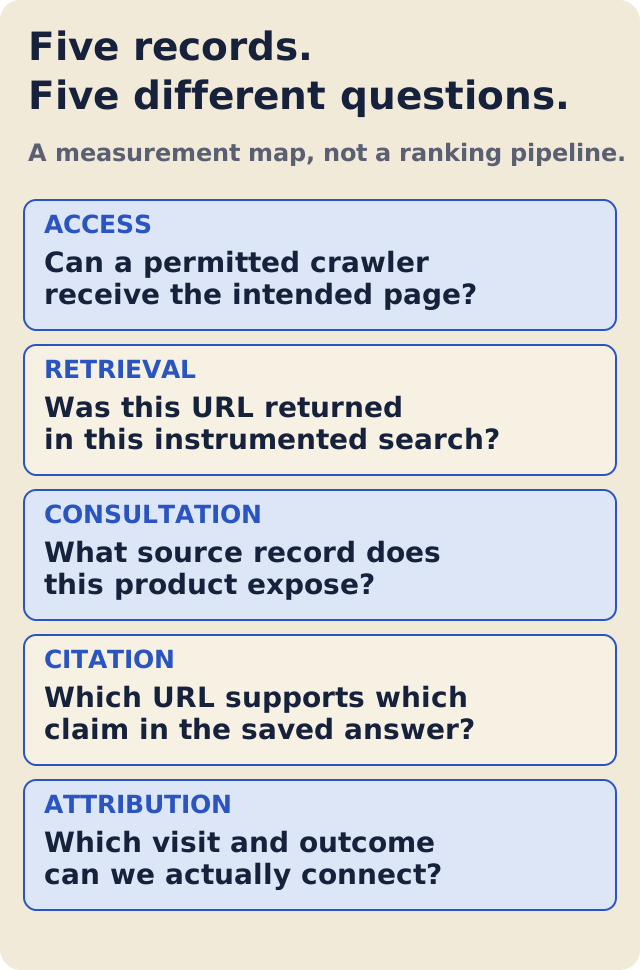
Each record answers a different question. The diagram is a measurement map, not a disclosed ranking pipeline.
Does allowing OAI-SearchBot make ChatGPT cite a page?
Allowing the search crawler addresses access. OpenAI's crawler documentation distinguishes OAI-SearchBot for search, GPTBot for potential training and ChatGPT-User for user-triggered actions. The first two permissions are independent; allowing search doesn't require allowing training.
Audit the particular URL, not just the homepage. Check the site's robots rules and whether the host or content delivery network returns the intended page to permitted traffic.
A challenge screen with a successful status code still isn't your article. Check redirects, error bodies and the text received by the requester.
Keep crawler identity separate from the request's user-agent label. Where possible, verify the request against the published network information before attributing it to OpenAI. Anyone assessing logs should retain the timestamp, URL, status and verification method, without publishing visitor identifiers.
Robots rules describe crawler behaviour, not a security boundary. RFC 9309 explicitly separates the protocol from access authorisation. Protect private material with authentication; don't rely on a disallow line to keep it confidential.
These checks can justify an access repair. They cannot tell you which paragraph persuaded an assistant. If you need a broader technical checklist, our guide to why a website doesn't appear in ChatGPT covers the page-level foundations.
Keep each platform's eligibility rules attached to that platform. For example, Google requires a page to be indexed and eligible for a search snippet before it can appear as a supporting link in AI Overviews or AI Mode. That's a documented Google condition, not proof that Google indexing is an OpenAI citation requirement.
Can the same buyer question lead to different searches?
Yes. OpenAI's search help describes rewriting a request into targeted searches and sometimes issuing follow-up searches. It also describes location and relevant saved memory affecting queries.
That's a reason to record test conditions, not evidence that every question produces a fixed number of searches.
Consider this invented buyer question: “Which booking system lets a small venue take deposits and export guest data?” A useful answer needs several facts.
A system's deposit policy answers one part; its export instructions answer another. A comparison page that repeats “best booking software” without those details leaves the actual decision unresolved.
Give one buyer task a strong page; use supporting pages when the task changes, such as configuring a deposit or understanding an export format.
Merge two pages when they answer the same buyer question from the same evidence. Keep them separate when completing one task needs facts the other page doesn't carry.
For repeated tests, save the exact question, date, product, selected model where visible, language, location and whether search ran. Note relevant account or memory conditions without copying private conversations into a public report. A changed answer under changed conditions is weak evidence of a content improvement.
What does “consulted” mean, and where can you see it?
In the Responses API web-search documentation, the sources field lists URLs retrieved or consulted for a response; inline citation annotations identify selected references. Developers can request that source information with the documented include option. This is an API capability.
Don't turn those terms into two guaranteed, independently observable internal stages. OpenAI uses retrieval and consultation language in describing the same sources field. A listed URL doesn't certify that every word of the page was read, nor does it explain how much any particular claim depended on it.
The consumer interface is a different evidence surface. ChatGPT's Sources panel can contain cited sources and other relevant links.
Do not label the Sources panel a complete API-style consultation log. Save the answer with its visible citations, record the panel URLs in a separate column, and mark the unobservable research set as unknown.
If a monitoring platform reports “retrieved”, ask what produced that record. Was it an API tool result, a visible browser source, a crawler request or an inferred classification?
Keep that definition beside the metric. Two tools can use the same label for different events, which makes a combined total misleading.
Why can a visible citation still be weak evidence?
A citation is a checkable link attached to an answer. Open the link and compare the supported passage with the claim beside it.
A page about deposits doesn't automatically support a statement about refund deadlines. A product can be cited for documentation while another product is recommended in the answer.
Keep three judgments separate: the URL was cited, the cited passage supports the claim, and the brand was recommended. Record all three when the distinction matters. A flattering mention without a source and a source link in a critical answer aren't equivalent wins.
For page improvements, start with the exact mismatch. If the question asks about exports, put the available formats, scope and limitations together.
Identify who maintains the information and when a time-sensitive fact was checked. Link to the underlying policy or documentation, so the reader can inspect it.
This is editorial advice, not a promised ranking boost. Judge the change through repeatable observations after release. Our guide to getting recommended by ChatGPT deals with the wider recommendation problem; this article's narrower task is understanding the source evidence.
How should you diagnose a page with visits but few citations?
Use the earliest problem you can demonstrate. Don't assume an invisible stage failed. These examples suggest a next investigation, rather than proving why an assistant chose another source.
| What you observe | Sensible next investigation | Avoid this conclusion |
|---|---|---|
| Permitted bot gets a challenge page | Inspect host rules and the returned content | The article's prose caused the failure |
| No URL citation in saved answers | Verify search conditions, relevance and access | The page was never consulted |
| API source record contains the URL, but no citation | Compare the relevant passage with cited evidence | The consumer product rejected the page |
| Citation points to outdated information | Correct the page and check the saved claim | Any citation is a successful recommendation |
| Visits arrive, enquiries don't | Inspect reader intent, offer and form friction | The crawler needs a different robots rule |
Here is an illustrative example, not a result from a business. You run ten fixed questions twice and save twenty answers. Your page receives a citation in four answers.
Separately, the server records 120 verified crawler requests and analytics records three referral sessions. One visitor submits an enquiry, but nobody has assessed its fit.
You can report 4 of 20 sampled answers citing the page, 120 requests and three recorded sessions. You cannot divide four citations by 120 requests to calculate a citation conversion rate.
Those records don't represent the same population. Nor can you report one qualified lead: its status is still unknown.
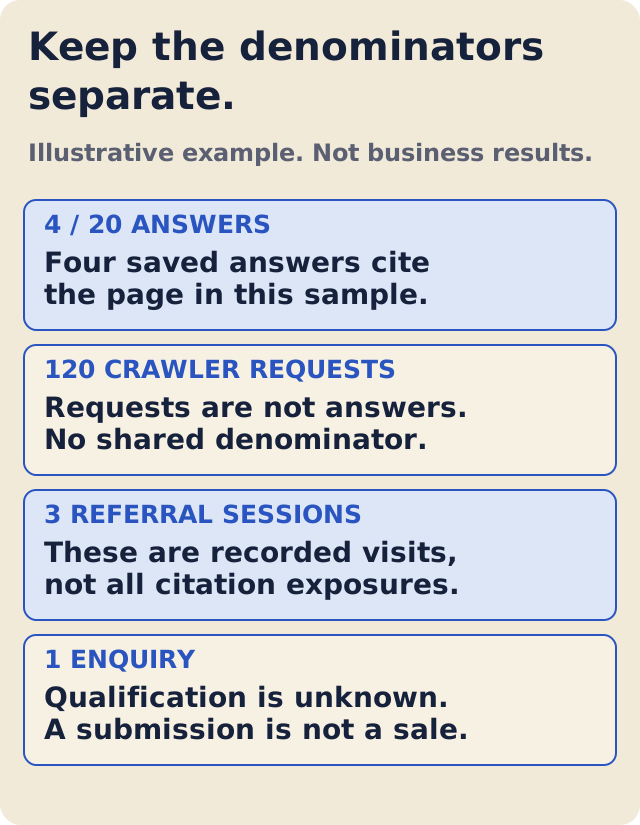
Only 4 of 20 has a shared denominator here. The other records need their own definitions and links before they become a funnel.
How do citations connect to traffic and qualified enquiries?
Start with recorded arrivals. OpenAI's publisher FAQ describes ChatGPT referral URLs carrying utm_source=chatgpt.com.
Google Analytics explains how traffic-source parameters become report dimensions. Inspect what your implementation actually retains through redirects and consent choices.
A referral label doesn't expose the private question that produced the visit. It also doesn't tell you whether the visitor saw an organic citation, another ChatGPT link or a copied URL. Keep the landing record and answer-sampling research separate unless you have evidence connecting them.
Define an enquiry before counting one: a valid submitted request is different from a button click or form start. Define qualification separately, using criteria the sales team can assess. For example, a real company with an in-scope need can pass a qualification review; an unreviewed submission remains unreviewed.
Record acquisition evidence, submitted request, qualification decision and booking confirmation as separate events. A booked meeting doesn't prove that this article caused the meeting. If the attribution link is missing, preserve the commercial result and call its source unknown.
When testing tags, use a controlled test visit and confirm the stored event. Google's campaign URL guidance explains the parameter format. Exclude your test from business reporting, and don't alter site-wide tracking just to make a single article's numbers look better.
When is a Schmitdy audit useful?
Before changing a page, save the exact URL, the relevant answer and the problem you can demonstrate in one dated record.
Assign one person to the change and name the check that would show it worked: the returned page content for an access repair, or a corrected passage for a factual repair.
Make the next review comparable: repeat the same questions under recorded conditions, inspect the actual answers and keep the sample denominator visible. Track other page changes during the period. A wider movement in the product or market can change results even when your page stays still.
If you want help prioritising content, technical access and the wider sources that shape buyer decisions, request a free AI Search audit from Schmitdy, our AI-search growth service. You receive a full analysis of how you show up across ChatGPT, Claude and Google AI, plus a prioritised 30-day plan.
The form requests a review; it doesn't promise acceptance, instant analysis or a ChatGPT placement. Bring any saved answers, cited URLs and analytics you already have. The useful starting point is the evidence you can inspect, followed by one specific change worth testing.
Sources
- OpenAI: Searching the web with ChatGPT.
- OpenAI: Overview of OpenAI Crawlers.
- OpenAI: Web search, including output, citations and sources.
- OpenAI: Publishers and Developers FAQ.
- IETF: RFC 9309, Robots Exclusion Protocol.
- Google Analytics: Traffic-source dimensions, manual tagging and auto-tagging.
- Google Analytics: URL builders and campaign data.
- Google Search Central: AI features and your website.


 Squarespace
 Webflow
 Sanity
 Shopify
 HubSpot