



If visitors already find your restaurant and you need more regulars in the quiet months, spend the first hour on one weekday meal at one Copenhagen branch that people nearby can book again and again. Use visitor results as a comparison when deciding where to work.
TL;DR Copenhagen visitor discovery needs a separate check from a restaurant’s overall AI visibility. Across 40 Danish and English visitor and landmark questions, Restaurant Schønnemann appeared for 21 and Mad & Kaffe for nine. Operators should inspect the particular meal, location and service constraint behind each result before choosing changes.
Restaurant Schønnemann serves a recognisable Danish lunch: its herring menu includes a Snapsemad of boiled potatoes, herring salad and dill. That meal gives a visitor something concrete to choose. Knowing its name, however, does not answer every practical question about where to eat during a Copenhagen trip.
Our Copenhagen research lets us look at those questions separately. It contains a visitor and landmark section covering a first evening, a weekend, an English menu, luggage, harbour views and meals around specific city anchors. For restaurant teams with limited marketing time, the useful decision is which of those requests the business can actually serve, then whether the answers describe that fit accurately.
Which visitor request deserves limited marketing time?
For local growth, choose a recurring occasion such as weekday dinner near home or lunch near work and check that meal and branch in Danish and English. Keep the comparison with the visitor requests below separate. The language can change the answer, but cannot tell you where the guest lives.
Choose a request that a real Copenhagen branch can serve with an actual meal, then read the answer for suitability. A brand’s overall recognition does not decide whether it suits that visit or which page change deserves attention.
The visitor section contains 20 dining intents, each asked in Danish and English: 40 question strings in total. A restaurant counts once for a string if any observed nonempty answer names it across ChatGPT, Gemini and Google AI Overviews and their repeats. This is the same question-coverage definition used in the main Copenhagen study, applied to a narrower section.
These are selected examples from the 33 reviewed concepts, presented alphabetically. They are not a ranking of restaurants for visitors.
| Restaurant | Visitor questions naming it | Nonempty answers naming it |
|---|---|---|
| Aamanns | 15 of 40 | 74 of 1,189 |
| Høst | 17 of 40 | 128 of 1,189 |
| Mad & Kaffe | 9 of 40 | 28 of 1,189 |
| Madklubben | 14 of 40 | 44 of 1,189 |
| Restaurant Karla | 16 of 40 | 98 of 1,189 |
| Restaurant Schønnemann | 21 of 40 | 209 of 1,189 |
Coverage counts question strings with at least one name appearance. Answer counts tally appearances among observed nonempty answers. Neither measures visitor numbers, quality or reservations. The question set covers decisions, not landmark search volume. The earlier index used different questions and a different calculation; this panel is not a time comparison.
A name can also appear in a warning or an unsuitable suggestion, so read the answer before treating it as a visitor opportunity.
The section has 1,189 observed nonempty answers from 1,200 planned answer slots. The remaining outcomes cannot establish whether a restaurant would have been named. Repeated answers also do not represent independent diners. These boundaries matter when a team decides how much effort a result deserves.
Start with a meal the branch already serves. The study’s question about dinner near Rådhuspladsen is more specific than its first-evening question. Restaurant Karla was named in 36 of 59 observed nonempty answers to the Danish and English Rådhuspladsen question. Its official site places it at Dantes Plads 1 and offers Danish food, lunch and dinner. Those are useful facts to investigate together. The result does not establish a route time or prove that every returned recommendation was geographically correct.
Being in central Copenhagen does not establish harbour views, suitcase storage or a particular meal at a particular time.
The Nyhavn visitor guide describes a district of canal tours, dining and waterfront activity. The city’s central dining guide already helps people choose among nearby places. An operator considering a local guide should read those existing answers first. A useful addition explains the restaurant’s actual place in a trip; a page repeating the area name adds little.
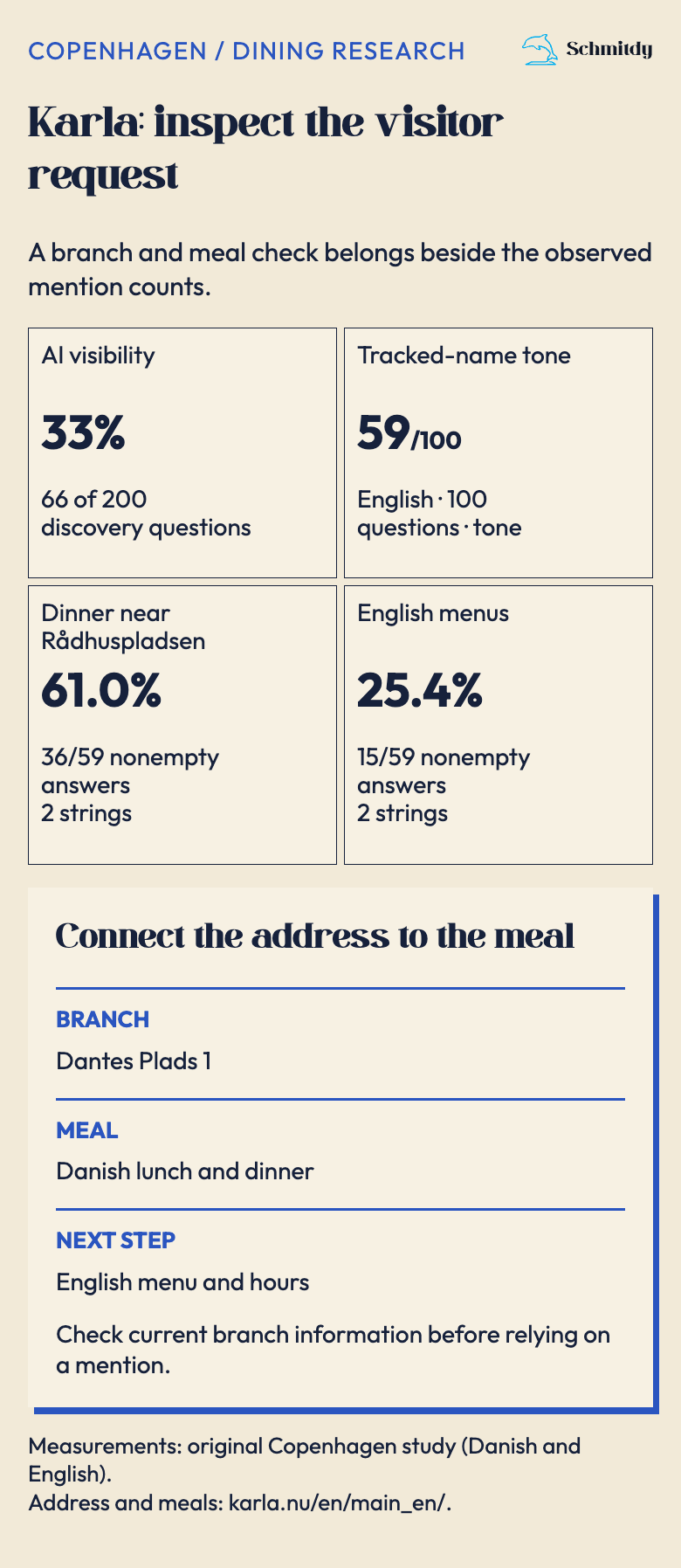
Diagram: Schmitdy. Study measures: overall coverage across 200 discovery question strings, tracked-name tone across 100 English questions, and two visitor diagnostics with 59 nonempty answers each. Address and meals: Karla’s official page. A name appearance does not establish suitability.
Question language is not a record of who asked, where they live or whether they are travelling. The visitor questions were put in both languages. The Danish and English collections were separate, so the differences cannot isolate a language effect.
Mad & Kaffe appeared for seven of the 20 Danish visitor strings and two of the 20 English strings. That is a reason to inspect which requests differed. It is not evidence that English-speaking visitors avoid the cafés or that translation would produce a particular gain.
Google’s guidance for multilingual sites is a useful implementation reference when a business maintains equivalent language pages. The commercial question comes first: can an English-speaking guest find the right branch, understand the meal and complete the booking? Translate those decisions accurately before expanding a content programme.
What should the branch page answer, and how should the team test the work?
Start with one branch and one weekday occasion you can actually serve. Have the manager check the menu, kitchen hours and booking route. Correct the clearest gap and repeat the same question before putting more scarce hours into the visitor work. Prioritise local repeat business during weak tourism and keep the visitor representation check below as a distinct use case.
Start with the existing page for one eligible branch and a supported visitor decision.
A visitor-facing page earns its place by resolving uncertainty. The Union Kitchen City already describes its Store Strandstræde address, brunch and evening sharing offer. It illustrates the level of practical detail worth examining. Its existing content should be inspected before anyone prescribes another page covering the same ground.
For an eligible meal, useful information includes the actual location, service times, current menu, reservation or walk-in policy and any relevant restrictions. If a restaurant cannot confirm luggage storage or step-free access, the page should not acquire those claims merely because an AI question asks for them.
Google’s local-business structured-data documentation explains how business information can be represented. The Restaurant vocabulary includes fields for menus and reservations. These can describe verified information; they cannot establish an unverified service or guarantee an AI recommendation. The information must also be useful in the visible page.
The branch manager should confirm the facts before the marketing team assigns a repair.
- Record the exact visitor request and eligible branch, then read the returned answers for unsuitable suggestions and warnings.
- Check whether the branch’s visible information answers that request, including the practical constraint.
- Repair a factual omission or inconsistency, or choose an existing page to improve if it already owns the subject.
- Connect the relevant menu and booking pages through ordinary links.
- Agree a separate future measurement with the same question and engine scope, then examine traffic and enquiries separately.
Google’s crawlable-link guidance supports the linking work. Its AI search guidance says there are no extra technical requirements or special optimisations for appearing in AI Overviews or AI Mode. A clear, accurate page is a defensible task. A promised recommendation is not.
Search Console’s Performance report can help an authorised team inspect queries, pages, clicks and impressions. Those are different observations from the name appearances in this study. Keep a future increase in page visits separate from table bookings, and avoid attributing either to a content change without suitable evidence.
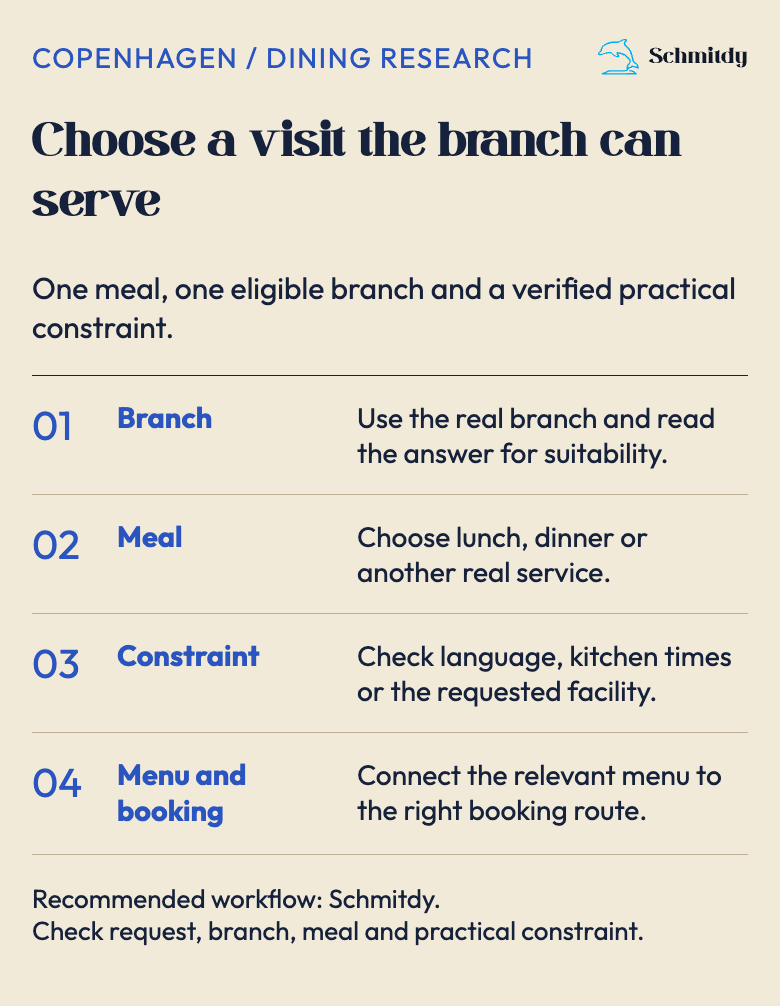
Recommended workflow: Schmitdy. Check the request, eligible branch, actual meal and practical constraint, then connect the menu and booking route.
Use the restaurant’s real service geography to choose the task. A high overall score does not settle a visitor request; a low visitor count does not make every request commercially relevant.
The Schmitdy research collection provides the wider context. An operator who wants help choosing the first branch and visitor decision can request an AI-search audit, with priorities tied to the restaurant’s actual offer.
Sources
- Schmitdy: original Copenhagen Danish and English restaurant study
- Restaurant Schønnemann: herring menu and Snapsemad
- Restaurant Karla: address, food and service information
- VisitCopenhagen: Nyhavn visitor information
- VisitCopenhagen: dining in the city centre
- Google Search Central: multilingual and multi-regional sites
- The Union Kitchen City: location, meals and booking
- Google Search Central: local-business structured data
- Schema.org: Restaurant vocabulary
- Google Search Central: crawlable links
- Google Search Central: AI features and website guidance
- Google Search Console: Performance report
- Schmitdy: restaurant research collection
- Schmitdy: AI-search visibility audit
 Squarespace

 Webflow
 Sanity
 Shopify
 HubSpot