



TL;DR
Fix the clearest confirmed guest failure first. A wrong opening time or broken reservation link matters more than a new article or a week of prompt watching.
Keep Google AI Overviews and AI Mode, Google Maps and Business Profile, and ChatGPT Search separate because they use different systems 1[9][10]. Give every fix an owner, then confirm it by opening the published page, profile or booking route that a guest uses.
Start with a real failure, not a theory about AI visibility.
Google says normal Search foundations remain relevant for AI Overviews and AI Mode. A page must be indexed and eligible to show a Google Search snippet to be eligible as a supporting link.
Google also says there are no additional technical requirements or special schema needed for those AI features, and neither indexing nor serving is guaranteed 1. That makes a symptom-led audit more useful than a hunt for a magic field.
 Google Search ·
  ChatGPT Search
Which restaurant repair matters first in 2026?
| Priority and symptom | Evidence check | First repair and owner | How to confirm the repair |
|---|---|---|---|
| P0: Reservation or order link fails, names the wrong venue, or stops short. | Complete one mobile journey using a date, party size and location. | Correct the first broken link. Reservations manager owns it. | A mobile journey reaches the intended venue and shows the real next step. |
| P0: Maps or Search shows closed, an old address or wrong phone. | Compare the Business Profile, website, booking page and front-door sign. | Correct the wrong owned source. General manager owns it. | The published profile and website show the same fact. |
| P1: A guest cannot check a current dish, price, meal period or diet-relevant option. | Open the menu on a phone and answer the exact question. | Publish one readable current menu page. Head chef and web owner own it. | The profile menu link opens a text page with the answer. |
| P1: ChatGPT finds the site but cannot reach the useful page. | Check for robots rules, a challenge, login or broken scripts. | Remove the confirmed block. Web owner owns it. | A permitted crawler and normal visitor receive the public page. |
| P2: Recent reviews repeat one operational failure. | Read a bounded sample and group repeat themes. | Give the main theme to the relevant service owner. | The operation records the change and public facts are accurate. |
| P3: No AI Overview appears for a query. | Record the query, place, device and normal results. | Investigate the guest journey. Marketing lead owns the record. | The record links the observation to a defined next check. |
The P0 rows come first because a customer who cannot complete an action cannot benefit from a better description.
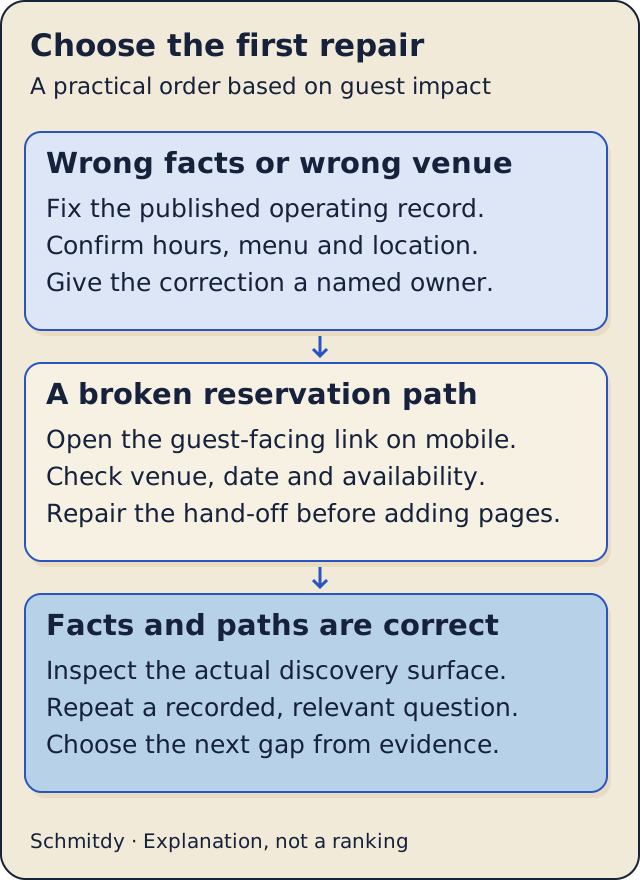
Illustration: Prioritise incorrect venue facts and broken reservation paths, then investigate discovery evidence after those faults are addressed.
1. Is the reservation route broken?
Test the route from a restaurant-name search, through the Business Profile, to the booking or ordering destination. Use a real date and party size. A button that loads a homepage is not evidence that the journey works.
Google lets businesses manage menu, reservation and food-order links, and select a preferred link where more than one is present 4. ChatGPT availability depends on supported third-party providers and varies by venue and location 10.
Fix the earliest broken connection. Correct or remove a link to a former provider. Provider inventory belongs with the reservation owner.
Confirm the repair when a manager reaches a valid reservation or ordering step on a phone and records the date, party size, destination and outcome. If the restaurant is honestly sold out, record that result.
2. Hours, address, phone or venue identity conflict
Basic identity conflicts often surface before holidays, events and seasonal reopenings. Google offers special hours for temporary changes and recommends confirming holiday hours 5.
Make a fact card for the name, address, dine-in hours and direct phone. Compare the Business Profile, website, booking confirmation page and physical sign for each location.
Correct the earliest owned source that is wrong. Google asks businesses to represent their real-world name accurately, keep address information precise and use suitable categories 2.
Confirm the repair by opening the published website and Business Profile. Record the submission date separately if the profile edit is still under review. Google says some attribute edits can take from minutes to longer review periods 6.
3. Can the menu answer the guest’s question?
A menu photograph or a handful of “popular dishes” leaves a guest with no reliable answer about a particular dish, price, meal period or current option. That is a guest-service failure before it is a discoverability problem.
Google says restaurant menus should represent available items and that a sample menu limited to popular items should not be submitted 2. Its menu editor supports sections, dishes, descriptions and prices 3. WCAG requires a text alternative for non-text content, so a menu image cannot be the only source for an essential answer 16.
Choose the single missing answer that blocks the most frequent real enquiry. Repair the current dinner menu page before creating a broad discovery article.
Put the current menu in readable text, label the service and use a visible last-updated date. Menu facts, especially allergens, ingredients and availability, need sign-off from the person responsible for service.
Close the job when a guest can open the menu from the profile on a phone and find the answer in text. The kitchen or manager must confirm that the page matches the service being sold.
4. The venue is omitted from an AI answer, but the facts are healthy
AI Overviews do not appear for every query. Google says AI Mode and AI Overviews can use different models and techniques, so their answers and links can differ 1.
ChatGPT can use approximate location for local results and provider-backed reservations 10. A missing mention is an observation, not a diagnosis.
Record the question, city or neighbourhood, date, device, whether an AI Overview appeared and ordinary results. Do not turn one personal prompt session into a visibility percentage.
If the facts and booking route work, investigate the guest’s intent before making another change. The next job could be a menu update, a local event page or a defined check of the guest journey.
5. The useful page exists, but cannot be reached
Good writing cannot help if a menu, private-dining or location page requires a login, bot challenge or unusable script bundle. Google asks site owners to keep crawling allowed, use internal links, make important content available as text and use Search Console for diagnosis 1. URL Inspection can show the indexed information Google holds for a managed URL 8.
OpenAI says public content can be discovered and cited in ChatGPT Search when OAI-SearchBot, host and CDN access are not blocked 9[11].
The web owner should fix the confirmed block on one useful page. Check robots rules, CDN or firewall treatment, authentication, challenge pages and text delivery. Validate crawler traffic against OpenAI’s published information 11.
Confirm the repair with a dated public check of the page, its relevant robots rule and a normal mobile render. For Google, inspect the managed URL after recrawl time.
6. Reviews reveal a service failure
Use reviews when they reveal a repeated operational problem. Do not use them as a target for manufactured praise. Independent research found that a local search often exposes a person to only one platform’s rating 14.
Read a recent bounded sample and tag repeat claims by journey stage: booking, arrival, service, menu, payment or follow-up. Keep factual errors separate.
Assign the highest-impact repeat theme to its operational owner. Repeated complaints that a confirmation never arrives call for a booking-route investigation, not a request for five-star reviews.
For US restaurants, keep review requests neutral. The US Federal Trade Commission’s Consumer Reviews and Testimonials Rule has applied since 21 October 2024 and addresses fake reviews, certain sentiment-conditioned incentives and review suppression 13. Restaurants elsewhere should follow the rules that apply to them and their review platforms.
Close the job when the owner records the service repair and any public response is accurate. The objective is fewer repeat failures, not a scripted review count.
7. Did the repair solve the problem?
Prompt watching can consume a week without explaining a booked table. Google continues to include AI-feature traffic in overall Web reporting.
Dedicated Search Generative AI reports rolled out worldwide on 31 August 2026. The Search report includes pages, countries, devices and dates; Discover has its own report 1[15].
Link one repair to one outcome. Check a booking link with a completed path and reservation-system outcome.
Check a menu repair with page availability and relevant visits or enquiries. Check a local fact by opening the published source.
Keep these separate from prompt observations.
Build a short repair log: symptom, date observed, source checked, owner, one change, how it was confirmed and follow-up date. It gives the next manager an evidence trail.
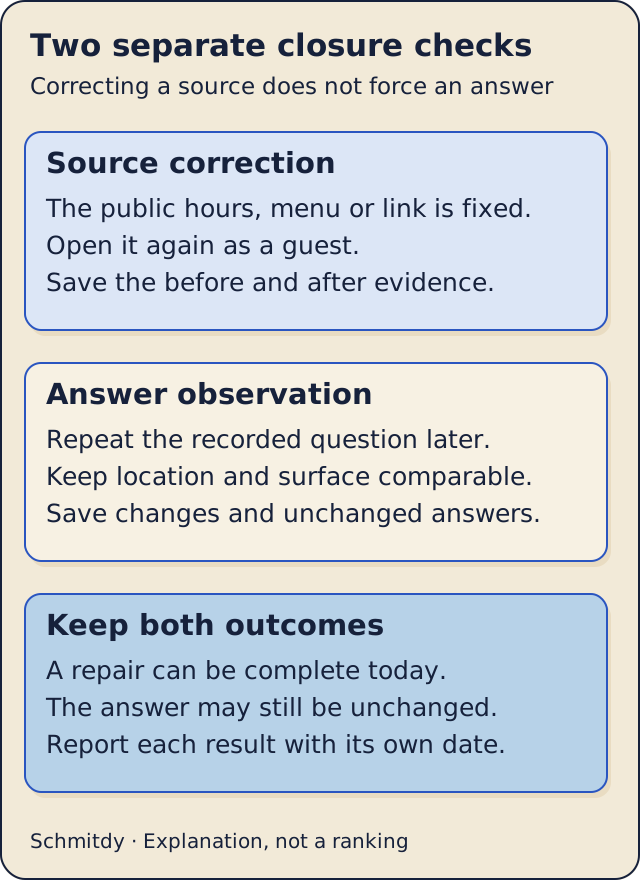
Illustration: Confirm the corrected public source and record later AI answers separately, with a date for each outcome.
Use arithmetic to choose one repair
When issues compete for the same afternoon, score customer harm from 1 to 5, evidence certainty from 1 to 5, then divide their product by estimated repair hours. This is a decision aid, not a ranking formula.
Imagine a neutral hypothetical restaurant finds three issues on Friday morning. A booking link sends diners to a former provider, with harm 5, certainty 5 and a 30-minute repair.
A dinner menu lists a retired dish, with 4, 4 and two hours. A location page has weak images, with 2, 3 and three hours.
The scores are 50, 8 and 2. Fix the booking link first, then recalculate.
Conflict cases that change the next move
Prompt checks are clean, but bookings are down. Check the booking journey, availability rules, confirmation emails, hours, event calendar and offer conditions. Search visibility and reservation conversion are separate systems.
The restaurant appears in ordinary Search, but no AI Overview appears. Do not treat an absent feature as a defect. Google says AI Overviews often do not trigger.
A no-show does not prove that schema or a rewrite is needed 1.
The restaurant appears in a local answer, but the booking action is missing. Diagnose the action layer. Check provider eligibility, live inventory and the profile’s reservation or food-order links.
The fix may belong entirely to the booking provider 4[10].
The website and Business Profile agree, but a third-party listing is wrong. Preserve the evidence, use that listing’s correction process and fix the bad feed if you control it. Do not alter correct owned facts to match a third-party error.
Where Schmitdy can help
Compare the discovery products. Assess the changes for a restaurant group.
For a first self-check, use the restaurant AI visibility diagnostic. If you need to coordinate several venues or teams, use Schmitdy’s restaurant AI-search service to explore help with your guest questions, conflicting venue information and reservation paths.
Sources
- Google Search Central, AI features and your website, updated 10 December 2025.
- Google Business Profile Help, Guidelines for representing your business on Google.
- Google Business Profile Help, About the menu editor.
- Google Business Profile Help, Manage your local business links.
- Google Business Profile Help, How to set special hours.
- Google Business Profile Help, Manage your business attributes.
- Google Search Central, General Structured Data Guidelines, updated 10 July 2026.
- Google Search Central, Welcoming the new Search Console URL Inspection API.
- OpenAI Help Center, Publishers and Developers FAQ, updated August 2026.
- OpenAI Help Center, Searching the web with ChatGPT, updated August 2026.
- OpenAI Help Center, Overview of OpenAI Crawlers, updated August 2026.
- Schema.org, Restaurant.
- US Federal Trade Commission, Consumer Reviews and Testimonials Rule: Questions and Answers, 2024.
- Li, M., and others, Restaurant ratings on multiple platforms, Proceedings of the ACM on Human-Computer Interaction, 2020.
- Google Search Central Blog, Introducing Search Generative AI performance reports in Search Console, 3 June 2026.
- W3C, Web Content Accessibility Guidelines 2.2, 5 October 2023.


 Squarespace
 Webflow
 Sanity
 Shopify
 HubSpot