



Most numbers about restaurants and AI search get passed around with no source, no date and no country attached, which makes them useless the moment anyone checks. This is the sourced version. Every figure below names who measured it, when, and in which market, so you can quote it with confidence and know exactly where it holds and where it is only directional. The short story: the invisibility numbers are large and consistent across studies by local-visibility software firms, almost all the hard data so far is from the United States, and the demand-side shift is already measurable in the UK and Germany.
TL;DR
- About one in five in each 2026 survey says it has used AI for restaurant choices, though each asked a different question: 22% in the US, 19% in the UK and 21% in a German vacation-travel survey.
- Audits by local-visibility software firms, mostly on US data, put restaurant invisibility in AI answers at roughly 75% for Google AI Overviews and around 83% for ChatGPT.
- A higher star rating does not protect you: 4.8-star venues were hidden more often than 4.5 to 4.7 star ones in the largest audit.
- Demand is real and UK-specific: 26% of UK consumers already use AI apps to learn more about a venue, level with Google Maps at 27%.
- Almost all invisibility data is US-sourced. Treat the percentages as directional for the UK and Germany until local studies exist, which is a gap worth naming rather than papering over.
Are people using ChatGPT to find restaurants?
Yes, about one in five, in every market where it was measured in 2026. In the US, 22% of consumers have used an AI tool such as ChatGPT or Gemini to help choose a restaurant. In the UK, 19% already use AI tools such as ChatGPT to plan a visit to a pub, bar or restaurant. In Bitkom's survey on AI and vacation travel in Germany, 21% had already had restaurants suggested by an AI app, and another 32% would.
| Market | Figure | What was asked | Source, date and sample |
|---|---|---|---|
| UK | 19% | Already use AI tools, such as ChatGPT or search engine summaries, to plan a visit to a pub, bar or restaurant | Zonal with NIQ, GO Technology report, published Oct 8, 2026, more than 5,000 British consumers |
| UK | 26% | Use AI apps to learn more about a venue | CGA by NIQ and Reputation, fieldwork Aug 2025, 755 consumers in Britain |
| US | 22% | Have used an AI tool like ChatGPT or Google Gemini to help choose a restaurant | Dynata for DoorDash, fieldwork Mar 2026, 3,001 US consumers |
| Germany | 21% (plus 32% who would) | Have used AI apps for restaurant suggestions, asked in the context of vacation travel; Bitkom does not state the base for this item, and the section covers vacationers | Bitkom Research for Bitkom, fieldwork Apr to May 2026, 1,004 people aged 16 and over, of whom 930 go on vacation trips; published Aug 7, 2026 |
Each figure answers a different question, so quote it with its own wording. The two UK numbers are the clearest case: 26% describes using AI to learn more about a venue, while 19% describes using it to plan the visit itself. Zonal, DoorDash and Reputation are companies that sell to restaurants, and their surveys are commissioned work; Bitkom is the German digital industry association.
The counter-case is plain: four guests in five still do not use AI to decide where to eat, and Zonal with NIQ found another 50% of British consumers are only considering it. But the guests who do ask want the facts a venue controls. Of UK AI users, 45% look for reviews and ratings, 43% check average food or drink prices, 38% view menus and 35% look up opening times, according to the same Zonal with NIQ report. If those facts are wrong or missing on the pages assistants read, that fifth of your guests hears the wrong answer.
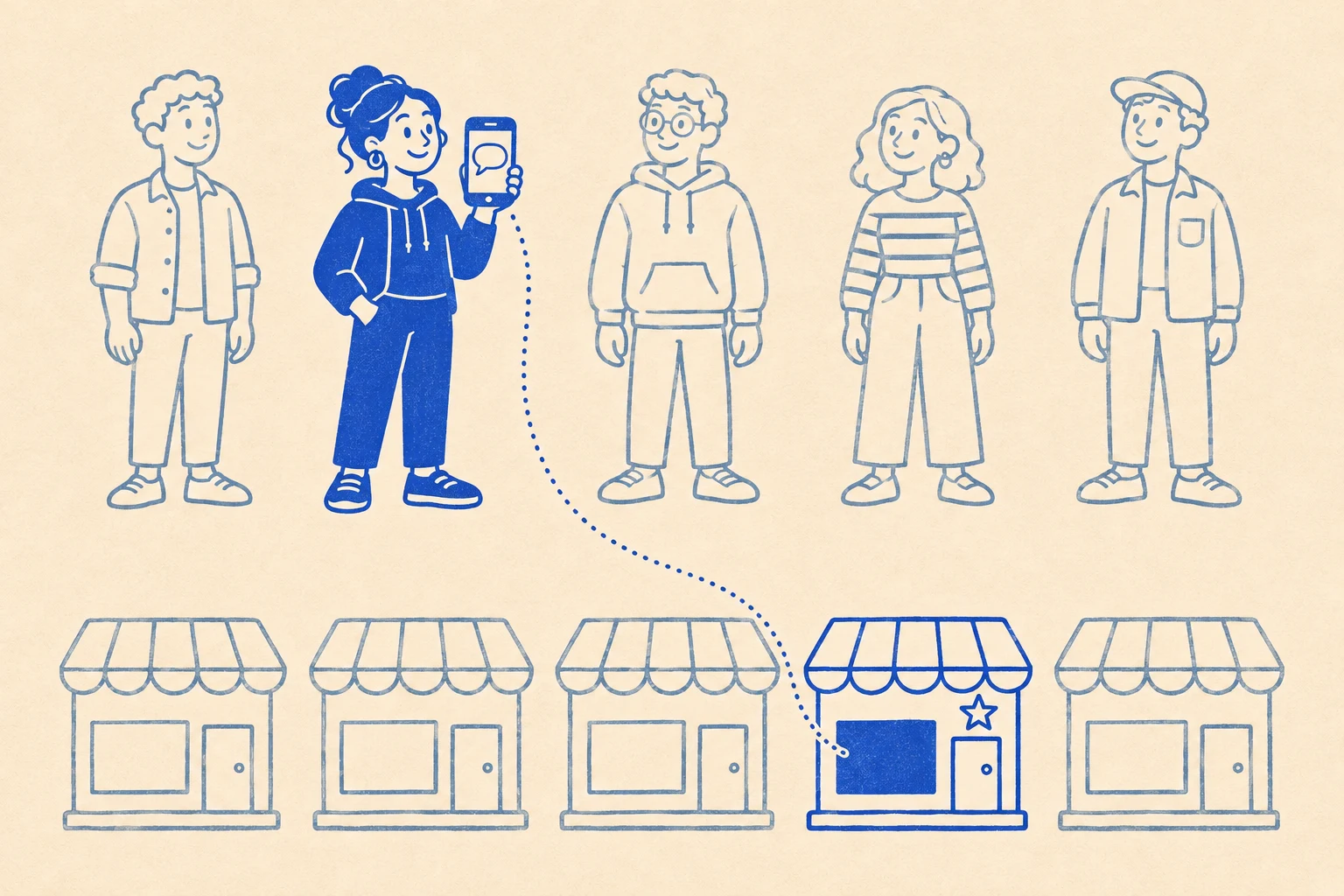
One guest in five would matter less if assistants named most restaurants. They do not, which is what the rest of this page measures. For what we found when we ran real diner questions ourselves, see the UK Restaurant AI Visibility Index.
How many restaurants are invisible in AI search?
Across every audit run so far, most of them, with remarkably consistent numbers given the different methods. Here is the sourced picture.
| Statistic | Figure | Source | Date | Market |
|---|---|---|---|---|
| Restaurants never appearing in Google AI Overviews | 74.9% | Local Falcon (10,000 restaurants) | May 2026 data | US |
| Restaurants invisible on ChatGPT | 83% | Local Falcon (approx 190,000 ChatGPT results) | Feb 2026 data, published March 2026 | Restaurants tracked on Local Falcon, global with US breakout |
| Restaurants invisible on Google (classic) in the same study | 14% | Local Falcon | Feb 2026 data, published March 2026 | Restaurants tracked on Local Falcon, global with US breakout |
| Multi-location restaurant locations invisible across ChatGPT, Gemini, Perplexity, Copilot and AI Overviews | 83% | Uberall GEO benchmark | May 2026 | Not stated (quick-service restaurant brands; sample not published) |
| Share of locations ChatGPT recommends vs 35.9% in Google's local 3-pack | 1.2% | SOCi Local Visibility Index (350,000+ locations), all industries | Jan 2026 | US |
| Share of locations Gemini recommends | approx 11% | SOCi, all industries | Jan 2026 | US |
| Share of locations Perplexity recommends | approx 7.4% | SOCi, all industries | Jan 2026 | US |
Three firms, four studies with different methods, and the same conclusion: a large majority of restaurants are simply not present when an AI engine answers a where-to-eat question. We walk through what causes it and how to fix it in why your restaurant is invisible on ChatGPT. Local Falcon, Uberall and SOCi all sell local visibility software, and SOCi's figures cover multi-location brands in every industry, not restaurants alone. If some of your venues appear and others do not, our guide on why some restaurants show up in AI answers covers the usual causes.
Does a higher star rating mean more AI visibility?
No, and this is the most counterintuitive result in the data. In the Local Falcon audit of 10,000 restaurants, the best-rated venues were hidden more often, not less.
| Statistic | Figure | Source | Date | Market |
|---|---|---|---|---|
| Restaurants rated 4.8 stars and above, invisible in AI Overviews | 69.0% | Local Falcon | May 2026 data | US |
| Restaurants rated 4.5 to 4.7 stars, invisible in AI Overviews | 60.0% | Local Falcon | May 2026 data | US |
| Restaurants with more than 1,000 reviews, still invisible | 70.9% | Local Falcon | May 2026 data | US |
The likely reason is that the highest-rated venues tend to be newer, with thinner review histories an engine hesitates to trust. The full explanation is in the star rating trap.
How many diners actually use AI to research where to eat?
Enough that this is no longer a fringe behavior, and here the data is genuinely local rather than borrowed.
| Statistic | Figure | Source | Date | Market |
|---|---|---|---|---|
| UK consumers who use AI tools to plan a visit to a pub, bar or restaurant | 19% | Zonal with NIQ | Oct 2026 | UK |
| UK consumers who use AI apps to learn more about a venue | 26% | CGA by NIQ and Reputation | Aug 2025 | UK |
| UK consumers using Google Maps for the same, for comparison | 27% | CGA by NIQ and Reputation | Aug 2025 | UK |
| UK diners who trust AI-generated review summaries | 60% | CGA by NIQ | Aug 2025 | UK |
| UK diners who would leave a review if an AI assistant asked at the right moment | 51% | CGA by NIQ | Aug 2025 | UK |
| US consumers who have used an AI tool to help choose a restaurant | 22% | Dynata for DoorDash | Mar 2026 | US |
| German guests who use digital platforms to find a restaurant | approx 70% | YouGov, commissioned by METRO and DISH | Jan 2025 | Germany |
| German guests, of those, using classic search engines | 51% | YouGov, commissioned by METRO and DISH | Jan 2025 | Germany |
| Germany, vacation-travel survey: had restaurants suggested by an AI app (base not stated) | 21% | Bitkom | Apr to May 2026, published Aug 2026 | Germany |
AI-assisted venue research in the UK is now essentially level with Google Maps, and the German digital-discovery base is large too. The German-market detail is in our Germany GEO guide for hospitality.
What is actually live: AI Mode and agentic booking
The channel context that makes the numbers matter, with dates.
| Development | Detail | Date | Market |
|---|---|---|---|
| Google AI Mode live in UK Search and the Google app | Live | July 2025 | UK |
| Google AI Mode can find and book a UK restaurant table directly | Via TheFork, OpenTable, SevenRooms, ResDiary, DesignMyNight | April 2026 | UK |
| Google AI Overviews in Germany | Signed-in users aged 18 and over | March 2025 | Germany |
| Google AI Mode in Germany | Live | Oct 2025 | Germany |
| TheFork integrated into ChatGPT for booking | Selected European countries; no confirmed Germany date | Dec 2025 | Europe |
The honest gap in the data
Almost every invisibility statistic above is US-sourced. There is, as far as we can establish, no recurring UK or German study measuring how many local restaurants appear in AI answers, and no one anywhere is tracking it as a daily time series rather than a one-off snapshot. So the responsible way to use these figures is as directional for a British or German market, not as verified local truth. That gap is precisely why ongoing, market-specific measurement matters: the only way to know your own number is to run the real queries your diners use, across the real engines, and record who gets named.
The demand side has moved faster. Since this page was first published, 2026 surveys have measured AI use for choosing restaurants in the UK, the US and Germany. The supply side, how many local restaurants the engines actually name, still has no UK or German study. Our own measurements of which sources ChatGPT cites for London dining and who AI names in the UK are single-city snapshots, not a national rate.
How to cite these figures
Use the source, date and market columns as given. When quoting an invisibility percentage outside the US, say "US data, directional for the UK" rather than presenting it as a local finding. The demand-side UK and German figures (CGA by NIQ, YouGov for METRO) can be cited as local. For the difference between this kind of AI-answer visibility and classic search ranking, see AEO vs GEO vs SEO.
The same applies to the 2026 demand figures: Zonal with NIQ for the UK and Bitkom for Germany are local, DoorDash is US data, and each should travel with the question it asked. Bitkom asked about AI use in connection with vacation travel and does not state the base for this item, so do not present it as the share of all German diners.
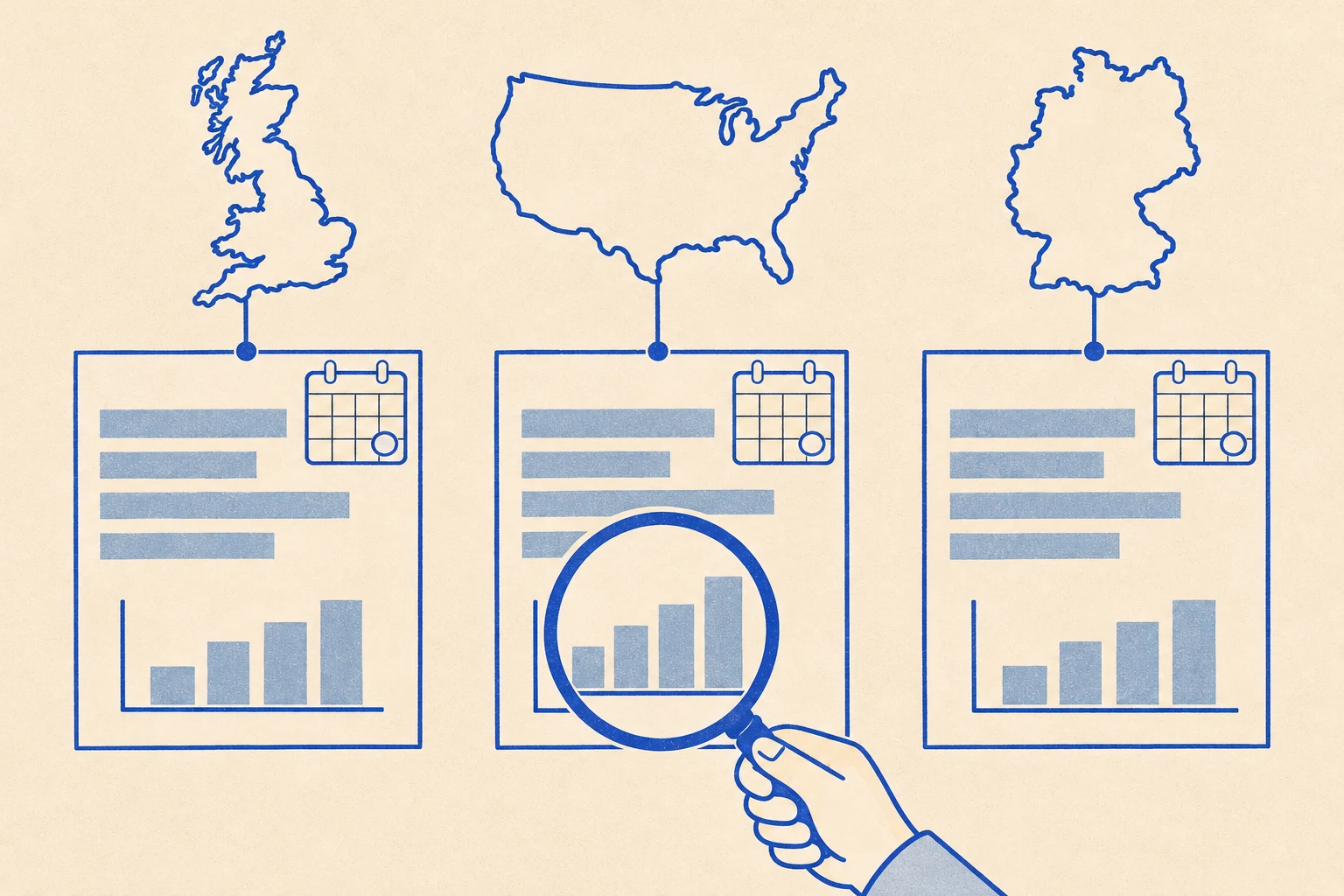
If you want your own figure rather than a borrowed one, the free AI search audit shows how often the major AI engines name your venue for the questions your diners actually ask. To start fixing what it finds, our guide on how to get your restaurant recommended by ChatGPT sets out the first fixes.


 Squarespace

 Webflow
 Sanity
 Shopify
 HubSpot