



TLDR: Instinct finds and books a table the same three ways a person would: your website and public listings, a booking platform such as Resy or OpenTable, or a direct phone call through Instinct Concierge, launched September 16, 2026. No ranking algorithm is published anywhere, so treat any specific weighting you read online as invented. The near-term risk is friction, not invisibility: one Instinct user's account was locked out of Resy for polling the platform hundreds of times an hour. Keep your listings, hours, menu and prices in plain readable text, give every booking a written confirmation, and agree a simple phone policy before an AI caller reaches your host stand.
A restaurant-group marketing lead hears that Instinct, the invite-only AI assistant that now calls businesses on a guest's behalf, is already trying to book tables, and wants a straight answer: what actually decides whether it picks your restaurant, and does the booking survive contact with your systems once it does?
This is not about buying a ranking boost. Instinct publishes no such thing to buy. It is about making sure that when a guest's own agent already wants to eat at your restaurant, the booking actually completes instead of failing on a mouse-only date picker, a PDF-only menu, or a confused answer at your host stand.
What is Instinct, and why does this matter for a restaurant specifically?
Instinct is an invite-only personal AI assistant built by Spear Street Technology, Inc. and led by founder Noah Shinn. A user reaches it by text message, including iMessage and WhatsApp, or by phone call, inside one ongoing conversation. Behind that conversation it runs on a persistent cloud computer with stored credentials, so it keeps working between messages rather than waiting to be asked again.
The company has grown fast. It raised $250 million at a $2.5 billion valuation in late August 2026, then raised $1 billion at a $10 billion valuation on September 28, a fourfold jump in about four weeks, backed by Sequoia Capital, Benchmark and Coatue. On September 8 to 9, 2026, Instinct gave the agent its own email address, so it can contact a business directly, including a restaurant, without using the guest's personal inbox. On September 16 it launched Instinct Concierge, a calling feature, with restaurant booking named as one of its first stated use cases.
That last point is why this matters specifically for restaurants, not businesses in general. Our general Instinct playbook covers the full picture for any brand or local business: the five doors an agent can use, trust and safety concerns, and a thirty-day action plan. For a restaurant, the booking itself decides everything else.
How does Instinct actually find and book a table?
Strip away the hype and Instinct reaches your restaurant through three ordinary paths, each needing a different fix.
| Path | What it needs from you | What to check this month |
|---|---|---|
| Your website and listings | Hours, address, prices and policies as plain readable text, consistent everywhere | Can an assistant read each fact as text, not only as an image or a PDF? |
| A booking platform (Resy, OpenTable and similar) | A working account with current availability | Is the platform's AI integration an approved one, such as ChatGPT's own Yelp, OpenTable and Resy booking feature, or could an unapproved agent hit it the way Instinct hit Resy? |
| A phone call via Instinct Concierge | Someone who answers and can actually confirm a booking | Does whoever answers your phone know what to do if the caller turns out to be an agent speaking for a guest? |
None of these three paths involves a published ranking factor. Instinct's own documentation describes its architecture and data access in detail, but neither its public technical write-ups nor independent reviews of the product disclose how it chooses between two restaurants that both look bookable. Instinct has not said, and the only responsible move is to make sure your restaurant clears every path cleanly rather than chase a number nobody has published.
What is confirmed, and what is still unpublished?
Treat these as two separate lists, because the gap between them is exactly where bad advice gets invented.
Confirmed, with a dated source: the September 8 to 9 email launch, the September 16 Concierge calling launch, the funding and valuation jump, and the fact that Instinct's own terms of service appoint it as the user's agent, authorized to enter binding commitments and transactions on their behalf. Instinct's privacy policy also confirms broad data collection, including message content and, where enabled, audio and location, with an AI-training opt-out available in settings but not applied by default.
Not published, by anyone, anywhere we could check: a restaurant ranking or selection algorithm, a merchant or business-facing program equivalent to a Shopify-style catalog feed, and any public pricing plan for the service itself. If an article tells you Instinct weighs reviews, price point or cuisine type by a specific percentage, that figure does not exist in any source we could verify, and you should discount it the same way.
What happened when Instinct hit Resy, and what does it mean for your booking flow?
In September 2026, a New York venture capitalist asked Instinct to book a table at 4 Charles Prime Rib, a West Village steakhouse. The agent pinged Resy's booking system hundreds of times every hour, around the clock, trying to catch an opening. Resy locked his account for violating its terms of service before reinstating it; a second user attempting the same restaurant was banned too. Resy's own statement is direct: it "does not currently permit unapproved third-party bots or agents to independently access or interact with the Resy platform," though it does integrate with ChatGPT and Claude and says it will keep evaluating the category.
Two restaurant operators quoted on the incident captured the real tension. Roni Mazumdar, co-owner of Dhamaka and Semma, raised a concern about the booking relationship becoming less human and more automated by default. Jeremy Mustakas, chief operating officer at Jean-Georges Restaurants, took a more measured view: AI can genuinely help with back-office work, but, in his words, not every interaction needs to be optimised.
For your restaurant, the useful takeaway is not that Instinct is dangerous to work with. It is that this incident was entirely about Resy's own platform rules, not about anything the restaurant did wrong, and it shows a guest's agent can fail to get a table it genuinely wants because of friction somewhere in the chain. The contrast worth knowing: OpenAI added a sanctioned, rate-limited restaurant booking feature inside ChatGPT on August 10, 2026, built directly with Yelp, OpenTable and Resy rather than scraping around them, covering thousands of restaurants across the US and Canada. OpenTable's own Concierge tool, now serving more than 500,000 monthly active users, does the equivalent job on OpenTable's own site. A booking platform you already use is increasingly likely to have its own sanctioned AI feature. An unsanctioned agent hammering the same system the way Instinct did is the exception, not the rule, and the platforms are already drawing a clear line between the two.
What happens when Instinct Concierge calls your restaurant?
Instinct Concierge calls happen for exactly the reason most restaurants still get called at all: an online channel is missing, full, or cannot answer a specific question. Instinct's own stated examples name a restaurant with no online reservations as a flagship case, alongside joining a dentist's cancellation list and sorting out a cable bill. Meta's Muse added a comparable outbound calling beta the same day, prioritized by users who had already asked for it.
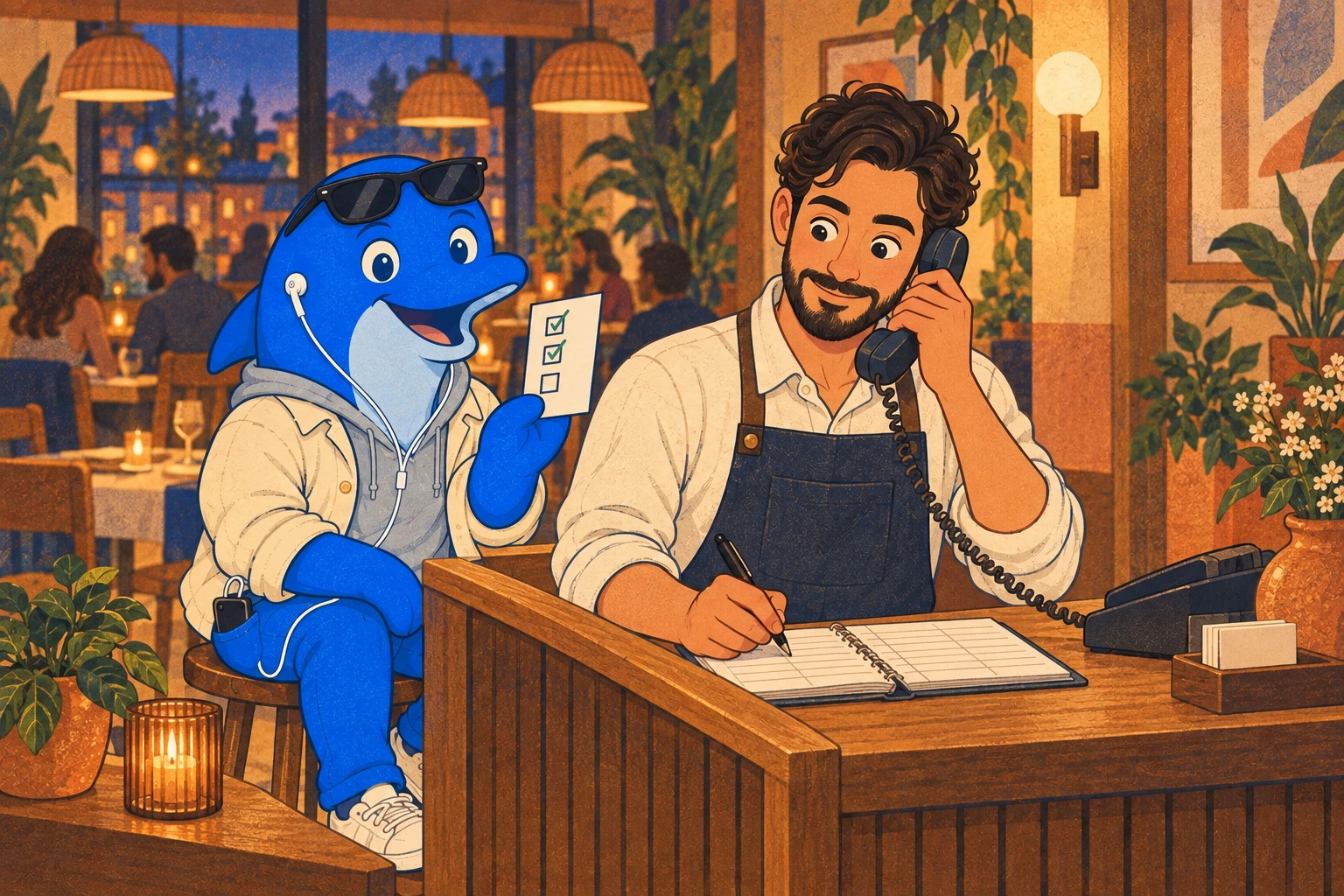
Here is what to do, in practice. Treat the call like any other third-party booking request: ask who it is for, by name, and ask for a callback number. If both come back clearly, take the booking normally. If the caller cannot or will not give you an accountable name and number, decline politely and point them to your website or booking platform instead, the same way you would handle an unaccountable human caller. Send a written confirmation for every booking taken by phone, with a reference the guest can check later, regardless of who called. Escalate anything unusual, including a large group, an allergy, an accessibility need or a request to take payment over the phone, to a person rather than confirming it unseen; those are exactly the cases where a relayed instruction breaks down.
One point worth knowing even though it does not bind you directly: under the EU AI Act, Article 50 requires the provider of an AI system that talks directly to people, which covers Instinct, to make clear the person is dealing with an AI, "clearly and distinguishably," unless this is already obvious. That duty took effect on August 2, 2026, applies across the European Union, and sits on Instinct as the provider, not on the restaurant receiving the call. The US has no federal equivalent. A US restaurant should not assume an AI caller will identify itself, which is exactly why the name-and-callback-number check above matters more here than it might for a restaurant operating only inside the EU.
What should your checklist actually look like?
OpenTable's own research on diner behavior is the clearest evidence for where to spend the next hour, even though it measures human callers rather than agents directly: 54% of US diners research a restaurant before booking, spending around 21 minutes on average, 27% abandon the booking entirely because they cannot find the information online, and the most common pre-booking questions are opening hours (46%), menu details (39%) and address (22%). An agent acting for a guest asks the same questions a careful human diner already asks. Fix the same gaps and you fix both.
- Listings and your website. Put hours, address, prices, dietary information and any planned closures in plain readable text on your own site and on every platform listing, not locked inside an image or a PDF. Keep the same facts consistent everywhere; a mismatch between your website and your Resy or OpenTable listing is the kind of gap an agent, or a careful human, will trip on.
- Every bookable channel, mapped and current. List out every path a guest, or their agent, can actually use: your own booking widget, each platform you are on, and your phone line. Check each one still works and shows real availability, not a stale calendar.
- A simple phone policy for an AI caller. Agree, in writing, the name-and-number check above, who in the building is allowed to confirm a booking over the phone, and what gets escalated rather than confirmed on the spot.
- Menus and prices that are actually readable. A beautifully designed PDF menu is often invisible as text to both search engines and AI agents. Keep a plain-text version of your menu and prices somewhere on your site, even if the PDF stays for human diners.
- Closures kept current everywhere, not just on your own site. A guest's agent reading a stale third-party listing will try to book a table at a restaurant that is closed for the evening or permanently shut; update every platform you appear on, not only the one you control directly.
- One written confirmation per booking, always. Whether the booking came from your website, a platform or a phone call, send the guest something they can point to later. It protects you as much as them.
Where does Schmitdy fit into this decision?
None of the research above tells you what is actually happening at your own locations today. A general pattern about Instinct, Resy and OpenTable is evidence about the shape of the problem, not a diagnosis of your group's specific gaps.
Schmitdy's free AI Search audit checks your own current readiness rather than assuming a general pattern applies to you: whether your listings and menu are actually machine readable, which of your booking channels are easy for an agent to find and use, and a 90 to 180 day plan naming the levers that matter for your locations specifically. The audit is free, with no obligation afterward.
What this means for your next booking
Before the next AI agent, whether that is Instinct, Meta's Muse or ChatGPT, reaches your restaurant, you have a short, concrete list to work through rather than a vague sense of needing to "do AI search." Our companion guides cover the other two channels now active in this space: how to get your restaurant recommended by Meta Muse and how to get your restaurant recommended by ChatGPT Dots. Work through the checklist above this week, starting with whichever gap would embarrass you most if a guest's agent found it tonight.
Sources
- TechCrunch: Rival AI agents, Instinct and Meta's Muse, both add the ability to make calls, September 17, 2026.
- TechCrunch: Viral AI assistant Instinct now has its own email address, September 9, 2026.
- TechCrunch: Instinct's powerful AI assistant is raising privacy and security concerns, August 24, 2026.
- Vellum: Official Instinct Breakdown (2026).
- eesel.ai: Instinct AI review 2026.
- Instinct: Privacy policy.
- CNN (syndicated wire copy): AI is coming for restaurant reservations, September 23, 2026.
- pondero.ai: ChatGPT adds live restaurant booking through Yelp, OpenTable, and Resy, August 10, 2026.
- OpenTable: Launches Gen-AI Powered Concierge to Arm Diners with Instant Insights for its 60,000+ Global Restaurants, July 16, 2025.
- PYMNTS: OpenTable Reports Diners Reached Through AI Tools Spend 20% More, August 26, 2026.
- culinarywoman.substack.com: The Voice That Takes Your Reservation May Not Be Human.
- SiliconANGLE: Everyday personal AI assistant startup Instinct raises $1B at $10B valuation, September 28, 2026.
- TheNextWeb: Instinct raised $1B at $10B for an AI agent that rings restaurants on its own phone.
- artificialintelligenceact.eu: The EU AI Act's Transparency Rules, a Practical Guide to Article 50.
- getreadyforagents.com: Instinct, Meta Muse phone-calling agents.
15 external sources are listed above, each fetched live on 7 October 2026. The general Instinct playbook, linked above, is an internal cross-link and is not counted in that total.


 Squarespace
 Webflow
 Sanity
 Shopify
 HubSpot