



TLDR: Most restaurant groups should give AI search to one owner, either an agency or one person in-house, for everything every venue shares: the website, the accounts, the facts and the measurement. Venue managers keep what only they know. Separate contracts per venue only make sense when the venues are separate businesses, such as franchises or brands on their own websites.
It's usually an accident. Head office pays one agency for the website. The manager at the newest venue hires a local freelancer for Instagram and the Google profile. The chef at a third venue asks a friend to get the restaurant into ChatGPT. Six months later three suppliers are editing the same facts in different places, and no one's sure which venue's missing from AI answers or why.
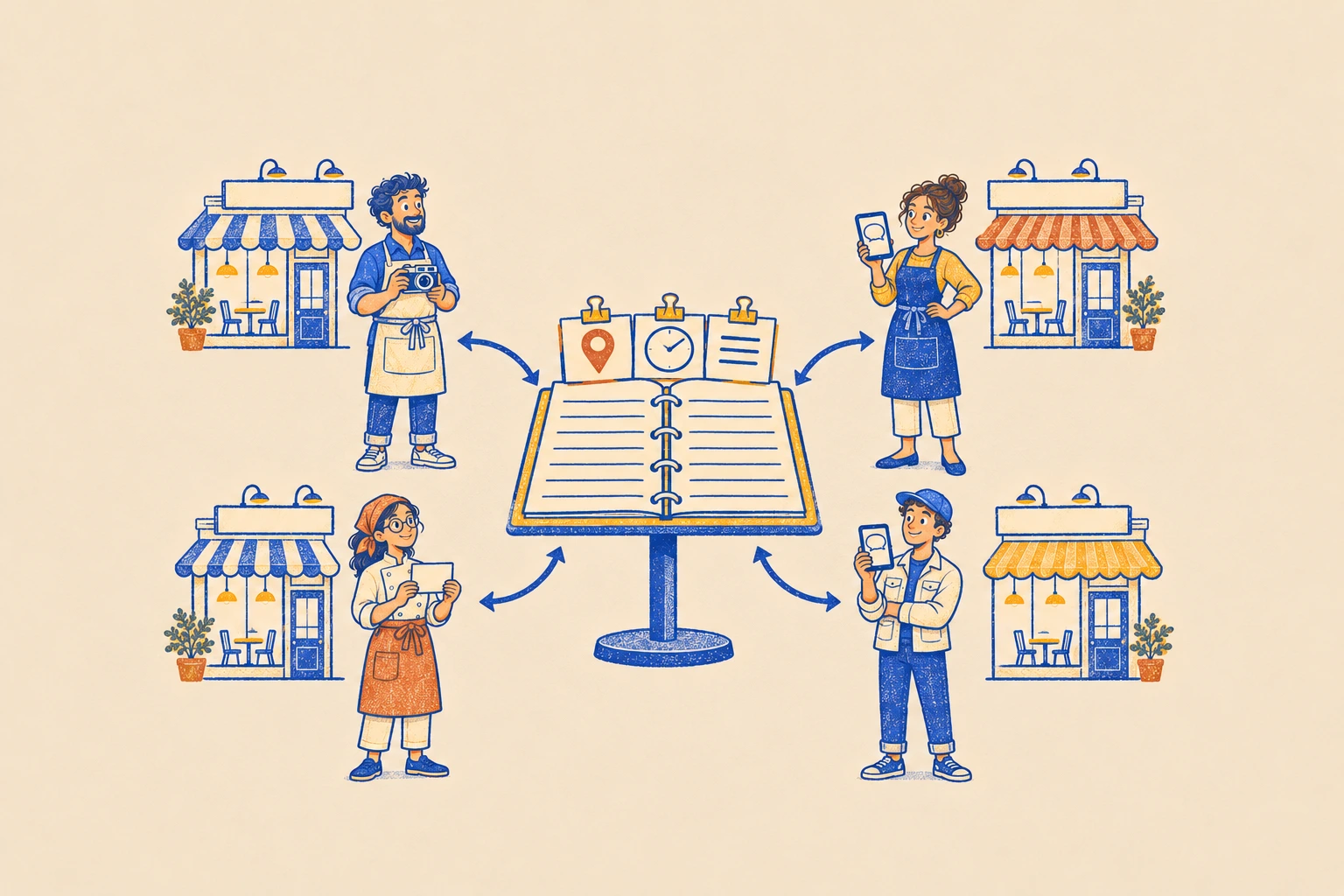
For most groups the fix is one owner for the shared layer and a short checklist for each venue. Most of what an assistant can read about each venue lives on systems the group shares: the website, the Google accounts and the booking engine. Split those across suppliers and every venue's paying for it. For Google's AI features there's no special optimisation to buy either: Google says no additional requirements or special optimisations are needed to appear in AI Overviews or AI Mode.
Which jobs belong to the group, whoever does them?
Anything that lives on a shared system needs one owner, because only one supplier can sensibly change it at a time. Here's how we'd split it.
| Job | Owner | Why it's hard to split |
|---|---|---|
| Website and robots.txt | One technical owner | One file controls crawlers for the whole website |
| Account ownership | Head office | Agencies get manager access |
| Venue facts register | One named person | Hours and menus must match everywhere |
| Venue page template | One web owner | Every venue needs the same fields |
| Measurement | One method | Different methods give numbers you can't line up |
Start with the website. Google's robots.txt rules apply only to the host, protocol and port where the file sits, so a group on one domain has one file deciding which crawlers, including OpenAI's OAI-SearchBot, can read every venue page. Give five suppliers access and you're one careless edit away from closing that door for every venue on the domain.
Then there are the accounts: head office should own the Google profiles (where managers can't add users), Search Console (where owners have full control) and Analytics (where adding users needs an Administrator), as question 7 of our agency screening guide explains. For groups, Google also allows bulk verification only for 10 or more profiles from the same business, and agencies holding several businesses in one account can't use it. If a freelancer set up a venue's profile in their own account, you'll want to sort that out first.
The venue pages need one template too, and that's where structured data comes in. Google's local business structured data treats each location as its own business, with its own URL, hours and menu link, and its profile guidelines say not to create more than one profile per location. That's far easier when one person owns the template and fills it in the same way for every venue, and it's where we'd start.
Measurement's the shared job that splits most often by accident. If each supplier tests different questions in different assistants, you can't tell whether one venue is weaker than another or just measured differently. Take a hypothetical group with venues in Clapham and Leeds: two suppliers, two methods, and the comparison you actually need disappears. Answers also vary between runs: SparkToro found less than a 1 in 100 chance that ChatGPT or Google's AI repeated the same list in 100 runs, and our guide to measuring bars venue by venue shows how to cope with that.
What should each venue keep?
Each venue keeps the facts only someone in the building knows, and it reports changes to the central owner: today's hours and closures, real photos, the details behind a reply to a review, local partners and events. Our guide to local store marketing for restaurant groups sets out the full split between head office and the venues.
It's the same evidence from both ends. In an August 2026 preprint covering 4,776 cafés, restaurants and bars in Bali, 85.6% of venues were never recommended by any of four AI systems, and appearing at all was linked to review volume, an own website, listed prices and mentions on other sites. Some of that sits with the central owner, like the website and prices. Some of it grows at the venue, like reviews and local coverage.
When do separate agencies per venue make sense?
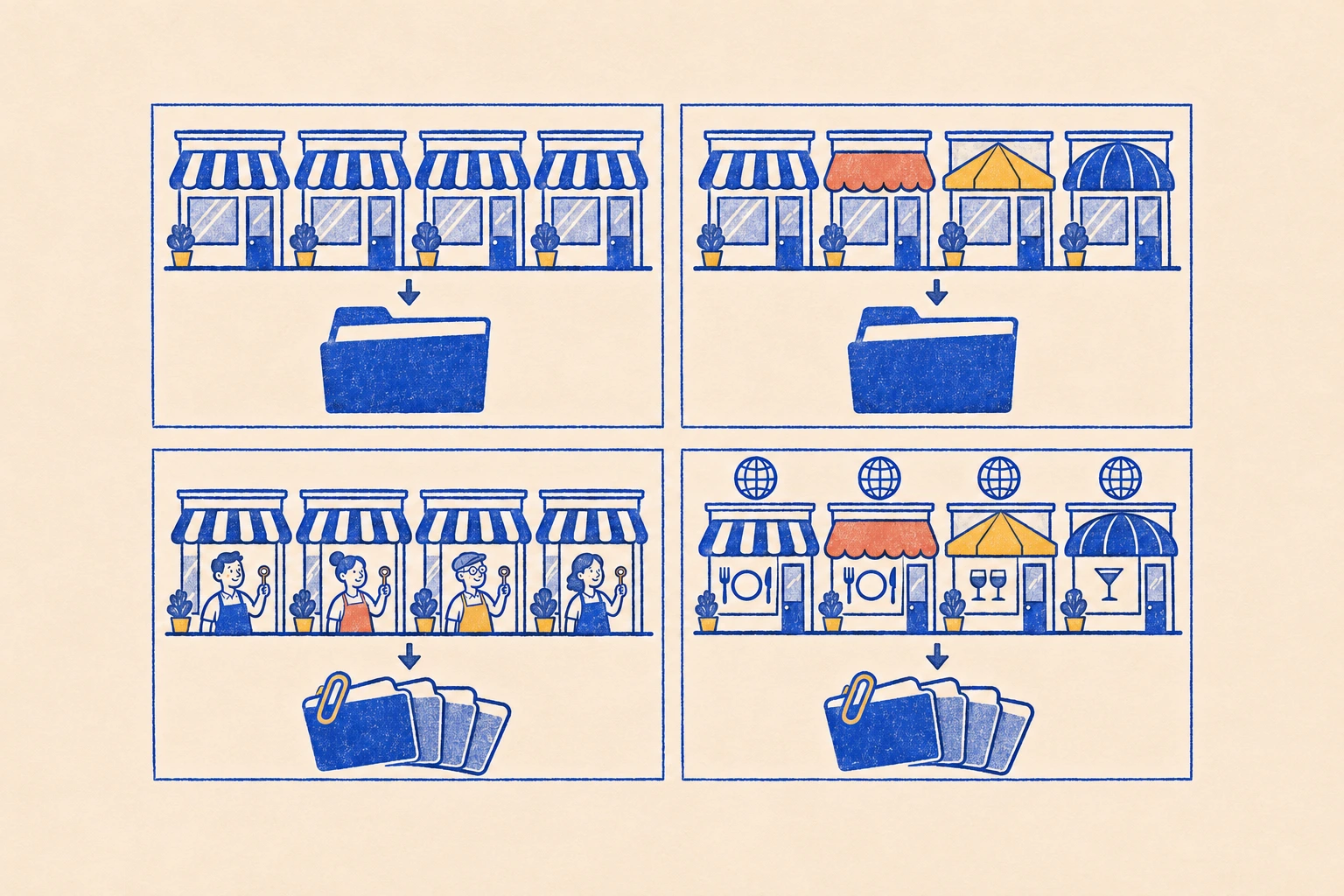
Separate agencies make sense when the venues are separate businesses. Different addresses alone don't justify it, so look at the shape of your group.
- One brand, many venues. One owner. Every venue shares the website, the brand and the accounts, so splitting the work mostly creates conflicting edits.
- Several concepts on one group website. Still one owner, with a distinct page and profile for each concept. Our guide to whether AI sees your group as one brand covers keeping concepts apart.
- Franchises or partner-owned venues. Separate suppliers can work, because each owner controls its own profile and guest data. Head office should still set the facts template and the measurement method. If any supplier handles guest data on a business's behalf, UK GDPR requires a written contract with set minimum terms, and each business signs its own.
- Acquired brands still on their own websites. A separate website has its own robots.txt and its own technical owner until you merge it or keep it on purpose. Our guide to one website or separate websites for a restaurant group helps with that call.
What does splitting the work cost?
It costs time first, and the arithmetic shows where it goes. Take a hypothetical group of six venues. Assume each venue changes its hours, menu or booking details three times a month, and each change has to be made in five places: the venue page, the Google profile, the booking engine and two guides that list the venue.
That's 6 × 3 × 5 = 90 edits a month. With one owner and one facts register, those 90 edits follow one checklist and one person can see which are done. With six suppliers, the same 90 edits happen six different ways, and it's hard for anyone to see the whole list.
Money follows the work. A single agency should price by venues and workload, and shouldn't charge every venue again for the same shared website and template. We price this way ourselves: the pricing answer on our Restaurant AI Search page says the fee grows with the number of locations or the amount of work. Ask every bidder to show which part of the fee covers shared work and which part grows per venue. If they can't split it, you'll likely pay twice for the shared work.
Who should own the shared layer?
Pick the supplier who'll actually touch the shared systems every week. That's usually your AI search owner or your web agency, and rarely the PR or social team. Here's the split we'd start from:
| Supplier | What they own | What they hand over |
|---|---|---|
| AI search owner | Facts register, measurement, venue page content | Monthly gaps per venue |
| Web agency | Website, template, robots.txt | Changes the AI search owner asks for |
| PR agency | Press and relationships | Coverage the register can cite |
| Venue managers | Today's facts, photos, replies, events | Changes into the register |
If your web agency already runs the template and robots.txt well, don't move that. Give the AI search owner edit rights to venue page content and a standing slot in the web agency's queue. If nobody in-house can referee between them, make the AI search owner the one who decides what changes first, because they're the one reading the answers.
How should the PR agency fit in?
Keep the PR agency on press and relationships. Have the AI search owner pass it the outside sources that keep appearing beside answers for your venues. That way the PR team's pitching the guides and writers that matter for discovery. Our guide to whether your PR agency should own AI search visibility sets out the boundary.
How do you move from venue-by-venue to one owner?
It's six steps, and the account work comes before any new content.
- List every account and its owner. Google profiles, Search Console, Analytics, the website, the booking engine and the main guides, venue by venue.
- Make the group the owner. Head office holds owner access everywhere; agencies and venue staff become managers or editors.
- Build one facts register. One row per venue for hours, special hours, menus, booking link, private dining and access.
- Agree one measurement method. The same guest questions per venue, the same assistants and the same number of runs each month.
- Brief one owner for the shared layer. Give each venue a short local checklist for photos, replies, events and changes.
- Review by venue every month. Compare each venue's answers with its register and fix the first mismatch.
Two cases break the rule. A two-venue group whose owner already keeps the facts tidy probably doesn't need an agency yet; the register and a monthly check will do. And a venue in another country may need a local-language writer, who can still work inside the same register and method.
Where does Schmitdy fit?
We run the shared layer for groups and we keep each venue's evidence separate. Our Restaurant AI Search service starts at £1,200 a month and gives groups the same depth by location, with shared brand work where it saves time. If you'd like to see first which venues are missing and why, our multi-location AI visibility audit compares them one by one, and the free AI search audit is the quickest place to start.
Sources
All pages were checked on 12 November 2026.
- Google Search Central: AI features and your website.
- Google Search Central: introduction to robots.txt.
- OpenAI: overview of OpenAI crawlers.
- Google Business Profile Help: manage your Business Profile owners and managers.
- Google Business Profile Help: verify Business Profiles in bulk.
- Search Console Help: managing owners, users and permissions.
- Google Analytics Help: add, edit and delete users.
- Google Search Central: local business structured data.
- Google Business Profile Help: guidelines for representing your business.
- SparkToro: AIs are highly inconsistent when recommending brands or products, 28 January 2026.
- Pitenin, V.: Invisible to the Machine, arXiv:2608.07069, preprint, 7 August 2026.
- ICO: what needs to be included in a controller and processor contract.
 Squarespace

 Webflow
 Sanity
 Shopify
 HubSpot