



When a diner asks an AI tool for a restaurant, the answer may appear in very different places. ChatGPT Search and Google AI Overviews are separate products with different data paths, booking boundaries and reporting. Treating them as one channel produces weak operational decisions.
TL;DR
ChatGPT Search is a conversation that can use a diner’s stated preferences and location. On eligible consumer plans and supported models, it can show partner reservation availability in covered markets.
Google AI Overviews are summaries within regular Search and do not trigger on every query. Google AI Mode, Maps and local listings are separate surfaces.
Google now offers one combined generative Search Console view that includes AI Overviews and AI Mode visibility. Neither product guarantees that a restaurant will be recommended.
The useful operator question is simple: which facts decide whether the venue fits the diner’s actual request, and where must those facts remain current?
How do the two products differ in 2026?
Google AI Overviews are part of Google Search. They place an AI-generated summary above or among regular results for some searches.
Google says they are designed to appear only when they add something beyond classic Search, so an Overview is not a permanent result type for every restaurant query. Google also says that AI Overviews and AI Mode use different models and techniques, which means their answers and links can differ. Google Search Central
ChatGPT Search is a conversational search experience. A diner can ask a broad question, add constraints in the same chat and inspect citations.
OpenAI says ChatGPT may rewrite a local query into targeted searches and use approximate location from an IP address. If a person chooses to share device location, it can use a more precise location.
A vague request such as “somewhere good nearby” therefore has a different context path from a Google result typed into a browser. OpenAI Help Center
That difference matters before anyone talks about visibility. An AI Overview is a response attached to a search results page.
ChatGPT Search is a dialogue that can retain the constraints already placed in the chat. A restaurant does not need a separate strategy for every sentence a diner may type.
It does need public information that remains coherent as a system combines location, cuisine, price, service style, access needs and current availability.
| Question for the operator |  ChatGPT Search ChatGPT Search |  Google AI Overviews Google AI Overviews |
|---|---|---|
| Where the diner encounters it | ChatGPT web, desktop or mobile app | Standard Google Search results page |
| How the request develops | A continuing conversation, with location and stated preferences available as context | A generated summary for some individual searches, alongside classic results |
| Location signal | Approximate location may come from IP; device location is optional | Google Search can draw on its local search ecosystem, but an Overview is separate from Maps and local listings |
| Restaurant booking in 2026 | Availability may appear from OpenTable, Resy or Yelp for eligible consumer plans, models and markets | Do not treat Google AI Mode booking as an AI Overview feature; AI Mode bookings launched in the UK separately |
| Public operator reporting | No equivalent ChatGPT restaurant visibility report described in the cited public Help documentation | One combined generative Search Console view includes AI Overviews and AI Mode visibility |
| What eligibility documentation says | An eligible site must permit OAI-SearchBot crawling; inclusion is not guaranteed | Standard Google indexing and snippet eligibility apply; Google says there are no additional AI feature requirements |
The table describes documented product behavior, not a ranking study. Neither company promises that a particular venue will be selected for a particular diner.
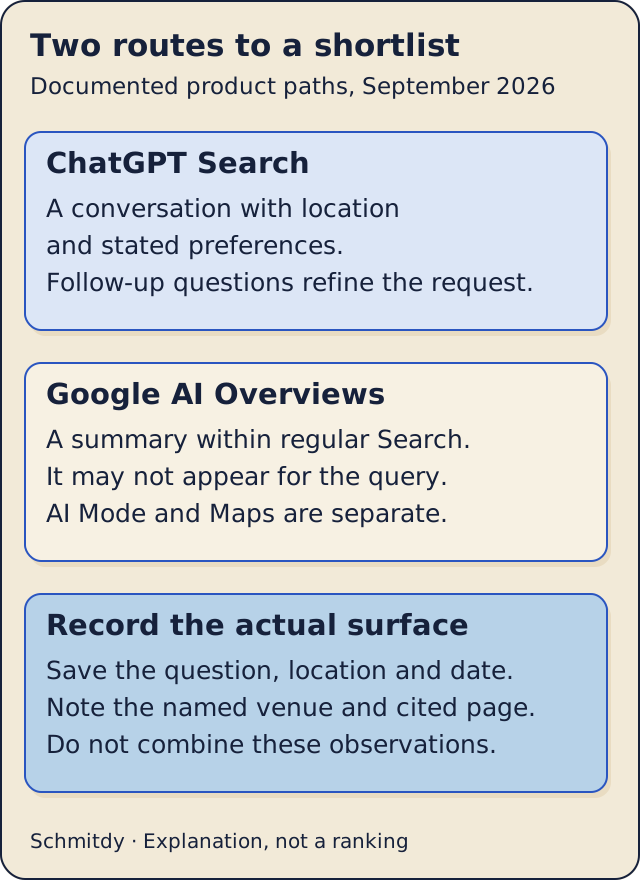
Illustration: ChatGPT Search is a conversation; Google AI Overviews appear within Search. Record the actual surface, question and context.
What can ChatGPT Search do for a diner?
OpenAI says ChatGPT can find restaurants and available times using location, date, time, party size and preferences. It may show availability from OpenTable, Resy or Yelp.
The current help page says reservation search is on eligible consumer plans on web, mobile and desktop with GPT-5.6 Sol or GPT-5.6 Luna, and excludes ChatGPT Work, Business, Enterprise, Edu and voice conversations. It also says provider coverage varies by restaurant and location OpenAI Help Center.
Separate three events: a text recommendation, a live time and a confirmed reservation. The first is a search response.
The second depends on partner data. The third depends on the provider flow and current inventory.
OpenAI says a site must permit OAI-SearchBot crawling to be eligible for inclusion and says placement is not guaranteed. That is a technical check worth making, alongside the ordinary check that the site presents the same facts a diner sees elsewhere. OpenAI Help Center
What can Google AI Overviews do for a diner?
Google describes AI Overviews as a way to get the gist of a complex question quickly, with links for further exploration. It says both AI Overviews and AI Mode can use query fan-out, which means related searches across subtopics and sources may help form a response.
The same document says an Overview often does not trigger. Operators should therefore avoid reporting every Google restaurant search as an AI Overview opportunity. Google Search Central
Google Maps and local listings are a different part of the picture. Google says local listings are shown across Google Search and Google Maps and combine public web information, licensed third-party data, user contributions, owner-claimed listing information and Google interactions with a place.
These listings may have their own AI summaries. A local listing summary is not evidence that an AI Overview cited a restaurant website, and a Maps result is not an AI Overview result. Google Local Listings Help
The booking boundary is equally important. Google announced agentic restaurant booking in UK AI Mode on 10 April 2026.
The announcement is about AI Mode, not AI Overviews. Google’s own reservation integration documentation describes feeds for merchants, services and availability, a booking server, sandbox and production review before public launch.
That is operational booking infrastructure, not a shortcut created by a generative summary. Google UK Blog Google Actions Center
For regular web visibility, Google says the same foundational Search practices apply to AI features. A page must be indexed and eligible to appear with a snippet, and Google states that there are no additional technical requirements or special schema for AI Overviews or AI Mode. Local Business structured data can help Google understand business hours and related details, but it does not guarantee a carousel, an Overview citation or a recommendation. Google Search Central Google Local Business documentation
An illustrative diner scenario
The following is a hypothetical situation. It is not a test and does not predict either product’s output.
Hypothetical venue A has an official site that gives its address, opening hours, menu, dietary options, price cues and direct booking route. Its local listing has the same core facts. Hypothetical venue B has a strong review profile but a site with old hours and a booking link that no longer reflects availability.
A diner asks ChatGPT Search: “I need a quiet dinner for four near the station on Friday at 7 pm, one guest avoids dairy, and we have a mid-range budget.” The documented product can use the stated constraints, location and, where supported, reservation availability. A good response has to survive a compound fit test.
Venue A has public facts that can support several parts of the request. Venue B may still appear, but its stale operating facts create a real risk for the diner when the request is time-specific.
That is an inference from the documented input types, not a claim that ChatGPT will rank Venue A first.
The same diner searches Google for “quiet restaurants near the station dairy-free Friday”. Google might return local listings and ordinary results.
It may generate an AI Overview if its systems judge one additive. If the diner enters AI Mode, that is another surface again.
If agentic booking is available in their market, that is a separate capability. The operator’s job is to recognise the surface before drawing a conclusion from a screenshot.
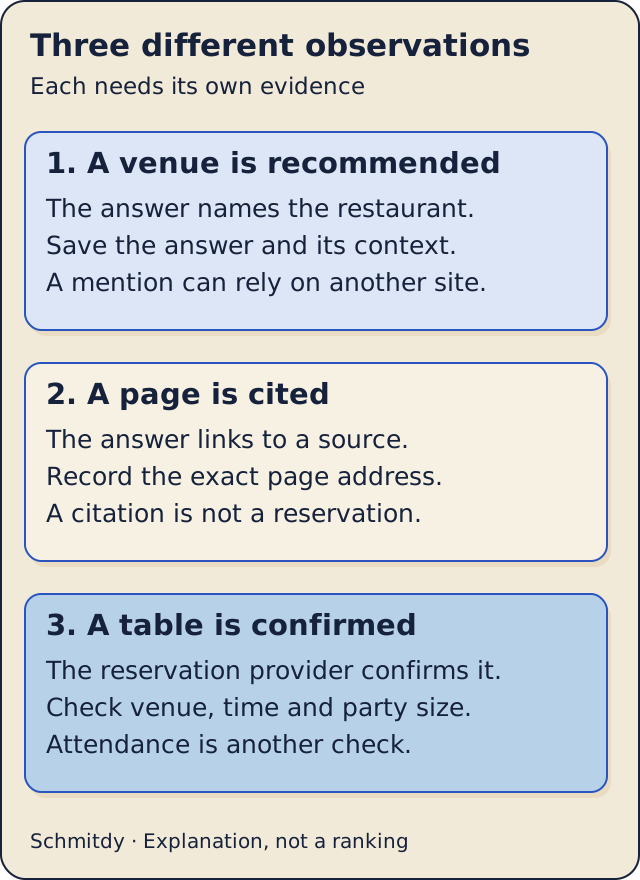
Illustration: A named venue, a cited page and a confirmed table are three different observations, each requiring its own evidence.
What the evidence says about exposure, and what it does not
Restaurant-specific independent evidence is starting to appear, but it is not a global league table. A preprint by Vladimir Pitenin audited 4,776 cafes, restaurants and bars in Canggu and Ubud, Bali, against 2,208 search-grounded responses from ChatGPT, Claude, Gemini and Perplexity.
Under its protocol, 85.6% of venues were never recommended by any system. The study found associations between entry into answers and review volume, an own website, listed price information and third-party web mentions.
It also found low agreement between systems and instances of closed venues being recommended. In those two markets, the findings support a verification priority: check that public documentation is present and that time-sensitive facts are current.
They do not establish the same rate, ranking factors or outcome for any other city. Pitenin, 2026 preprint
The Google click evidence has a similar scope warning. Pew Research Center examined tracked browsing from 900 US adults and 68,879 Google searches during March 2025.
Traditional result links were clicked on 8% of visits when an AI summary was present, compared with 15% when one was absent. The researchers collected matching results pages later in April and say results may change over time.
This is observational general-search evidence. It does not show that an AI Overview causes a particular restaurant’s traffic or bookings to fall. Pew Research Center
Two 2026 preprints reinforce the need for restraint. One analysis of the same US panel finds cited-source clicks in AI Overviews occurred on about 1% of Overview visits and reports associations with fewer clicks and more session endings.
Another estimates a decline in English Wikipedia search referrals after default AI Overview availability. Neither paper measures a restaurant website, reservation completion or revenue.
They are useful warnings against equating an impression with a booked cover. Chapekis et al., 2026 preprint Khosravi and Yoganarasimhan, 2026 preprint
The operator consequence: maintain a single reliable public record
The decision is not “choose ChatGPT or Google.” Diners use both, and each reaches beyond a restaurant’s own site. The useful operating question is whether essential public facts agree wherever a diner or system can encounter them.
That means the visible restaurant information needs a reliable source of truth: current hours, location, menu, dietary detail, service style, price framing, phone number, booking route and material temporary changes. The official site must be accessible to search crawlers.
Google’s local listing should be claimed and accurate. Booking data should be treated as live operational data, not marketing copy.
These are consequences of the documented product inputs and the independent findings on documentation and staleness.
Schema.org defines Restaurant as a shared type for describing a venue. Use that vocabulary to reconcile the business facts published on the site, then validate the visible page itself.
Do not treat structured data as an AI recommendation switch: Google says no special schema is required for AI Overviews or AI Mode. Schema.org Google Search Central
There is no case here for publishing pages solely to trigger an AI answer. Google explicitly says there is no special AI markup or new machine-readable file needed for its AI features.
OpenAI says ChatGPT placement is not guaranteed. A page earns its keep when it answers something a diner needs to know before choosing or booking, in clear text that matches the real venue.
Measurement has improved on Google. Google announced that its Search Generative AI performance reports were rolled out worldwide by 31 August 2026.
The combined generative view covers visibility in features such as AI Overviews and AI Mode, with impressions, pages, country, device and date dimensions. It is a visibility report.
It does not establish that an impression caused a visit, a booking or a return customer. Google Search Central Blog
For ChatGPT Search, the cited public Help documentation explains use, eligibility and reservations but does not describe an equivalent operator-facing restaurant visibility report. Use that wording carefully.
It is a description of the documentation available, not a claim that a venue is invisible or unmeasurable. Referral, booking-provider and owned-site data can still show pieces of the journey, subject to their own limits.
The hard part is not getting a restaurant mentioned once. It is keeping the answerable facts true when a diner asks a specific, time-bound question. That work holds up in ChatGPT Search, Google AI Overviews, local listings and ordinary search because it serves the diner before it serves a surface.
Where Schmitdy can help
Assess the changes for a restaurant group. Choose the first repair.
For a first self-check, use the restaurant AI visibility diagnostic. If you need to coordinate several venues or teams, use Schmitdy’s restaurant AI-search service to explore help with your guest questions, conflicting venue information and reservation paths.


 Squarespace
 Webflow
 Sanity
 Shopify
 HubSpot