



TL;DR
Restaurant discovery is moving into answer and booking surfaces. A guest can describe an occasion, receive a small set of places and enter a reservation path without making the old journey through search results alone.
The product change is confirmed. The commercial effect for an individual group still needs its own evidence.
In 2026, the leadership task is to manage accurate venue information and booking paths across every market, then distinguish visibility, reservations, seated covers and genuinely incremental contribution.
For restaurant groups, AI discovery is no longer a question about a single ranking. It is a question about who selects the venue, which public information they rely on and where the guest is sent next.
That distinction matters. A guest asking for a late table near a theater, somewhere that works for a vegetarian colleague, or a quiet dinner for six is no longer only looking for a list of links.
The system can narrow the options, explain the fit and increasingly connect the answer to availability. The point at which a group earns consideration and the point at which it receives a booking are getting closer together.
This is a dated assessment of that change. It deals with what is known about the products and the current research, where the commercial evidence stops, and what a multi-location leadership team should decide.
 Google Search ·
  ChatGPT Search
Which discovery products changed in 2026?
Treating every AI feature as "AI search" hides the operational differences.
AI Overviews are generated summaries that appear within ordinary Google results. They sit alongside conventional results and local information.
AI Mode is Google Search's conversational experience, designed for longer, follow-up questions. Google expanded AI Mode to more than 200 countries and territories in 2025 and said its queries were nearly three times longer than traditional searches.
A longer conversational query can hold details such as neighborhood, occasion, dietary needs, price and group size. 1
Ask Maps is separate. Google began rolling it out in the United States and India on Android and iOS in March 2026. Its own example is a request for a place where a group can meet, followed by the ability to reserve, save or share a venue. 2
ChatGPT Search can also connect restaurant discovery to a reservation flow. OpenAI says eligible consumer users can search by location, date, time, party size and preference.
OpenTable coverage is described as global, Resy as United States only and Yelp as United States and Canada only. Availability differs by venue and partner, and the feature is excluded from several business and education plans. 3
The result is a more fragmented market, not one new channel. A group may be visible in Google Maps, absent from a ChatGPT reservation result, bookable through one partner in one country and another partner elsewhere. That is why a groupwide score alone has little practical value.
What does the restaurant research establish?
One useful restaurant-specific study from 2026 is a complete market audit in Canggu and Ubud, Bali. The author of Invisible to the Machine enumerated 4,776 cafes, restaurants and bars, then tested 2,208 search-grounded responses from ChatGPT, Claude, Gemini and Perplexity across 96 persona-based queries over seven days.
They found that 85.6% of venues were never recommended by any of the systems. Even among venues with at least 50 ratings, 72.6% were never recommended 4.
The study is more useful than a vendor sample because it starts with a full local market. It also separates two decisions that groups often blur together.
Review volume, an owned website, published price information and third-party mentions were associated with entering answers. Among venues already selected, rating was associated with first position.
The audit recorded 93 recommendations for permanently closed venues. Its practical warning is stale local information, not widespread invention of non-existent restaurants. 4
The figures should not be copied into a UK, German or US budget. Bali has a particular tourism economy, language mix, local web environment and platform use.
The paper is a preprint. It gives restaurant leaders a defensible reason to inspect their own distribution data.
It does not supply a universal visibility benchmark.
| Evidence | What it establishes | What it cannot establish |
|---|---|---|
| Bali census, 4,776 venues and 2,208 answers | Assistant recommendations can be highly concentrated and can reproduce stale venue data | A forecast of one group's visibility or sales in another market |
| Pew browsing panel, 900 US adults | Google sessions with AI summaries had lower observed outbound clicking in March 2025 | Restaurant reservation conversion or AI Mode behavior |
| Google and OpenAI product documentation | Named discovery and booking features exist with stated product constraints | Equal access, traffic or demand in every country |
| Search Console generative-AI reports | Google now offers site-level visibility data for its own generative Search features | A full picture of Maps, ChatGPT, other assistants or completed covers |
Pew Research Center examined actual browsing activity from 900 US adults in March 2025. Users clicked a conventional result on 8% of visits where an AI summary appeared, compared with 15% where one did not.
They clicked a cited source in 1% of AI-summary visits. The research covers Google and a US panel, not restaurant booking journeys.
It still explains why website sessions alone are a weaker proxy for consideration than they were before answer-led search. 5
An August 2026 preprint by Chapekis and colleagues analyzes the same 900-person US panel used in Pew's report. It adds statistical analysis of that dataset; its roughly 1% cited-source click rate is the same underlying observation 6.
A separate August 2026 preprint reports a preregistered field experiment with 1,100 Google users. It found lower publisher referrals when AI Overviews and AI Mode were present 7. Neither dataset measures restaurant demand or reservations.
For restaurant groups, this general-search evidence suggests that some consideration may take place before a group's web analytics records a click.
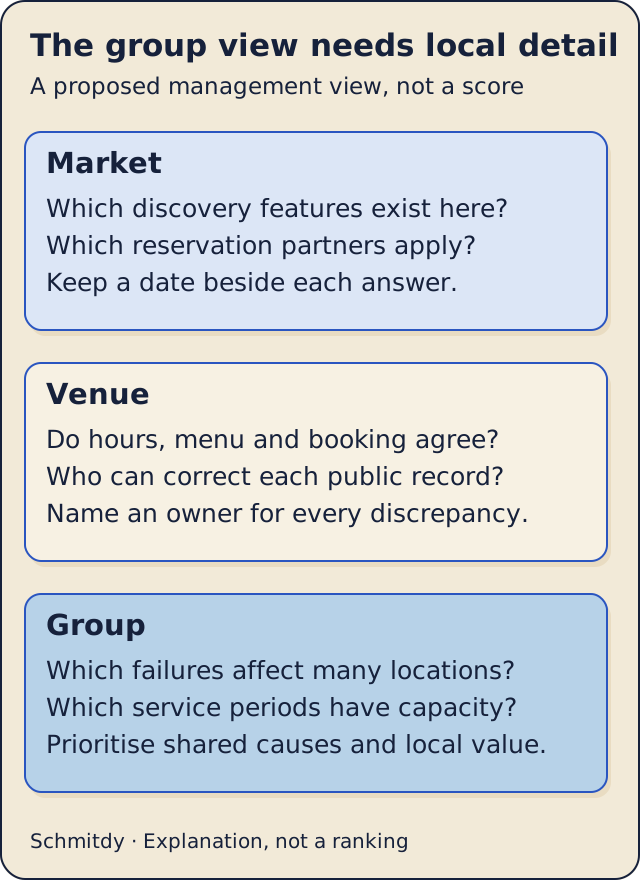
Illustration: A restaurant group can organize its view by market, venue and shared causes, with an owner for each local discrepancy.
Accuracy is a distribution issue, venue by venue
A restaurant group has several public records for every venue: its local page, Google Business Profile, booking provider, menu, review platforms, delivery services, local press and other third-party listings. A guest sees a joined-up experience. The group often manages it through several owners and systems.
A wrong special-hours entry can remove a venue from consideration. An old menu can lead a system to misstate price, cuisine or dietary suitability.
Incomplete inventory at a reservation provider can turn an otherwise strong recommendation into a booking dead end. These are operational data failures with a guest-facing commercial effect.
Google confirms that Business Profiles can carry links for reservations, bookings and food ordering in Search and Maps. Third-party links can appear automatically and businesses can select a preferred link 8.
Google also says booking-provider availability varies by country, and restaurant waitlists require an eligible provider 9. These are reasons to own the route, not promises that a route will be selected by an assistant.
The owned website matters in a narrower way. Google says LocalBusiness structured data can communicate facts such as hours and business details, yet does not guarantee a feature in Search 10.
OpenAI says a public site can be eligible for ChatGPT Search when OAI-SearchBot can access it, while placement remains unguaranteed 11. Those are specific eligibility and comprehension conditions for owned pages.
Restaurant recommendation can also draw on third-party information, reviews and reservation sources.
A stricter standard for commercial attribution
A reservation that follows an AI-led journey is commercially useful. It is not automatically incremental revenue.
The guest could have made the same booking through a direct search, a map listing or a familiar reservation app. A new source can displace an existing source.
It can matter more during quiet service periods than at a fully booked Saturday dinner. A group with different concepts, average spends and cancellation patterns will see different economics by venue.
The basic evidence chain should therefore separate four things: an appearance in a discovery surface, a click or booking hand-off, a completed reservation, and a seated cover with contribution. Search Console can now provide a dedicated view of impressions and pages in Google's generative AI Search features, with country, device and date dimensions.
Google says the insight had rolled out to all websites worldwide by 31 August 2026. 12 It is useful data for Google Search. It does not report every Maps interaction, every assistant answer or every completed reservation.
An illustrative capacity calculation shows the difference between arithmetic and proof. Imagine one venue with 20 unfilled covers on a Tuesday.
A new discovery-to-booking route fills 12 of them. Three of those guests would have arrived through another channel, leaving nine genuinely additional covers.
At $36 average spend, that is $324 in additional sales for that service. If the contribution after food and drink cost is 65%, the contribution is $210.60 before booking fees and labor changes.
This is not a forecast or a sector benchmark. It is a way to test the commercial question at the service level, where capacity, displacement and cost are visible.
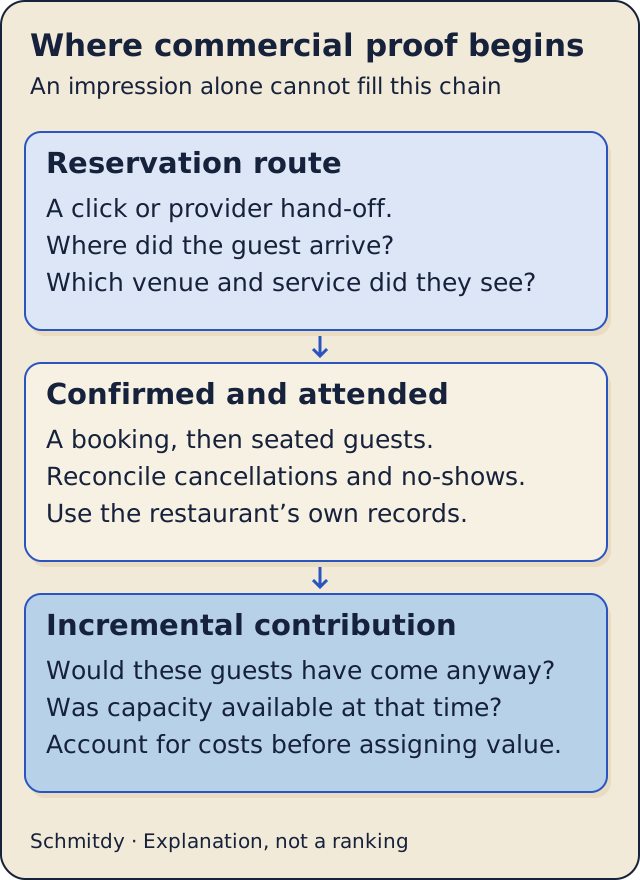
Illustration: Trace the reservation route, confirmed attendance and incremental contribution separately; an impression alone does not establish them.
What should restaurant groups decide?
The 2026 task is not a repeat of a location-page or schema project. It is a leadership decision about local distribution across a portfolio.
Start with an operating view for every venue: trading market, discovery surfaces available in that market, reservation and order routes, owner of each record, last verification date and known discrepancies. This catches the reality that AI Mode, Ask Maps, ChatGPT reservations and Google booking links have different geographic coverage.
Google described its wider agentic booking work at I/O 2026 as a US rollout across named local categories. 13 No single product announcement establishes worldwide restaurant-booking access.
The National Restaurant Association's 2026 outlook is useful context. It projects US restaurant sales of $1.55 trillion, real growth of 1.3%, and continued operator investment in technology and guest connection while costs and uneven traffic remain difficult 14.
Restaurant groups do not need a speculative AI revenue target to act on that context.
They need a clear decision about information ownership, booking-path quality and measurement.
Where Schmitdy can help
Compare the discovery products. Choose the first repair.
For a first self-check, use the restaurant AI visibility diagnostic. If you need to coordinate several venues or teams, use Schmitdy’s restaurant AI-search service to explore help with your guest questions, conflicting venue information and reservation paths.
Sources
- Google, AI Mode expands to more languages and locations, 7 October 2025, accessed 9 September 2026.
- Google, How we’re reimagining Maps with Gemini, 12 March 2026, accessed 9 September 2026.
- OpenAI, Searching the web with ChatGPT, updated 2026, accessed 9 September 2026.
- Vladimir Pitenin, Invisible to the Machine, arXiv preprint, 7 August 2026, accessed 9 September 2026.
- Pew Research Center, Google users are less likely to click on links when an AI summary appears, 22 July 2025, accessed 9 September 2026.
- Investigating Click Behaviors on Google Search Result Pages That Produce an AI Overview, arXiv preprint, 5 August 2026, accessed 9 September 2026.
- Wang, Gleason, Bart, Wilson and Metaxa, AI in Search Reduces Publisher Referrals Without Improving User Experience, arXiv preprint, 18 August 2026, accessed 9 September 2026.
- Google, Manage your local business links, accessed 9 September 2026.
- Google, Set up bookings through a provider, accessed 9 September 2026.
- Google, LocalBusiness structured data, accessed 9 September 2026.
- OpenAI, Publishers and Developers FAQ, updated 2026, accessed 9 September 2026.
- Google, Search Generative AI performance reports in Search Console, 3 June 2026, accessed 9 September 2026.
- Google, Google Search’s I/O 2026 updates, 19 May 2026, accessed 9 September 2026.
- National Restaurant Association, State of the Restaurant Industry 2026, 11 February 2026, accessed 9 September 2026.


 Squarespace
 Webflow
 Sanity
 Shopify
 HubSpot