



TLDR: An assistant names a bar when it can quote plain facts: what kind of bar it is, when it is open late, what it pours, who can get in and what the night is for. Publish them as text on your pages and Google profile, keep them identical on the guides listing you, and use one template per bar.
Picture your Thursday, 5 p.m. Someone asks an assistant for cocktail bars open late near the train station. It names three places. Yours is not one of them, and your Google profile says your hours "vary." That scene is made up, but its core problem is real: in our own test of 30 night-out questions in November 2026, the answers kept saying they could not confirm a bar's hours.
The fix is duller than most bar marketing. An assistant can only recommend what it can confirm, so the bar's job is to publish its hours, drinks, entry rules and occasion as plain text, and keep them the same everywhere. Reviews and guide lists still matter, as we show below. Posting more does not appear to.
What do people ask an assistant when they want a drink out?
They ask about an evening, not a venue: where to go after work, for a first date, with eight friends, or after midnight on a Thursday. On November 1, 2026, we put 30 such questions to Claude with web search turned on: ten set in US cities, ten in UK cities and ten in German cities. The test used one assistant on one day, so treat it as a snapshot, not a ranking.
| Question type | Example we asked | What the answer could not confirm |
|---|---|---|
| Late hours | A cocktail bar in Boston open after midnight on a Thursday | Current closing times |
| Group size | A cocktail bar in Austin that takes walk-ins for eight on Saturday | Walk-in rules for groups |
| Accessibility | A wheelchair-accessible cocktail bar in Seattle's Capitol Hill | A current access statement |
| Sunday nights | Cocktail bars open Sunday night in downtown Denver | Sunday hours |
Three things stood out.
- The assistant kept telling people to check with the bar. In 28 of the 30 answers it told the person to confirm hours, reservation rules or accessibility directly, and 22 answers said the details came from third-party listings or pages that might be out of date.
- Bars' own pages were rarely listed. Of 193 sources listed alongside the answers, five came from a bar's or bar group's own website, and all five were in UK answers. None of the ten US answers listed a bar's own site. Time Out appeared 21 times on its own.
- Social media did not appear. None of the 193 sources was an Instagram, TikTok or Facebook post.
The Austin answer shows the gap. Asked for a bar that takes walk-ins for a party of eight on a Saturday, it opened by saying no source it found confirmed a walk-in policy for a group that size, then built its shortlist from booking listings and city guides. Every bar on that list could have answered the question in one sentence on its own page.
Independent research points the same way. An August 2026 study by Vladimir Pitenin audited 4,776 restaurants, cafés and bars in two Bali markets across ChatGPT, Claude, Gemini and Perplexity. It found that 85.6% of venues were never recommended by any system. Whether a venue appeared at all was linked to documentation: review volume, its own website, listed prices and mentions on other sites. Star rating only affected where it ranked once it was in. Bali is not Baltimore, so read it as a pattern, not a local figure.
What facts does a bar need to publish?
A bar needs to publish the facts guests ask about, as text a machine can read. This also tests our starting position. When we asked ChatGPT and Google's AI Overview the owner's own question, "how do cocktail bars show up in AI recommendations," in late October 2026, both answers put reviews and guide roundups next to the website. So the lever is textual, not social, but it is not only your website: the guides that list you need the same facts.
Google's own help pages set the floor. Google says businesses with complete and accurate information are more likely to show up in local results, and that review count and links count toward prominence. It asks for one specific primary category rather than one for every service, lets you set special hours that cross midnight as two entries, and lists attributes such as a wheelchair-accessible entrance, some of which are filled in from customer input.
This is our checklist, built from those pages and the gaps in the test:
| Fact | Where it goes | Why guests need it |
|---|---|---|
| Category | Google primary category, page heading | Cocktail bar, wine bar and pub answer different nights |
| Regular and late hours | Profile hours, site footer, contact page | Most late-night questions failed on this |
| Holiday hours | Profile special hours, a dated line on the site | Holidays and temporary permits drift fastest |
| Drinks list | A page of text, not a PDF or photo | Lets an answer name a martini or a zero-proof list |
| Walk-in or reservation | One plain sentence per bar | Group questions hinged on it |
| Groups and buyouts | Party size, minimum spend, booking route | Birthday questions found only event listings |
| Age and ID rules | Site and profile description | Under-21 entry differs by venue and hour |
| Accessibility | Profile attributes and an access line | The Seattle answer found only user-edited tags |
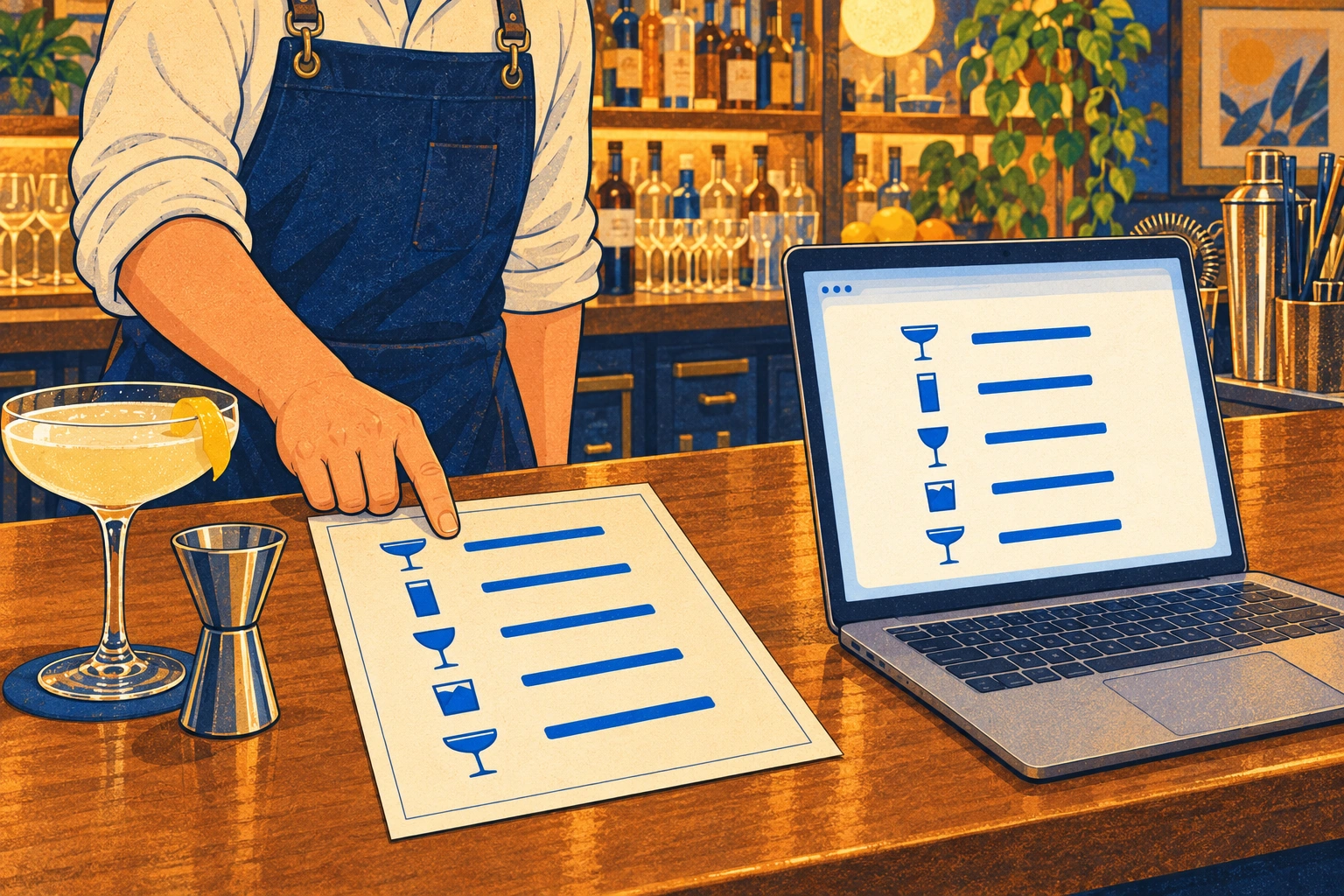
Our guide to menu pages for AI search covers how to turn a PDF list into a page. On the technical side, schema.org has a BarOrPub type with properties for the menu, reservations and opening hours, and Google's guidance on local business structured data says to handle hours past midnight in a single opening-hours entry. Google is also clear that its AI features need no special markup or AI text files, and that structured data should match the visible text. OpenAI recommends allowing OAI-SearchBot in robots.txt for a site to surface in ChatGPT search. Write the facts first; markup only repeats them.
What changes in the US, the UK and Germany?
The fact sheet stays the same in every market, but the rules behind the hours and the entry line change. Write each one for the country the bar is in.
What changes for US bars?
In the US the entry line matters most. The minimum legal drinking age is 21 in every state, so say whether guests under 21 may enter at all, at which hours and with which ID. Closing times are set by state and city law and can change: Boston ran a state pilot allowing 3 a.m. closing in towns that opted in through the end of July 2026, and our Boston answer was still weighing it in November. A dated hours line on your own page stops an old article from speaking for you.
What changes for UK bars?
UK hours are set by the premises licence, the UK term for a bar's license, so "late" means whatever that licence allows. In England and Wales a bar needs a premises licence from its local licensing authority, extending the hours it sells alcohol needs a full variation, and every licence carries a mandatory condition to adopt an age verification policy. It is illegal to sell alcohol to anyone under 18, though 16 and 17 year olds with an adult may drink beer, wine or cider with a meal, which never covers cocktails. If you run bars in both countries, keep the UK and US entry lines separate.
What changes for German bars?
German guests choose between a Bar, a Cocktailbar and a Kneipe, and those words describe different nights. Duden defines a Kneipe as a small, simple but cozy place visited mainly for a drink. In our test, a question for a cozy Kneipe in Hamburg's St. Pauli returned neighborhood pubs, not cocktail bars, so the category word on a German profile matters. Entry rules come from the Jugendschutzgesetz, Germany's youth protection law: no beer or wine under 16, except for 14 and 15 year olds with a parent, and no spirits under 18, so most cocktails are 18 and over. Under its section on bars and restaurants, under-16s need a parent with them unless they are having a meal or a drink between 5 a.m. and 11 p.m., 16 and 17 year olds may not stay unaccompanied between midnight and 5 a.m., and no minors may enter a venue run as a Nachtbar. Closing times are set by each German state under the Gaststättengesetz; in Bavaria the general closing hour runs from 5 to 6 a.m., and towns can change it.
What changes when you run several bars?
Several bars need one template, not one "best bars" page for the group. A group page tells an assistant that you exist; it cannot say which bar is open late on Sunday or takes walk-ins. When we asked ChatGPT how to market a bar group in late October 2026, it led with Instagram, TikTok and a group brand. That is sound advice for awareness, but none of the 30 guest answers in our test listed a social post.
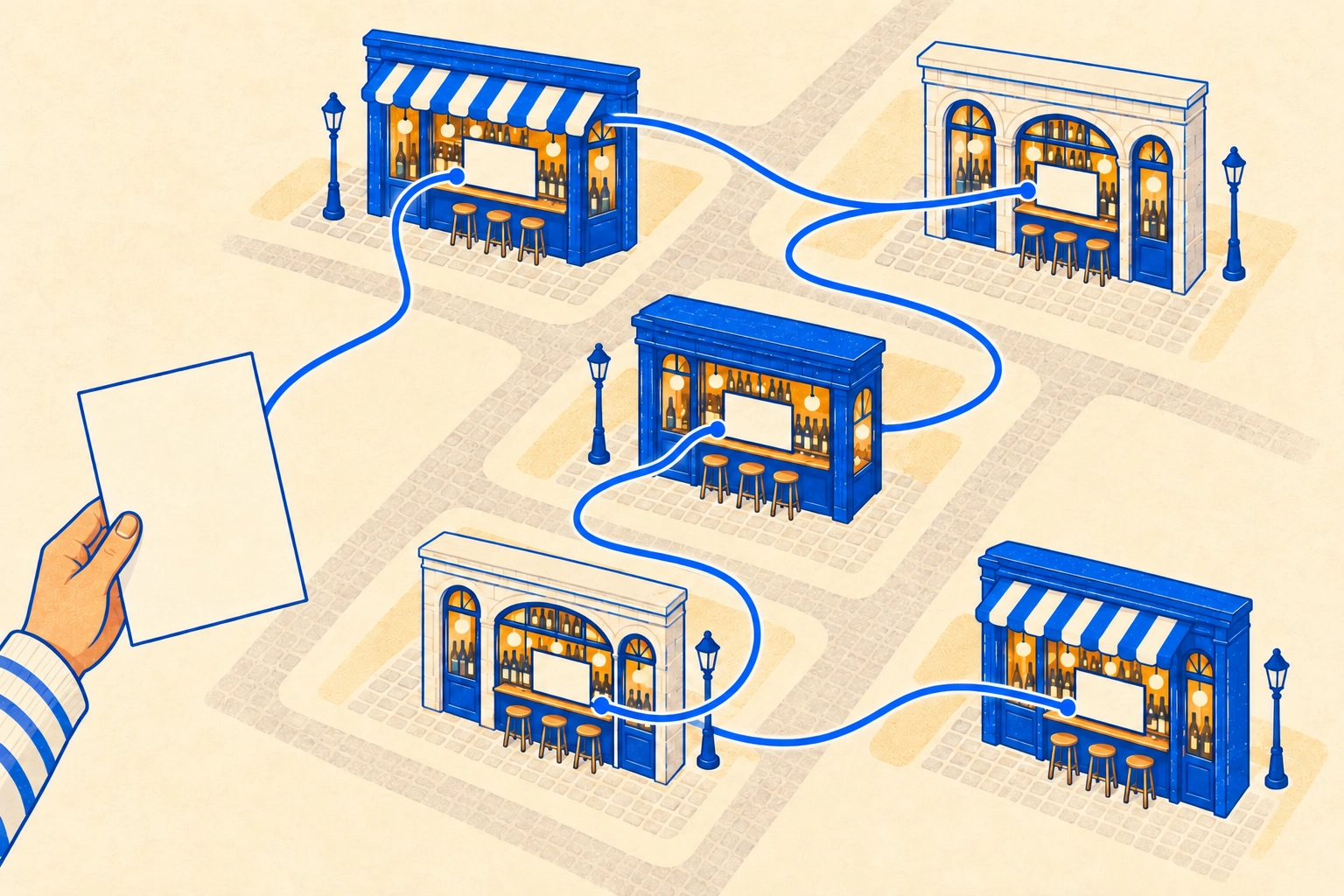
- Write one fact template. Agree on the fields every bar fills in: category, regular and late hours, holiday hours, drinks list link, walk-in and reservation rules, group size, age and ID rules, accessibility and events.
- Give every bar its own page. Publish each bar's facts on its own page on your site, with its own drinks list as text, and link that page from its Google Business Profile.
- Name one owner per bar. One person signs off on each bar's facts and is the only one who changes hours or entry rules on the site, the profile and the main guides.
- Check every month. Ask five guest questions for each bar, compare the answers with the fact sheet and fix the first mismatch before the next check.
Who keeps ten bars consistent is a staffing question, and our guide to local store marketing for restaurant groups sets out what headquarters runs and what each location owns. Access and change control are covered in Google Business Profile governance for restaurant groups, and whether assistants treat your group as one brand or many is in our one-brand guide. If one bar is named and its sister is not, read why some of your restaurants show up in AI answers and others do not.
This is also where we come in. Our free AI search audit records the answers for the questions your guests ask, location by location, with the pages and outside sources listed alongside them, and gives you a 30-day plan. Our Restaurant and Bar AI Search service then does the work at no extra charge: Google Business Profile optimization, Search Console and GA4 setup, and every menu, drinks lists included, rebuilt as a readable page for each location, with a person checking every change.
When is the website the wrong lever?
Sometimes the answer is not on your site at all. A neighborhood bar with a loyal local crowd often gets more from local guides, review volume and the lists a city's writers keep than from a new page. In our test, editorial guides were listed far more often than any bar's site, and the Bali study found review volume and outside mentions linked to whether a venue appeared. If your bar is already well reviewed and listed, fix the profile and the drinks list, then spend your time on the guides.
Two kinds of bar have their own playbook. Wine bars sell occasions and food as much as drinks, which our guide to AI search for wine bars covers. Venues that live on shows and DJs need event pages first, which our checklist for live music venue details sets out.
What should you do this week?
Ask five bar questions for your own area this week and write down which facts were missing. Use the night your guests actually plan: a late Thursday, a Sunday, a party of eight, a first date, a wheelchair-accessible entrance. Note whether your bar is named, which sources are listed alongside the answer and which of your facts the answer could not confirm. Then fill the first gap on your own page and your profile, and check that the main guide listing you says the same.
Five questions, one fact sheet, one owner. If you run several bars and want the answers recorded for each of them, book the free AI search audit for your bars.
Sources
All pages were checked on November 1, 2026. The 30-question test was run on November 1, 2026, with Claude and web search; the owner-question answers from ChatGPT and Google's AI Overview were recorded on October 31, 2026.
- Pitenin, V.: Invisible to the Machine, arXiv:2608.07069, August 7, 2026.
- Google Business Profile Help: tips to improve your local ranking.
- Google Business Profile Help: manage your business category.
- Google Business Profile Help: how to set special hours.
- Google Business Profile Help: manage your business attributes.
- Google Search Central: local business structured data, updated September 8, 2026.
- Google Search Central: AI features and your website, updated December 10, 2025.
- Schema.org: BarOrPub.
- OpenAI: overview of OpenAI crawlers.
- CDC: minimum legal drinking age.
- The Boston Globe: Boston bars and the 3 a.m. closing pilot, July 9, 2026.
- GOV.UK: alcohol licensing, updated August 8, 2025.
- GOV.UK: alcohol and young people.
- Jugendschutzgesetz, section 9 (alcohol), with section 4 (bars and restaurants) and section 1 (definitions).
- Gaststättengesetz, section 18 (closing hours) and Bavarian Gaststättenverordnung, section 7.
- Duden: Kneipe.


 Squarespace

 Webflow
 Sanity
 Shopify
 HubSpot