



TLDR: A restaurant group should run what has to match everywhere (brand, accounts, guest data, templates, budget) and leave each general manager what only someone in the building knows (today's hours, local partners, real photos, the facts behind a reply). Give each task one owner, give shared tasks a handover, and run it on a monthly rhythm.
Most groups never decide this split. It happens by accident: corporate keeps whatever it noticed first, and each location picks up the rest in its own way. The result is a Google profile that says one thing, a booking page that says another and an email list nobody is sure they may use.
The topic is marketing a location locally, often called local store marketing. For listing permissions and local SEO we link to our other guides instead of repeating them: Google Business Profile governance for restaurant groups and what local SEO still does for AI search.
How should a restaurant group split local marketing between corporate and its locations?
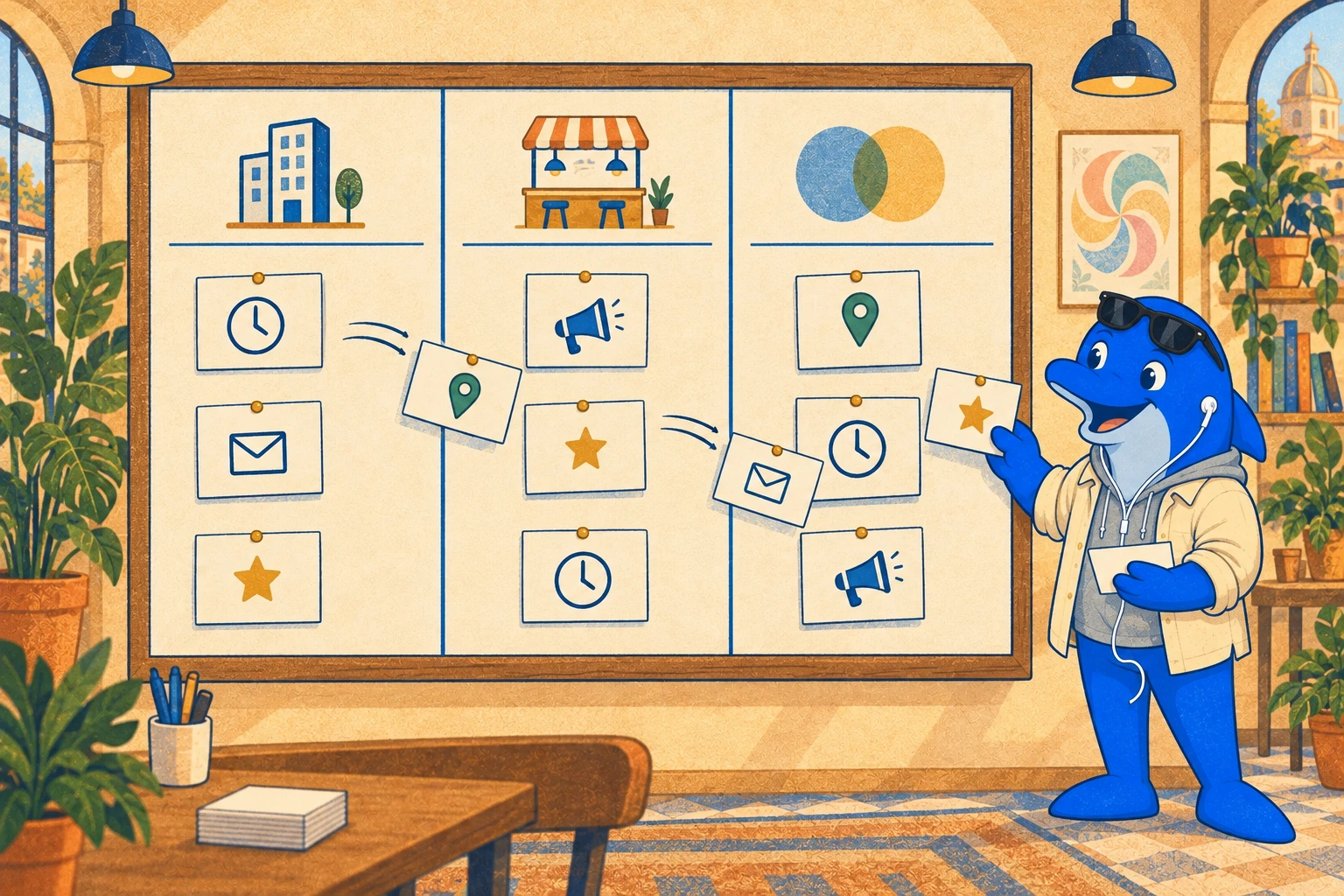
Ask two questions of every task. Would a mistake damage the whole brand or only one door? Does the job need someone who is in the building today? Brand-wide risk and shared data point to the group. Local knowledge points to the general manager. A task that scores on both gets one owner and a named handover.
The table applies those two questions to twelve tasks. It is our framework, not a measured benchmark. Change the rows to match how your group is structured.
| Task | Group runs | Location owns | Handover |
|---|---|---|---|
| Brand name, logo, tone and photo standards | Writes the standard, approves exceptions | Applies it in every local post, flyer and sign | The general manager sends anything that bends a standard for approval before it goes out |
| Website location pages | Template, navigation, structured data, the location index | Opening hours, menu, photos and a short local description | The general manager edits a form; the group's template publishes it |
| Google profile and other listings | Access, names, categories, verification, bulk updates | Photos, and a weekly check against what is true today | The general manager reports a change; the group applies it and logs it |
| Opening hours, holiday hours and menus | Yearly holiday calendar, one menu format, loading both into every place they show | Confirms or amends its own trading plan, supplies the real menu and flags a seasonal change | The general manager confirms by a fixed date each quarter; menu changes go in the shared channel |
| Review replies | Tone guide, escalation rules, monitoring | Checks the facts, sends or approves each reply | The general manager returns the checked facts within your own target time |
| Guest list, loyalty and CRM | Platform, consent wording, suppression list, group-wide campaigns | Collects sign-ups at the door; proposes local offers | The general manager's offer ideas feed the group's campaign calendar |
| Email and text campaigns | Sender identity, templates, sending, opt-outs | Local news: an event, a new dish, private dining | The general manager submits copy points by the monthly deadline |
| Paid media | Ad accounts, payment method, tracking, monthly budget per location | Local offers, dates, and a stop signal when a night is full | Group sets the budget; location asks for a push or a pause |
| Social accounts | Account structure, access, content frame | Photos and video from the room, local replies | The general manager uploads to a shared folder; the group schedules |
| Local partnerships and community | Spend limit, categories to avoid, a shared log | Chooses and runs the relationships with nearby offices, hotels, schools and organizers | The general manager logs each partner in the shared sheet |
| Creators and influencers | Disclosure rule, contract template, approved list | Suggests local names and hosts them | Group signs off before any free meal is offered |
| Reporting | Defines the numbers and builds the one-page view | Reads its own page each month and acts on it | A monthly review, location by location |
Which tasks stay central, and which need someone in the room?
Five things stay central because a mistake spreads to every location: accounts and logins (the group holds the owner role and gives general managers the access their job needs), guest data and consent, templates, the yearly calendar, and the monthly budget per location, so nobody buys ads on a personal card.
Four jobs need someone who can see the room: telling the group the location is full, closing early or out of a dish; taking real photos and video of tonight's food and team; building local relationships with nearby offices, hotels, schools and event organizers; and checking the facts in a review before anyone replies.
What does a shared task look like in practice?
A shared task has one owner and one handover, never two owners. Take Christmas Eve hours. The general manager owns the fact: the kitchen closes at 5 pm. The group owns putting that fact on every surface. The handover is a dated form, due on a set day each quarter. When a form is late, the group chases it the same day and does not guess.
How should opening hours, menus and location pages be handled?
Each is a fact with one owner and one handover, as in the table. Google says complete and accurate business information makes a profile more likely to appear in local search results, and guests and AI assistants draw on the same hours and menus. Permissions and change control are in the governance guide linked above, so this section keeps to what is new: who confirms the fact, and how many touches it takes.
What does a holiday-hours calendar save across twelve locations?
Google advises confirming hours for official holidays even when they match your regular hours. It offers bulk location management to businesses with ten or more locations, and its special hours page describes a special hours column in the upload spreadsheet.
Here is the arithmetic for a group of twelve locations. These are illustrations, not benchmarks:
- 12 locations.
- 8 dates a year on which a location changes its hours, such as Thanksgiving, Christmas Eve and New Year's Day. This is our assumption, not a statistic.
- 3 places that show hours: the Google profile, the location's page on your website and the booking platform.
Entering dates one location at a time takes 12 × 8 × 3 = 288 separate entries, and each is a chance to mistype a time. With a group calendar, the group drafts one sheet, the 12 general managers confirm or amend their own row, and the group loads it into the three places: 12 + 3 = 15 actions. That is 273 fewer touches out of 288, a cut of 94.8%, with every time coming from one confirmed source. Below ten locations Google's bulk tools are not offered, so each location loads its own Google entries and the saving is the single confirmed source, not the single upload. If a place does not accept a bulk change, count its entries one location at a time.
Who owns the location page on your website?
The group owns the template and the location owns the facts on it: address, hours, menu link, booking link and a short description from someone who works there. Avoid the page that only swaps the town name. Google lists substantially similar pages among its examples of doorway abuse, and its guidelines say not to create more than one page for each location of a business. Google's local business structured data documentation lists opening hours, a menu link and cuisine as recommended properties, which the template can fill from the location's form. To see where one location's public facts disagree today, run our free listing mismatch checker on one location at a time.
Who owns reviews and local reputation?
The location owns the facts and the group owns the rules. A Harvard Business School working paper on Seattle restaurants from 2003 to 2009 found that a one-star rise in Yelp rating raised revenue by 5 to 9 percent for independent restaurants, with no measurable effect for chain-affiliated ones. It is one city, one platform and an old data set, and it does not test restaurant groups, so we read it as direction only: a location trading under its own name is judged guest by guest. Google makes replies public, and the business must be verified before it can reply. The group therefore sets the tone guide, escalation rules and monitoring, and the location checks the facts and sends or approves each reply. The workflow is in our guide to review management for multi-site groups.
Who owns the guest list, loyalty and email?
The group runs the platform and the locations collect the sign-ups. The guest list is one of the few marketing assets a group can own outright, and the one most often left unowned: locations collect addresses on paper, the booking system holds others and a loyalty app holds a third list.
The group picks one platform, one consent wording, one suppression list of people who said stop, and one sender name. Locations ask at the host stand, on the booking form and at the table, using the group's wording, and send local offer ideas to the group's calendar. A loyalty program sits on the same list: the group runs one program and its rules, and each location decides local rewards within a budget the group sets.
Who is responsible for the guest data?
If each location is a separate company and the group decides why and how guest data is used, put the shared rules in writing between the companies: who runs the list, who answers an opt-out and who keeps the consent records. UK and EU law formalize this as joint control. The ICO says joint controllers need a transparent arrangement that sets out each party's roles and responsibilities, and Germany's DSGVO has the same idea in Article 26. If your group also emails guests in the UK or Germany, ask your advisor which rules apply to them. In the US, the duty to watch is the one in the CAN-SPAM row of the table below: an agency that sends your email does not take your responsibility with it.
What do the rules say about marketing email in the US, the UK and Germany?
The rule that applies depends on where the guest lives. This is a summary of three official sources, not legal advice.
| Market | Rule for marketing email to consumers | Source |
|---|---|---|
| US | CAN-SPAM covers all commercial email. Honor an opt-out within 10 business days, include a valid physical postal address, and remember you cannot contract away your responsibility if another company sends the email for you. | FTC, CAN-SPAM compliance guide |
| UK | Specific consent is needed. A narrow soft opt-in covers existing customers who bought, or negotiated to buy, a similar product, and who were offered a simple opt-out when their details were collected and in every message. | ICO, electronic mail marketing |
| Germany | Email advertising needs the recipient's prior express consent. An exception covers your own similar goods or services when you got the address in connection with a sale, the customer has not objected and was told clearly, at collection and at each use, that they can object at any time. | UWG section 7 |
This table covers email only. Texting rules are separate, so get legal advice before you text guests. The ICO marks its email guidance as under review following the Data (Use and Access) Act, so read the live page when you build the consent flow. Whether a table booking counts as a sale for the UK and German exceptions is a legal question for your advisor, not a marketing one.
How should paid media, social and local partnerships be split?
The group holds the accounts and the rules, and the location supplies the local material.
- Paid media. The group holds the ad accounts, payment method, tracking and monthly budget per location. The location supplies the local offer, the dates and a stop signal when a night is full.
- Social. The group owns the account structure, access and content frame. The location supplies photos and video from the room and answers local comments. Whether a location gets its own account is a naming decision, covered in our brand architecture guide.
- Local partnerships. The location chooses and runs them. The group sets a spend limit, lists categories to avoid and keeps a shared log.
- Creators. A general manager should not offer a free meal for a post without the group's disclosure rule, because undisclosed incentivized posts carry legal risk in all three markets.
The rules differ by market:
- US: the FTC says to disclose a financial, employment, personal or family relationship with a brand, including free or discounted products or services. The page tells influencers the duty to disclose is theirs and points advertisers to the FTC's Endorsement Guides.
- UK: the ASA and CAP publish the influencers' guide to making clear that ads are ads. Its third edition came out on March 23, 2023 and the ASA says it will be updated for the Digital Markets, Competition and Consumers Act.
- Germany: section 5a(4) UWG makes it unfair to leave the commercial purpose of a business practice unrecognizable when it does not follow from the circumstances.
What should the monthly operating rhythm look like?
Fix the dates once. The minutes below are our proposals for a group of about ten locations, not benchmarks. Once a year, review brand standards, platforms, contracts and budget, and set next year's calendar.
| Cadence | Group does | General manager does | Output |
|---|---|---|---|
| Weekly | Triages review replies and listing flags | 15 minutes: compare the location's listing, website page and booking page with what is true today, read new reviews, send one photo | One line in the change log |
| Monthly | Builds next month's offer and campaign calendar, sets each location's budget, sends the group email | 30 minutes: submits next month's events, offers and partner news by the set date | The calendar, and a one-page report per location |
| Quarterly | Collects hours and holiday forms, cleans the guest list, reviews who has access | Confirms hours, menu and contacts, updates the partner log | Confirmed facts on every surface |
What are the steps for the first 90 days?
Start with the facts and the data, because every later task depends on them.
- Days 1 to 14: list every place a guest meets a location. Per location, note the Google profile, website page, booking page, delivery listings, social accounts and email list, and who holds each login. The output is one sheet.
- Days 15 to 30: agree the table. Change the twelve rows to fit your group, then have each general manager and the corporate lead name their own rows in one meeting. The output is an agreed table.
- Days 31 to 45: fix the facts. Run the listing mismatch checker per location and correct every conflict, starting with hours, address and booking link. The output is a log with no open conflicts.
- Days 46 to 60: fix the guest data. Choose the platform, write the consent wording and the opt-out, merge the lists and build the suppression list. The output is one list and a record of consent.
- Days 61 to 75: run the first full monthly cycle. Calendar, budgets, campaigns and the one-page report for every location.
- Days 76 to 90: review and adjust. Ask each location what the group blocked and ask corporate what locations missed, then move rows in the table and set the quarterly dates for the year.
How do you know the split is working?
Look for fewer disagreements and fewer late changes. Per location and per month, count the rows confirmed on time, the conflicting facts across surfaces, the replies sent inside your own target and the sign-ups collected there. Keep bookings and visits separate from any count of AI mentions.
Each quarter, also ask a few AI assistants about each location by name and record its hours, address, menu and booking link, marking any answer you could not retrieve as unknown, not as a miss. An August 2026 preprint that audited 2,208 AI answers about 4,776 cafes, restaurants and bars in two Bali markets found fabricated mentions rare at 0.08%, while the systems recommended permanently closed locations 93 times, so stale facts were the larger failure. It is a foreign-market preprint and not peer reviewed, so we cite it for the type of failure, not for UK, US or German rates.
Where does Schmitdy fit into this decision?
We do not run loyalty programs, email platforms or paid media, and you do not need us for most of the above. Where we fit is the AI-answer layer: what ChatGPT, Claude and Google AI say about each location, what shapes those answers and who fixes them. For a group with more than one location, our free AI Search audit separates the branches, checks each location's local facts and assigns actions to the teams responsible. Our founder reviews every accepted request personally.
If your gap is the guest list, repeat visits or paid social, we are not the right first call: start with a CRM or loyalty platform, or an agency that runs paid social. If you have one location, you do not need this split at all.
| Option | What it covers | What it does not | Pick it when |
|---|---|---|---|
| Group marketing lead plus this table | The task split, calendar, consent wording and reporting | An outside read of what AI answers say | You have a corporate marketer and fewer than ten locations |
| Restaurant CRM or loyalty platform | The guest list, consent records, campaigns and offers | What AI answers say about each location | Your gap is the guest list or repeat visits |
| Agency for paid media and social | Campaign production and media buying | Ownership of your facts and consent decisions | The group lacks creative or media capacity |
| Schmitdy free AI Search audit | What AI answers say per location, what shapes them and an action list by team | CRM, loyalty, paid media or social | You want an independent read on how each location appears |
Pick one location and one row of the table this week, and name its owner. If you want an independent read on how each location appears in AI answers, request a free AI Search audit and bring your location list so each location is checked on its own.
Sources
- Google Help: Tips to improve your local ranking on Google
- Google Help: How to set Special hours
- Google Help: Bulk location management overview
- Google Help: Guidelines for representing your business on Google
- Google Help: Manage customer reviews
- Google Search Central: Spam policies for Google web search, doorway abuse
- Google Search Central: Local business structured data
- ICO: Electronic mail marketing
- ICO: What does it mean if you are joint controllers?
- FTC: CAN-SPAM Act, a compliance guide for business
- FTC: Disclosures 101 for social media influencers
- ASA and CAP: Influencers' guide to making clear that ads are ads
- Gesetze im Internet: UWG section 7 and section 5a
- DSGVO Article 26: joint controllers
- Luca, Reviews, Reputation, and Revenue: The Case of Yelp.com (HBS working paper 12-016)
- Pitenin, Invisible to the Machine (arXiv:2608.07069, preprint)


 Squarespace
 Webflow
 Sanity
 Shopify
 HubSpot