



TL;DR Among the 15 featured Copenhagen restaurants, Madklubben appeared for 75 of 200 discovery questions, Gasoline Grill for 74 and Høst for 70. The study covers 33 reviewed restaurant concepts, using 100 discovery intents in both Danish and English across three AI platforms, plus a separate cuisine sample.
The Copenhagen menus reviewed for this study offered several quite different answers to the same loose idea of going out for something to eat. At Høst, the menu included smoked scallops with sunchokes and hazelnuts. At Restaurant Schønnemann, a Snapsemad combined potatoes, spicy herring, red onion creme and capers. Slurp's listed Shoyu was a chicken broth with pork, egg and greens. Those are specific meals, with different reasons to choose them. An AI answer that mentions a restaurant name has only begun to make the choice useful.
We tested that beginning: which names appear when the question moves between everyday dining decisions, and when the same intended decision is put in Danish and English? The study covers Copenhagen, Denmark. It does not test British, American or German restaurant markets, even when you read it in one of those languages.
The main measure is question coverage. A restaurant receives one appearance for a question if any observed nonempty answer names it, across the three systems and their immediate repeats. It cannot receive extra credit for being named several times on that same question. This makes the main table a record of how widely a name travelled across our discovery questions, rather than how often the systems repeated it.
Which restaurants appear across the discovery questions?
The comparison covers 33 reviewed restaurant concepts, with 15 featured here. It measures question coverage within this set. The downloadable results table contains all 33 reviewed concepts, including Slurp and Gasoline Grill.
Among these 15 featured restaurants, Madklubben has the broadest question coverage: 75 of 200 discovery questions, or 37.5%. Gasoline Grill follows at 74 of 200 (37%), then Høst at 70 of 200 (35%). This order uses question coverage. It does not rank the number of individual answers naming each restaurant.
| Featured restaurant | AI visibility | Questions naming it | Danish questions | English questions |
|---|---|---|---|---|
| Madklubben | 37.5% | 75 of 200 | 44 of 100 | 31 of 100 |
| Gasoline Grill | 37% | 74 of 200 | 34 of 100 | 40 of 100 |
| Høst | 35% | 70 of 200 | 35 of 100 | 35 of 100 |
| Restaurant Karla | 33% | 66 of 200 | 28 of 100 | 38 of 100 |
| Hija de Sanchez | 31.5% | 63 of 200 | 24 of 100 | 39 of 100 |
| Kødbyens Fiskebar | 30.5% | 61 of 200 | 31 of 100 | 30 of 100 |
| Aamanns | 30% | 60 of 200 | 32 of 100 | 28 of 100 |
| Mad & Kaffe | 30% | 60 of 200 | 38 of 100 | 22 of 100 |
| Slurp Ramen Joint | 29.5% | 59 of 200 | 23 of 100 | 36 of 100 |
| Vækst | 29% | 58 of 200 | 25 of 100 | 33 of 100 |
| Restaurant Tight | 28.5% | 57 of 200 | 26 of 100 | 31 of 100 |
| Restaurant Schønnemann | 27.5% | 55 of 200 | 27 of 100 | 28 of 100 |
| Folkehuset Absalon | 25.5% | 51 of 200 | 24 of 100 | 27 of 100 |
| Maple Casual Dining | 25.5% | 51 of 200 | 21 of 100 | 30 of 100 |
| The Union Kitchen | 21.5% | 43 of 200 | 19 of 100 | 24 of 100 |
How to read the table: 50 of 200 questions would mean 25% coverage. It would not mean 25% of diners, 25% of bookings or a name in one quarter of all answers. The Danish and English columns each have 100 questions; their counts add to the combined count.
A restaurant can appear in both versions of one dining intent, only one version, or neither. Several restaurants can appear for the same question. Their percentages therefore do not divide a fixed market between them and do not need to add to 100%.
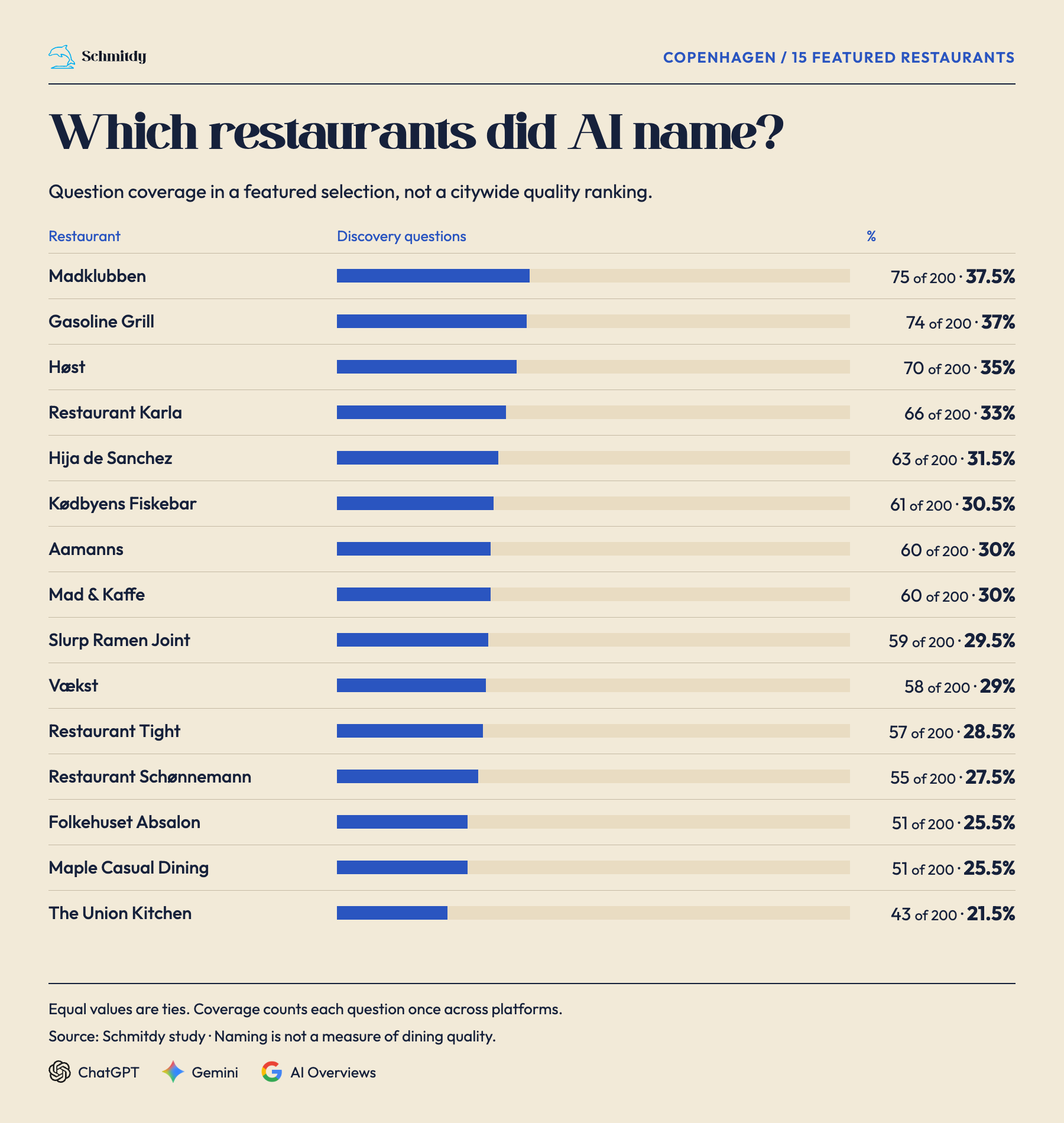
Equal percentages are ties in question coverage. Numbered positions in a layout do not create a score difference.
What does the food behind those names tell us?
Copenhagen’s menus distinguish the meals behind this AI visibility table: Restaurant Schønnemann’s herring lunch, Slurp’s Shoyu ramen, Kødbyens Fiskebar’s oysters, Mad & Kaffe’s brunch and Absalon’s communal dinner. These offers serve different dining decisions. The menu examples below show why finding a restaurant name is only the start of choosing a meal and the right branch.
Danish lunch needs more than the word “Danish”
Restaurant Schønnemann's herring menu included Snapsemad with potatoes, spicy herring, red onion creme and capers. Restaurant Karla's seasonal menu described its homemade herring with Krone aquavit, sour cream and dill. Both give a reader more to work with than a broad label such as traditional food, but the dishes are different.
Aamanns 1921 listed beef tartare with gherkins, roasted yeast emulsion and potato crisp. The branch name matters: a dish on the 1921 menu should not automatically be attributed to every Aamanns outlet. The same discipline belongs in an AI answer. Naming the group answers who; naming the right restaurant and menu helps answer where to go.
Scallops and oysters ask different questions
Høst's November menu included smoked scallops with sunchokes and hazelnuts. Vækst's November menu included salted scallops with gooseberries and smoked blue mussels. The shared ingredient doesn't make these the same plate, and a seasonal description should retain its menu context.
Kødbyens Fiskebar describes serving oysters from France. Its service information makes a further distinction: the kitchen opens from 11:30 to 14:30 and again from 17:30 to 23:00, while oysters and drinks are served throughout the day. A general lunch question and a request for a full late lunch are therefore different tests of suitability.
Brunch, a shared dinner and ramen aren't one casual category
Mad & Kaffe's brunch menu asks guests to choose three, five or seven items from five categories. That is a concrete format to examine against brunch questions. Its broader offer also includes lunch and early evening service; describing the business as breakfast-only would miss real meals it serves.
Folkehuset Absalon's food page listed whole-baked cauliflower with tahini and toasted seeds among its scheduled communal dinners. The dish belongs to the listed meal; guests should check the menu for the dinner they book. Communal dining and a flexible brunch selection need different information when someone is deciding where to eat.
Slurp's menu described Shoyu as chicken broth with chashu, tamago, spring onions, mushroom paste, chards and garden sorrel. The menu distinguishes current dishes from an archive and labels which branches serve them. Reading an archived ramen as a current recommendation would produce a plausible-sounding answer with the wrong meal at its center.
Casual evening dining still needs a specific plate
Madklubben København's evening menu included pork crepinette with mashed potatoes, pickled gherkins and sauce diane. Restaurant Tight's evening menu listed langostine bisque with tiger prawns, ling loin, coconut flakes and herbs. Maple Casual Dining listed Maple Glazed Pork Ribs with skinny fries and coleslaw.
The Union Kitchen's City menu included pork and shrimp dumplings with broth and spinach. Hija de Sanchez's Kødbyen page highlighted Taco al Pastor. Gasoline Grill's menu described a cheeseburger with organic Cheddar, fresh red onion and organic pickles. Those named offers belong in honest public coverage wherever measured. A brand appearing in the study is not a certification of a particular branch's current operating status.
What can Danish and English questions reveal?
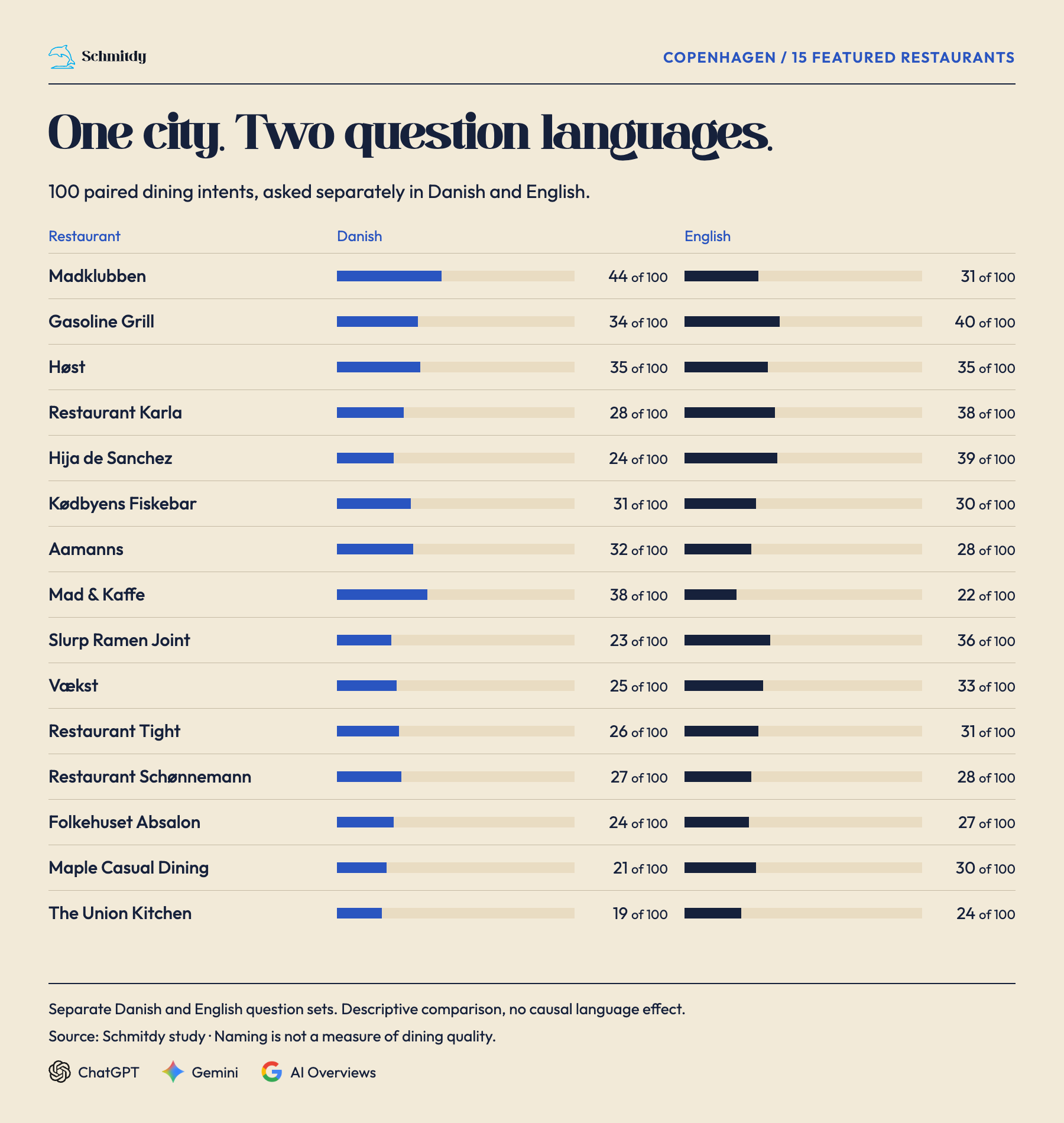
The paired questions let us compare the observed answers to the same intended dining decision. Mad & Kaffe, Hija de Sanchez and Høst show why checking both versions is useful.
Mad & Kaffe appears for 38 of 100 Danish questions and 22 of 100 English questions. Hija de Sanchez shows the reverse direction: 24 Danish questions and 39 English questions. Høst appears for 35 questions in each language. Even an identical total does not establish that the same individual questions named it; the appendix preserves the original question set for closer inspection.
Consider the paired broad lunch question: “Hvor får man en god frokost i København?” and “Where can I get a good lunch in Copenhagen?” Each belongs to the main discovery sample. A name in one version and not the other is a useful discrepancy to investigate. It doesn't establish that Danish speakers prefer the restaurant, that English-speaking visitors avoid it or that translation alone would change the result.
When does cuisine recognition reach a broader meal decision?
The study keeps a second sample for cuisine questions: 100 further intents, each in Danish and English, across ten topics. These 200 additional question strings do not enter the headline denominator. A restaurant's cuisine coverage and its general discovery coverage answer different questions and must retain their own labels.
Mæxico is named for all 20 supplemental Mexican question strings, but only two of the 200 common discovery strings (1%). Wokshop is named for all 20 Thai strings and 24 of 200 common strings (12%). Gaza Grill appears for 19 of 20 Middle Eastern strings (95%) and 26 of 200 common strings (13%). These are different designed question sets, not interchangeable success rates. They identify a narrower investigation: which broader meals and places fit each restaurant, and what happens on those exact questions?
How was the study measured?
We used 200 paired dining intents, expressed as 400 original Danish and English question strings. The headline sample contains 100 common discovery intents, or 200 strings. The supplemental sample contains 100 cuisine intents, also 200 strings, arranged in ten topics of ten intents each. The questions were selected prospectively; we did not measure search volumes or weight them by consumer demand.
The study used ChatGPT, Gemini and Google AI Overviews, with immediate repeated observations. The results describe the sampled answers. They do not isolate a causal language effect, establish change over time, or measure food quality, popularity, bookings or revenue. The language batches were collected separately, so language and collection conditions cannot be disentangled.
The design contained 12,000 answer slots. We observed 11,835 records: 11,797 contained text and 38 were blank. The remaining 165 design slots were unobserved; the records do not establish that every one was a failed request. In the main discovery sample, 5,919 records were observed, including nine blanks and 5,910 with text. The supplemental sample had 5,916 observed records, including 29 blanks and 5,887 with text.
Text does not necessarily mean a complete restaurant recommendation. Nonempty records include technical, refusal, partial and unclassified material. The measure counts attributed restaurant names in observed nonempty answers; it does not certify every answer's usefulness or treat every mention as praise.
For each restaurant and common question string, we ask whether at least one observed nonempty answer names that restaurant. A yes contributes one to its total, regardless of how many engines or repeats name it. We divide that total by 200. More observed answers create more opportunities to find a name, so missing and blank observations remain material limits on interpretation.
Names are matched as restaurant identities. A dish, street address or longer name containing the same words is not sufficient by itself. The published table is limited to 33 reviewed restaurant concepts; a restaurant outside it has an unknown result, not a proven zero.
The original question appendix makes the full sample inspectable. The measurement methodology explains why a named answer, a source link and a booking are separate observations. A source appearing beside an answer doesn't prove that it caused a particular restaurant to be named.
At Aamanns, 1921’s vegetarian smørrebrød gives mixed-diet discovery a concrete offer to work with. Aamanns was named in 2 of 118 observed nonempty answers across four question strings in that diagnostic cut. Slurp’s Veggie bowl can be made vegan; Slurp appeared in 0 of 60 answers across two vegan question strings. The Union Kitchen’s City night menu offers sharing food with dumplings; its sharing cut returned 0 of 59 answers across two question strings. These separately selected diagnostics describe different dining decisions. Their measure is answer frequency, distinct from the headline question coverage.
Høst’s three- and five-course Nordic menus and Danish-design dining room fit a dinner-date investigation: it appeared in 6 of 59 observed nonempty answers across two question strings. Its vegetarian cut was stronger, at 55 of 118 answers across four strings. Absalon’s 18:00 communal dinner and online tickets until 16:00 fit casual weeknight dining: 2 of 60 answers across two strings, alongside a stronger family-meal cut of 88 of 178 across six strings. These are two offer dimensions per restaurant, each with its own answer denominator; neither is the overall question-coverage measure.
Brand sentiment is the reported tone score out of 100 when a tracked restaurant name is mentioned in answers to the 100 English discovery questions. ChatGPT, Gemini and Google AI Overviews were selected. Name matching is narrower than in the bilingual question-coverage measure, which is reported separately. A blank score is shown as Not reported.
Original questions and wider results
The accompanying downloads contain all 400 original question strings, identified by language, cohort and topic, plus question coverage for the 33 reviewed restaurant concepts. The first 200 strings belong to the main discovery sample; the remaining 200 belong to supplemental cuisine questions. They are separate populations, not 400 distinct needs.
Download the original Danish and English questions. Download question coverage for the 33 reviewed concepts.
Our earlier Copenhagen index used a different sample and calculation; it should be read as a separate study.
For an operator, the next useful step is narrow: choose a meal and location the restaurant serves, inspect the corresponding answers, and check the current menu, service details and sources before changing anything. If you want help turning that diagnosis into an actionable restaurant plan, request a hospitality AI-search audit.
 Squarespace

 Webflow
 Sanity
 Shopify
 HubSpot