


Last updated: 2 October 2026.
A patient asking ChatGPT or Google AI which dentist to see in London gets an answer built from a handful of sources, usually NHS.uk, a few practice websites and a couple of directories, not a ranked list of every practice nearby. Most practices never appear in that answer at all. Getting named is not about buying an ad. It is about publishing the facts an AI answer actually needs, in a form it can read.
In short
- Our own tracking of 40 London-area dental practices, with a focus on Kensington and west London, across 75 patient questions found the top-named practice in just 24.65% of answers, and the median practice in under 1% (0.94%).
- On the broadest "best dentists in London" questions, none of 40 tracked practices appeared in any of 153 answers.
- nhs.uk was the single most retrieved source behind these answers, ahead of every practice, directory or review site checked.
- No UK dental practice can currently pay to appear in a ChatGPT answer. OpenAI's advertising policy restricts health service ads to a US-only approval path.
Do London patients actually ask ChatGPT and Google AI to find a dentist?
Yes, and the habit is recent. Ofcom reported in 2026 that 54% of UK adults now use AI tools such as ChatGPT, Copilot or Gemini, covering everyday research, planning and advice as well as entertainment. Dentistry itself is starting to show up on the clinical side of that shift: Dr Bethany Rossington told Dentistry.co.uk in April 2026 that a patient arriving at an appointment with an AI-generated treatment plan had gone from something she had never seen six months earlier to a weekly occurrence in her practice.
That does not mean every patient types "best dentist in Clapham" into ChatGPT before booking. It means a growing share of the research patients do before they choose, or before they ask a follow-up question about a treatment, now happens inside an AI assistant rather than a page of blue links. If your practice has no presence in that research step, you are not losing a ranking position. You are simply not part of the conversation.
Why doesn't ChatGPT mention my practice?
Because almost nothing does, consistently. We ran our own category study tracking 40 London-area dental practices, with a focus on Kensington and west London, against 75 real patient questions, logging 1,915 AI-generated answers from ChatGPT and Google's AI-generated results. The top-named practice in the whole set, the one AI mentioned more than any other, still only appeared in 24.65% of answers. The median practice across all 40 was named in under one answer in a hundred, at 0.94%. And on the broadest type of question tested, the plain "best dentists in London" style prompt, not one of the 40 tracked practices appeared in any of the 153 answers logged for that question type. You can read the full method and numbers in our west London dental AI search report.
The practical point for a practice owner: nobody has this sewn up. The gap between "never named" and "regularly named" is smaller than it looks, because even the practice with the strongest presence in that study is still absent from three answers out of four. A practice that currently gets zero mentions is not fighting an entrenched leader. It is fighting a mostly empty field.
What does an AI answer about a dentist actually need from your website?
An AI assistant can only repeat what it can read and trust. For a dental practice, that means a small, specific set of facts stated in plain text, not buried in a PDF or a contact form.
| What the answer needs | Where it usually lives on a good practice site |
|---|---|
| Treatments offered, named plainly | A distinct page per treatment, not one paragraph covering ten procedures |
| Area and nearest landmarks | Address, postcode and a line naming the neighbourhood, not just a map embed |
| Fees, as a range | A visible price list or fee page, "from" or range pricing is accepted under GDC guidance |
| NHS or private status | Stated directly: NHS, private, mixed, and whether new NHS patients are being accepted |
| Opening hours, including evenings or weekends | In text on the page, not only inside a booking widget |
| GDC registration number | Shown on the site, as GDC advertising guidance requires |
| CQC registration | Named or linked; dental practices providing regulated activities in England are required to register with the CQC |
| Structured data | Accurate schema for the business, its address and opening hours |
| Crawler access | robots.txt that does not block the AI crawlers reading the page |
Two of these deserve more than a line. Fees are the one most London practices skip, and it has knock-on effects for how AI answers price questions, which our fees page guide covers in full. And structured data is useful technical hygiene, not a guaranteed citation switch: a 2026 controlled study found schema markup produced close to no measurable change in AI citation rate on its own, so a page still needs a clear, readable answer in its visible text, schema cannot substitute for one. Our Dental website AI readiness checker runs through this exact list against your own site and tells you which of these facts are missing and where.
Where do AI answers about dentists actually pull their information from?
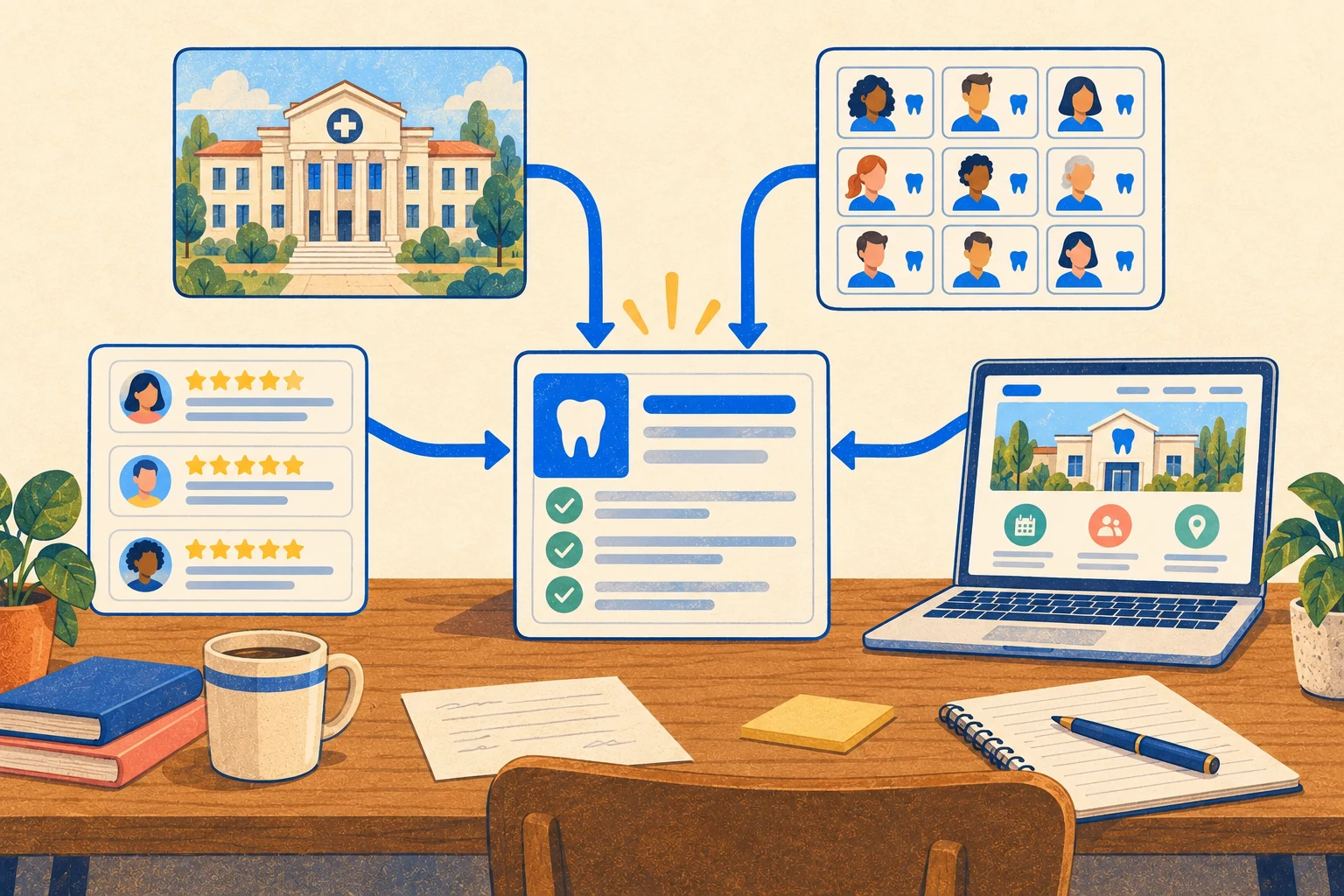
How a typical AI answer about a London dentist is assembled: official NHS content, a practice's own pages, directories and reviews, in that rough order of weight in our tracked set. Illustration, not a real AI interface.
In our tracked set, the single most retrieved source behind the 1,915 answers was not a practice, a directory or a review platform. It was nhs.uk, retrieved in 16.14% of answers, ahead of everything else checked. Four separate practice websites were also read directly often enough to outdraw the three dedicated dental directories in the set combined, which tells you a practice's own pages can be pulled straight into an AI answer without a directory sitting in between, provided the page is structured in a way the answer can use.
Community content told a different story. Reviews, video and forum content were retrieved far less often than official or practice content, and video currently outdraws forum discussion: YouTube was retrieved more than Reddit in our tracked set, while naming none of the 40 practices in the pages that got pulled in. That is a gap rather than a dead end. If a practice has no video presence at all, it is absent from a channel AI answers are already reading, even if a competitor's video never names a single practice either.
How does Google AI Overview choose which dentist to mention?
Google's own documentation describes the method as a "query fan-out" technique: AI Overviews and AI Mode may issue multiple related searches across subtopics and data sources to develop a response, drawing on pages that are indexed and eligible to appear in ordinary Google Search with a normal snippet. Google is explicit that there are no additional requirements to appear in AI Overviews or AI Mode, and no special machine-readable files, AI text files or markup are needed. The same logic applies to a widely discussed shortcut in 2026: Google's own search advocate has argued that a file such as llms.txt cannot help a model differentiate one practice's website from another's, because it is self-reported. A practice can claim anything it likes about itself in a file only it controls, so the file gives a model nothing it can trust to tell one site apart from the next.
What does help: a treatment page that states its facts plainly, is linked from your own site rather than orphaned, and matches its schema to what a reader actually sees. That is a longer list than "add a file," but it is also a list a practice can work through without a developer.
Can a London dental practice pay to appear in a ChatGPT or Google AI answer?
No, not currently. OpenAI's advertising policy treats health services, including dental services, as a restricted category approvable only on a US-only, case-by-case basis, so a UK practice cannot currently buy placement in a ChatGPT answer. Whatever presence a practice has in an AI-generated answer to "which dentist should I see" has to be earned through what the practice publishes and how it is structured, not purchased.
What does a practical 30-day plan look like?
A practice does not need a new website to move from absent to present. It needs the gaps closed in order of what the AI answer actually reads.
- Week 1: find out where you stand. Run a real sample of the questions patients in your area actually ask, for your treatments, and see whether your practice is named, who is named instead, and which sources the answers lean on. Our Dentist AI recommendation checker does exactly this for a treatment and area you choose.
- Week 2: fix the facts, not the design. Add a fee range page, state NHS or private status plainly, show your GDC registration number, add opening hours in text, and link your CQC registration. None of this requires a rebuild.
- Week 3: give each treatment its own page. A single "services" page covering ten procedures in one paragraph each reads poorly to a model looking for a specific, quotable answer about one treatment. Split the busiest ones out first: implants, Invisalign or aligners, and whitening showed the most AI answer volume in our tracked category.
- Week 4: check crawler access and re-run the sample. Confirm robots.txt is not blocking the AI crawlers that read your site, then repeat the same question sample from week one and compare.
How do you measure whether it's working?
Not by checking your Google ranking. The number that matters here is how often your practice is actually named across the real questions your patients ask, and which sources the answers are leaning on instead of you. That is a different measurement from a keyword position, and it needs checking periodically rather than once.
It is also worth remembering that being named is not the end of the decision. In a 2026 US consumer survey, BrightLocal found that among people who use AI for local recommendations, 88% check whether a review is legitimate or check the source behind it, and 97% at least sometimes cross-check an AI recommendation against real reviews, figures from a US panel rather than a UK one, but a reasonable steer that your own reviews and your own page still carry the weight once a patient has read the AI answer. A single question sample, run every month or two with the same question set, will tell you whether the gaps you closed actually moved the needle before you spend time on the next fix.
Fees are usually the fastest fix and the one most practices skip, which our GDC and AI search guide to fees pages covers in full. If you want a starting point before committing to the 30-day plan, the Dentist AI recommendation checker and the Dental website AI readiness checker are both free and take a few minutes each. The free Schmitdy AI visibility audit runs the full question set across more engines than the single-engine sample above, covering ChatGPT, Gemini, Google AI Overviews and Claude.
Sources
- Schmitdy, "How Often AI Names West London Dental Practices: A 2026 Category Study". Source for the 40-practice, 75-question, 1,915-answer tracking numbers, the 24.65% and 0.94% figures, the empty "best dentists in London" tier, and the nhs.uk, practice site and YouTube/Reddit retrieval figures.
- OpenAI, "Ad policies". Source for the health services advertising restriction and the US-only approval path.
- General Dental Council, "Guidance on advertising". Source for the GDC registration number requirement and the "from-to" price range allowance referenced from the companion GDC costs page.
- General Dental Council, "Dental costs". Source for the price list and "from-to" range guidance.
- Dental Protection, "The CQC: what you need to know". Source for the CQC registration requirement for primary dental care.
- Ofcom AI adoption finding, reported by Anadolu Agency, "Majority of UK adults using AI tools: Online safety regulator". Source for the 54% UK adult AI tool adoption figure.
- Dentistry.co.uk, "ChatGPT and dentistry: how to handle the AI-informed patient". Source for the Bethany Rossington anecdote.
- Schmitdy, "AEO vs GEO vs SEO" schema evidence section. Source for the schema markup citation evidence referenced above.
- Google Search Central, "AI features and your website". Source for the query fan-out description and the statement that no special file or markup is required to appear in AI Overviews or AI Mode.
- Search Engine Journal, "Google's Mueller Says llms.txt Can't Help LLMs Differentiate Sites". Source for Mueller's June 2026 argument that an llms.txt file cannot help a model tell one site from another, because its content is self-reported.
- BrightLocal, "Local Consumer Review Survey: AI trust research". Source for the 88% source-checking and 97% review cross-checking figures, from a 2026 US consumer panel.


 Squarespace
 Webflow
 Sanity
 Shopify
 HubSpot