



TLDR: A restaurant marketing agency that understands AI search can tell you on the first call how it'd test each of your venues and what it'd fix first. Ask the ten questions below. Drop any agency that guarantees a recommendation or offers to write reviews.
Three agencies have pitched your group this month, and every deck now has a slide on AI search. The slides look alike. The work behind them often isn't. You've got about 30 minutes on a first call to tell the difference, and the questions you ask decide what you learn.
Ask about method. An agency that does this work can name the guest questions it'd test for each venue and the facts it'd fix first. An agency that's renamed its SEO offer talks about rankings and guarantees. The ten questions below separate the two quickly.
Why does AI search need different first-call questions?
For Google's AI features there's no special optimization for an agency to sell you. Google says there are no additional requirements or special optimizations needed to appear in AI Overviews or AI Mode, and that it doesn't guarantee indexing or serving. The work is ordinary work done carefully. It starts with correct venue facts on pages machines can read, and it needs measurement that copes with answers changing from day to day.
The best public study on restaurants points the same way. In an August 2026 preprint, Vladimir Pitenin audited 4,776 cafes, restaurants and bars in two Bali markets across ChatGPT, Claude, Gemini and Perplexity, and found 85.6% of venues were never recommended by any system. Getting into an answer was linked to documentation: review volume, an own website, listed prices and mentions on other sites. Star rating only mattered for position once a venue was already in. It hasn't been peer reviewed and Bali isn't Boston, so read it as a pattern. It still tells you what a serious agency should bring up unprompted.
Answers also move. SparkToro and Gumshoe had 600 volunteers run 12 prompts through ChatGPT, Claude and Google's AI a combined 2,961 times. There was less than a 1 in 100 chance that ChatGPT or Google's AI gave the same list twice in 100 runs. The study didn't cover restaurants, and the authors flag a commercial link to an AI-tracking company. For your venues the lesson's simple: one screenshot doesn't prove much.
Guests are already asking. In a March 2026 survey of 1,002 US adults by BrightLocal, a local marketing software company, 45% had used AI tools for local business recommendations, up from 6% a year earlier. It's a vendor's survey, and it explains why the slide turned up in every deck.
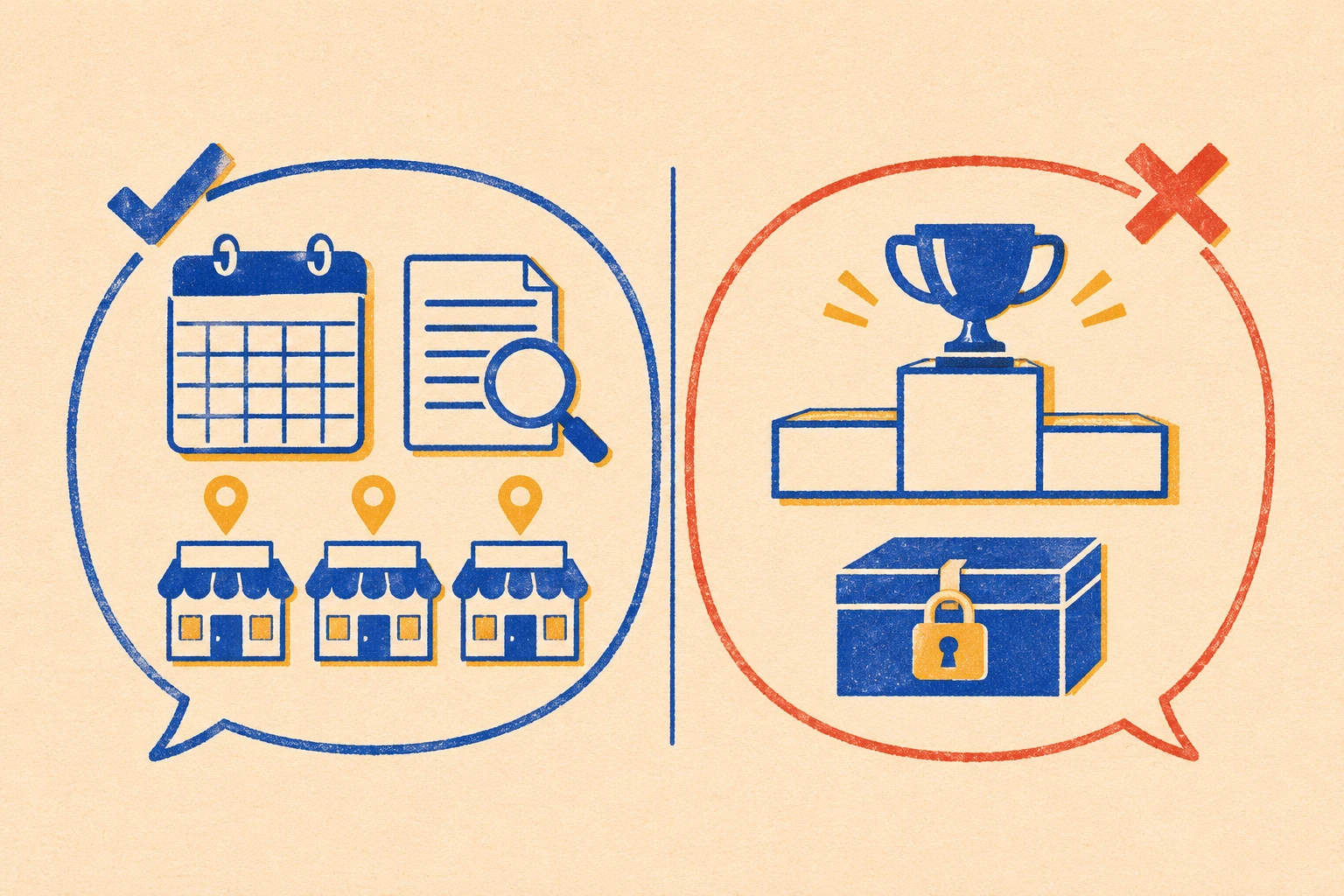
What are the ten questions?
The ten questions fall into four groups, one per heading below. Ask them in order and write down the answers, whatever the slides say.
| Question | Reassuring answer | Warning sign |
|---|---|---|
| 1. Which guest questions would you test? | Occasions per venue, from your booking data | One generic city question |
| 2. How often do you repeat them? | Many runs, counted as how often you appear | A single position in one answer |
| 3. How do you report by venue? | One row per venue and question | One score for the group |
| 4. What changes in month one? | Venue facts, readable menus, own pages | Secret AI markup or bulk pages |
| 5. How do you find outside sources? | Reads the sources listed beside answers | Bulk directory submissions |
| 6. How do you handle reviews? | Fair asking and accurate replies | Writing or buying reviews |
| 7. Whose name is on the accounts? | Yours, with agency access added | The agency's own account |
| 8. What do we see each month? | Questions, dates, sources, changes made | A dashboard with no method |
| 9. What can't you promise? | Any recommendation or position | A guarantee |
| 10. What have you done for restaurants? | Dated examples with method | Screenshots with no context |
How does the agency measure?
1. Which guest questions would you test for our venues, and how would you choose them? A good answer starts with your guests: Sunday brunch near the train station, a private room for twelve, a late table after the theater. It asks for your booking data and your busiest occasions. If they offer one generic city question for the whole group, that's weak.
2. How many times would you ask each question, and in which assistants? Lists change from run to run, so a credible agency counts how often a venue appears across many runs. SparkToro suggests asking at least 60 to 100 times and averaging when you need a stable read. If someone quotes you a position in ChatGPT from a single run, treat it as a red flag.
3. How would you report each venue separately? A group score hides the venue that's missing. Ask for a sample report with one row per venue and question, showing the date, the assistant and the sources listed beside each answer. A single visibility percentage for the brand won't show you where to act.
What work would the agency do?
4. What would you change in the first 30 days? Listen for the boring list: correct hours, menus as text on the page, one clear page per venue, and matching facts on Google and the main guides. That list lines up with the factors in the Bali study. Don't trust anything sold as secret AI markup, and be wary of plans for hundreds of near-identical pages. Google calls that scaled content abuse when many pages are made mainly to manipulate rankings. Ask instead how they'd check your site is open to the crawlers assistants use: OpenAI, for example, recommends allowing OAI-SearchBot in robots.txt for a site to appear in ChatGPT search.
5. Which outside sources matter in our area, and how would you find them? A good agency reads the guides, listings and articles that sit beside the answers to your own questions, then picks the ones worth approaching. If they're selling bulk listings, move on. Google's own advice on hiring help calls submitting your site to thousands of search engines a typically useless exercise.
6. How do you handle reviews? Google says more reviews and positive ratings can improve local ranking, so they'll come up. You want fair, consistent asking and accurate replies. If they offer to write reviews or reward only good ones, you're done. In the UK, the CMA's fake reviews guidance covers the rules that changed in April 2025. In the US, the FTC's final rule on fake reviews bans fake and AI-generated reviews and lets the regulator seek civil penalties. In Germany, the UWG lists submitting or commissioning fake consumer reviews among practices that are always unfair.
Who owns the accounts?
7. Whose name will be on the Google profile, Search Console and analytics? Yours. On Google Business Profile, owners can add and remove users, while managers can't, so the agency should be a manager. In Search Console, owners have full control and full users can't add or remove others. In Google Analytics, adding or changing users needs the Administrator role. An agency that wants to hold the keys is building a switching cost.

What will you see, and what has the agency done before?
8. What will you show us every month? When we checked Google's page on hiring an SEO on November 12, 2026, one of its suggested questions was still whether the agency will share all the changes it makes to your site and explain its reasoning. For AI search, add the questions tested and the sources listed beside each answer, with dates. A movement after a change is a lead to check. It doesn't prove the change caused it.
9. What can't you promise? A recommendation. Google puts it bluntly: "No one can guarantee a #1 ranking on Google." AI answers move between runs, as the SparkToro numbers show, so a promised position deserves even less trust. A good agency tells you what it controls (your facts and your pages) and what it doesn't (what an assistant chooses to say).
10. What have you done for restaurants in our market? Google's list of questions for any search agency includes examples of previous work and experience in your industry and city. Ask for dated examples with the method and the period they measured. They're easy to give when the work's real. A cropped screenshot of a chatbot naming a venue says little about how often it happens.
How do you score the answers after the call?
Score each answer as solid, vague or a warning sign, and treat two answers as decisive. A guarantee (question 9) or an offer to write reviews (question 6) ends the conversation, however good the rest sounded. After that, count solid answers.
Here's a worked example with made-up agencies. Agency A gives seven solid answers, three vague ones and no warnings. Agency B gives eight solid answers and one vague one, then promises a top spot in ChatGPT within 90 days, which is a warning on question 9. Agency B is out despite the higher count. Agency A goes forward.
Question 2 also shows why a spreadsheet won't do this job for you. Take a group with four venues, five guest questions per venue and three assistants: that's 60 question and assistant pairs. At ten runs each you'd read 600 answers a month, and SparkToro's 60 to 100 runs would multiply it again. That's a job for a system, so ask any agency how it collects and counts answers at that volume.
If two agencies pass, stop asking and compare work. Our guide to choosing between good finalists with a 30-day test sets one up on two venues. Then write the brief with our guide to briefing an AI-search agency for a restaurant group, and check any audit they propose against what a restaurant-group audit should check. The vendor-neutral AI search RFP template puts the same questions to every bidder in writing.
When is your current agency enough?
Your current agency may be enough if it already answers questions 1, 3, 7 and 9 well. Plenty of good restaurant agencies look after reviews, listings and venue pages with care, and that's most of the work. Extend its brief to cover repeated testing and a monthly source review before you hire a second firm. If you're deciding whether one agency should cover every venue, our guide to one AI search agency or site by site sets out the split. If your PR agency wants to take this on, our guide on whether your PR agency should own AI search visibility splits the two jobs.
Sometimes you don't need an agency yet. If your site lists last winter's hours and a PDF menu, fix those first. That's where any good agency would start anyway.
We sell this service, so put the same ten questions to us. Our Restaurant AI Search service starts at $1,650 a month, with half the fee tied to an agreed monthly goal, and rebuilds every menu as a readable page for each venue as part of the fee. We don't promise a recommendation. To see how we'd answer questions 1 to 3 for your venues, book the free AI search audit and bring your hardest guest question.
Sources
All pages were checked on November 12, 2026.
- Google Search Central: AI features and your website.
- Pitenin, V.: Invisible to the Machine, arXiv:2608.07069, preprint, August 7, 2026.
- SparkToro: AIs are highly inconsistent when recommending brands or products, January 28, 2026.
- BrightLocal: local consumer review survey, AI trust findings, March 10, 2026, a US survey by a local marketing software company.
- Google Search Central: do you need an SEO?
- Google Search Central: spam policies.
- OpenAI: overview of OpenAI crawlers.
- Google Business Profile Help: tips to improve your local ranking.
- CMA: fake reviews guidance (CMA208), April 4, 2025.
- FTC: final rule banning fake reviews and testimonials, August 14, 2024.
- German Unfair Competition Act (UWG), annex to section 3(3), no. 23c, in German.
- Google Business Profile Help: manage users on your profile.
- Search Console Help: managing owners, users and permissions.
- Google Analytics Help: add, edit and delete users.
 Squarespace

 Webflow
 Sanity
 Shopify
 HubSpot