


TLDR: A restaurant group's PR agency and its AI search visibility are not the same job, even if they sound similar on a pitch call. PR earns press coverage and relationships. AI search visibility depends on structured, consistent facts about every location, feeding the platforms your guests already ask. Run the five-question self-test below on your current agency before you extend its brief, add a specialist, or replace the relationship.
If you operate more than one location, you have probably already asked your PR agency whether it "handles the AI piece." Most will say yes, because telling a paying client no is a hard sentence to write. What actually happens usually lands somewhere between "we mention it in reports" and "we have never actually measured it," and that gap is an expensive thing to discover after you have already paid for a fix that never happens.
PR and AI search visibility are different disciplines. Run the five-question self-test below on your own agency relationship, then weigh the answers against what Schmitdy's audit is actually for in this decision. None of this says to drop your PR agency. It says to find out whether that agency was ever the right vendor for this specific job.
What are PR agencies actually built to do?
A restaurant group's PR retainer typically buys relationships, judgment and access: pitching journalists and editors, placing stories, managing a launch, briefing a spokesperson, and handling the occasional crisis call. PRSA's own definition describes public relations as "a strategic communication process that builds mutually beneficial relationships between organizations and their publics," and lists media relations as one discipline among several, alongside reputation management, crisis response and content creation. The UK's CIPR gives a similar frame, describing public relations as the discipline that looks after reputation, "the result of what you do, what you say and what others say about you." Neither definition mentions tracking what an AI engine says about one specific location. Press pitching is a real, valuable skill. It is not the whole job description, and it was never built to be.
That earned coverage can genuinely help AI search visibility, just indirectly. When OpenAI and Yelp confirmed a data partnership putting Yelp's reviews, ratings and photos directly into ChatGPT's local answers, and Perplexity's own account described its Yelp integration for local search, both point to the same mechanism: a review platform, not a press release, is doing the talking. A strong piece of press coverage can still be a citation an AI engine finds and reads. It is one input among several, not a visibility plan on its own. Our own piece on connecting press to guest-facing information goes into this for fine dining specifically: recognition is evidence of standing, not a guarantee of a recommendation.
Picture a twelve-location group that lands a strong regional write-up for its newest flagship. The PR agency reports a clean win: coverage, tone and reach all land well. A few weeks later, an AI assistant asked about that same location still states last season's hours and names a dish the kitchen dropped months ago. Both things are true at the same time. The press win happened. The AI-search answer is still wrong. Neither fact cancels out the other, and a retainer built only to produce the first does not automatically produce the second.
How much does an unowned task actually cost?
Say a group's PR retainer runs to one press report a month, built around pitching the same dozen or so trade and local reporters. That is a bounded task with a start and an end each month. Checking whether a dozen locations' hours, menus and listing data are accurate across Google Business Profile, Yelp and the group's own site is a different kind of task: it never really finishes, because facts drift every time a location changes its hours, swaps a dish or closes temporarily for a remodel.
If the agency has not explicitly billed for that second task, the safer assumption is that it is not getting done, not that it is happening for free on top of everything else. A twelve-location group checking each site's listing data twice a year, at around fifteen minutes per location per check, comes to roughly six hours of work a year at the low end, before any actual corrections are made. On its own, that is a small number. It becomes a real gap the moment nobody has agreed whose job it is, because then it simply never happens.
What does AI search visibility actually require?
AI search visibility is a data-hygiene job wearing a marketing jacket. OpenAI confirms that ChatGPT search can use a user's approximate location to shape local results, and that it does not publish its full ranking logic. Perplexity's help center explains its answers come from a live retrieval pipeline that searches, reads and cites real pages, backed by a separate crawler that respects robots.txt. Neither company is reading your press clippings file. Both are reading structured, retrievable facts: your name, address, phone number, hours, menu format and reviews, wherever those facts actually live online.

That is why Google's own structured-data documentation asks every local business to declare name, address, phone, hours, coordinates, price range and cuisine type in a machine-readable format built on the open schema.org LocalBusiness vocabulary, and why a group running ten-plus locations gets a dedicated bulk-management tool built specifically so those facts stay identical across every location from one dashboard. A ten-location group with one flagship press story and nine locations nobody has checked since a remodel is not an AI-search win. It is nine unverified answers waiting to go wrong.
What does this actually involve, week to week?
The job, in practice, covers four things a press-focused retainer rarely scopes in. It means testing what AI engines actually say about each location, fixing wrong or missing facts across every site rather than just the one with the press hit, keeping listing and review data consistent location by location, and feeding direct, structured answers to the questions guests actually ask an AI assistant. None of that calls for a journalist relationship. All of it calls for someone with a standing mandate to check it on a schedule, not as a one-time project.
How do you test whether your agency already covers this?
Before you decide your PR agency already has this covered, ask it these five questions and get the answers in writing.
- Do you currently track what ChatGPT, Gemini, Perplexity and Google AI say about us, beyond monitoring press mentions?
- Is fixing inaccurate hours, menu, address or review information across every one of our locations explicitly in your scope, or is that assumed to be someone else's job?
- Who owns our Google Business Profile, Yelp and listing data at each location, and is that work billed separately or just assumed?
- Does our retainer include a line item for structured data or schema markup, or does that sit with "whoever built the website" and never get revisited?
- If an AI engine gives a wrong answer about one specific location next month, who is responsible for catching it and fixing it, and what is the expected turnaround?
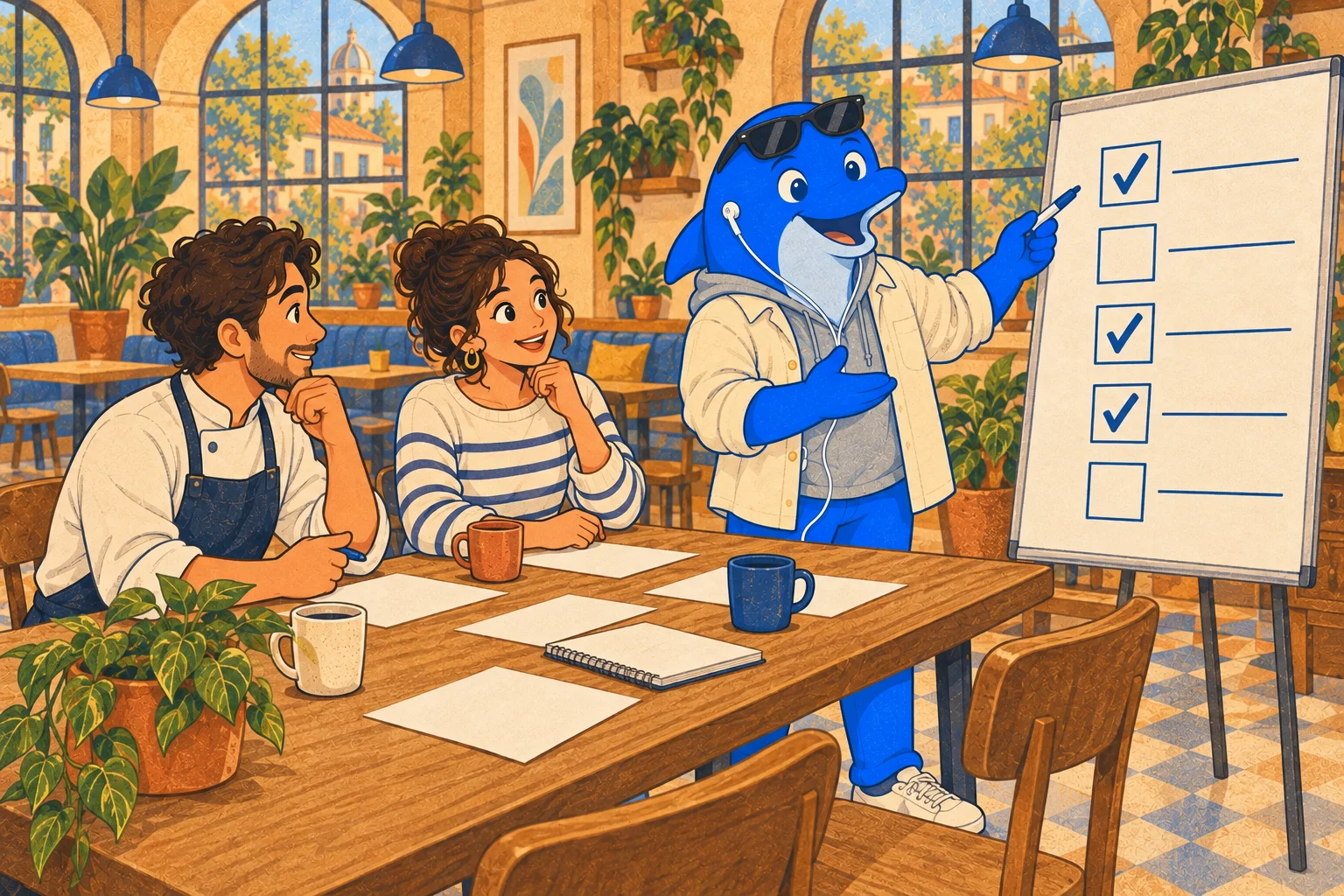
A confident, specific answer to all five is a real reason to extend the current brief. A vague answer to two or more is a reason to add a specialist alongside the agency, or to split the two jobs cleanly before more money goes into either one.
Where does Schmitdy fit into this decision?
Schmitdy's role here is narrow and specific: the free AI search audit is the tool that answers the open questions from the self-test above with evidence instead of a guess. It records how your group currently shows up across the engines your guests actually use, separates "how you show up" from "what shapes the answers" and from the 30-day plan, and treats a location with inconsistent facts as a problem to name, not a number to bury inside a group average. If you run several locations, the audit is built to separate them rather than report one blended score.
This decision usually lands in one of three places, and the audit evidence is what tells you which one:
| Path | What it means | When it fits |
|---|---|---|
| Extend the current agency's brief | Add AI-engine tracking and a listing-data mandate to the existing retainer, in writing | The agency answered all five self-test questions with specifics, and has the bandwidth to take this on |
| Add a specialist alongside the agency | Keep press work with the current agency; bring in a separate AI search mandate for tracking, fixes and structured data | PR performance is solid, but the agency cannot answer the data-hygiene questions |
| Replace the relationship | Move the whole brief to a vendor built around AI search visibility from the start | Both jobs are weak, or the agency has shown no interest in taking on the AI-search mandate |
None of these is automatically the right call. The audit gives you the evidence to pick one instead of guessing, and it costs nothing to request.
The audit has limits worth stating plainly. It is a diagnostic, not a guarantee of any particular AI engine's future answer, and it cannot force an engine to recommend you. It also will not fix a genuine press or reputation problem; that still belongs with a PR specialist. What it will do is tell you, with evidence from the engines your guests actually use, which of the three paths above fits your situation today.
Run the audit before your next retainer renewal, not after. A renewed contract with an unanswered question still inside it is the expensive way to find out which path you were actually on.
Sources
- PRSA: About Public Relations.
- OpenAI Help Center: Searching the web with ChatGPT.
- Perplexity Help Center: What is Perplexity?.
- Perplexity Help Center: How does Perplexity follow robots.txt?.
- Axios: Yelp reviews come to ChatGPT.
- Search Engine Land: ChatGPT gains access to Yelp reviews, ratings, and photos.
- Google Search Central: LocalBusiness structured data.
- Google Business Profile Help: Bulk location management overview.
- Google Search Central: Generative AI and search.
- CIPR: About PR.
- Perplexity (official account) on X: Yelp integration for local search.
- Schema.org: LocalBusiness.
- Schmitdy: Fine-Dining AI Search, turning press into useful guest information.


 Squarespace
 Webflow
 Sanity
 Shopify
 HubSpot