



TLDR: Fine-dining restaurants get recommended by AI when the chef, the restaurant and its current menu clearly point to one another. In a chef-led room, much of the coverage names the chef rather than the room, so your site, profiles and coverage must all say who cooks where now, with dates.
Picture a guest's booking note. It says they found you by asking an assistant about your head chef, and that the answer placed the chef at the restaurant the chef left two years ago, with your dining room in one line near the bottom. Everything that makes your room worth the train fare was in the answer, attached to the wrong door.
That is the risk for a chef-led restaurant. Much of the coverage an assistant can list about such a restaurant is written about the chef, and profiles and award stories follow the chef from kitchen to kitchen. In our view the restaurant gets recommended when the chef, the room and the current menu point to each other on your own site, your profiles and your coverage. A common assumption is that a star or a strong review carries the restaurant on its own. We think the bigger danger is press that names the chef and not the room, or that still describes a previous kitchen, menu or chef. If your restaurant is known for the room rather than a chef, the answer changes, and we cover that case below.
Why does the chef carry so much of the answer?
The chef carries so much of the answer because much writing about fine dining is about chefs, and the guides split the person from the room in ways an assistant has to piece back together. MICHELIN is explicit that it "awards stars to restaurants based on the quality of the food they serve", not to individuals. It adds that "Chefs can't take off with the stars, nor do the stars transfer to another restaurant owned by the same chef" (MICHELIN Guide). Its FAQ goes further: a restaurant keeps its star after a head chef leaves if the new kitchen maintains "the same standard of cooking" (MICHELIN Guide).
Other records tie the two together at a fixed moment. The James Beard Foundation's 2026 winners list gives each Best Chef as a chef, a restaurant and a city (James Beard Foundation, 15 June 2026). Profiles, interviews and award stories follow the person from kitchen to kitchen and stay online after they move. So the web holds a durable record of the room, a moving record of the chef, and many dated pages pairing them as they were.
Google describes the same weight in plainer terms. Its local results are "mainly based on relevance, distance, and popularity", and it explains that popularity factor as prominence: "how well-known a business is", based partly on "how many websites link to your business and how many reviews you have" (Google Business Profile Help). For a chef-led room, check how many of those links are really articles about the chef.
When an assistant searches the web for a fine-dining question, it often lists guide and press pages alongside its answer. In our own test of whether MICHELIN stars affect AI restaurant recommendations, which put 60 questions to one assistant on 1 November 2026, a guide's page was listed beside 28 of 30 special-occasion answers, among about ten websites per answer. A listed source shows what was retrieved, not what the assistant relied on. We have not measured how often an answer attaches a chef to a former kitchen; the risk follows from how the sources are written, which is why your own pages come first.
What should your own pages say about the chef and the room?
Your own pages should state, in plain words and with dates, who cooks where now. They are the one place you control, and the place a careful assistant or guest can check older coverage against.
Give the chef a page on the restaurant's site with a dated career line: head chef here since a named month and year, the previous kitchen with its years, and the guide recognition the restaurant holds today. Write the restaurant page so it names the chef in its first paragraph and links to that chef page, and make the chef page link back. Google's guidance on helpful content asks whether it is "self-evident to your visitors who authored your content" and encourages "accurate authorship information" (Google Search Central); a fine-dining room has the same job for the kitchen.
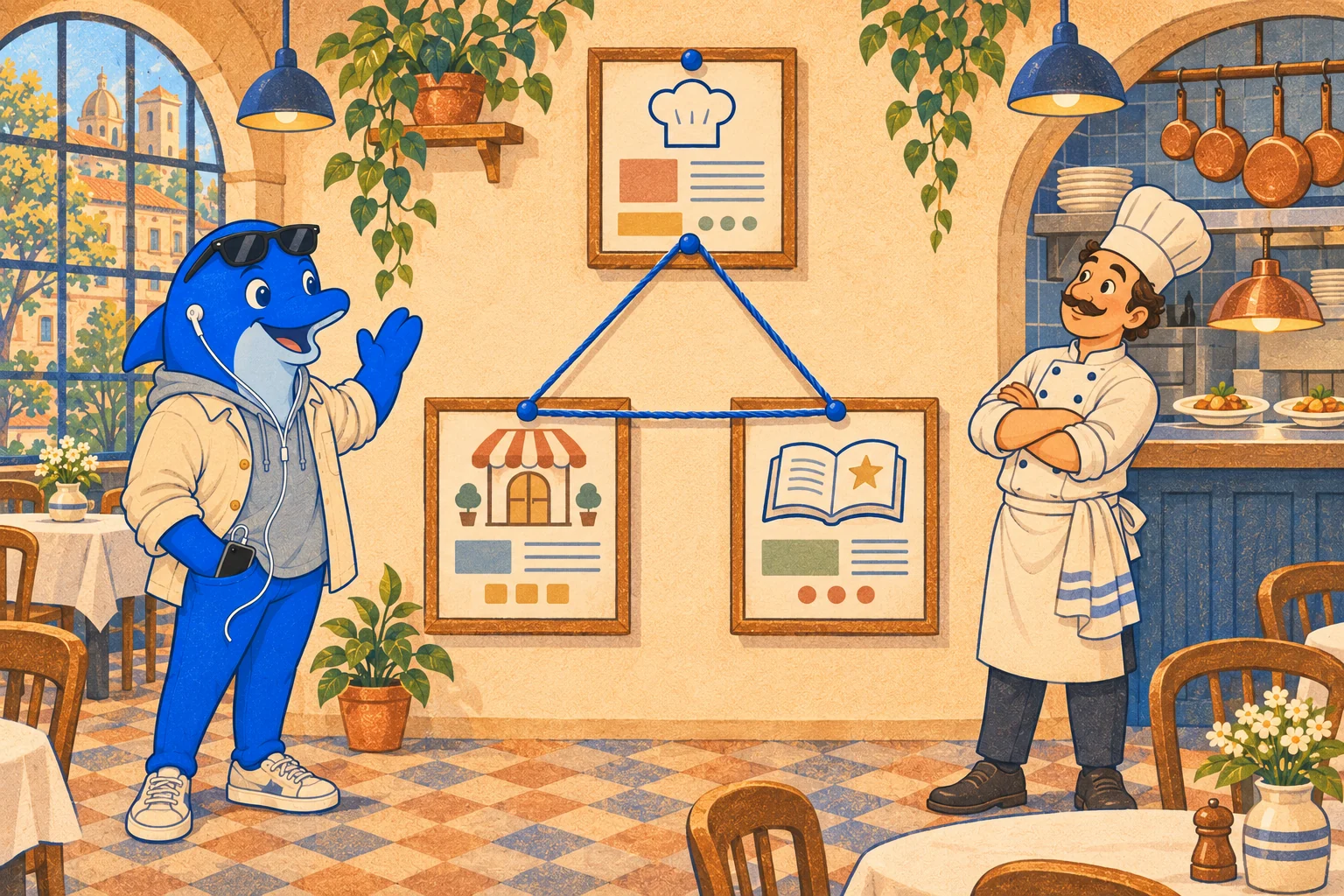
The structured data can carry the same links. schema.org's Restaurant type takes founder and employee for the people, hasMenu for the current menu and servesCuisine for the style, and a Person can carry worksFor pointing back to the restaurant (schema.org Restaurant, schema.org Person). Google says AI Overviews and AI Mode need no special structured data (Google Search Central), so treat markup as a clear statement of the facts already on the page, never as a shortcut.
| Page | Must say | Links to |
|---|---|---|
| Chef page | Role here, start date, previous kitchens with years | Restaurant page, current menu |
| Restaurant page | Chef's name in the first paragraph, current menu format | Chef page, booking, menu |
| Menu page | Date of the current menu, price, format | Restaurant page, booking |
Once your own pages agree, the weaker link is everything other people have written.
Which coverage should you earn, and how do you keep it current?
The coverage worth earning names the chef and the room in the same sentence. A chef profile that leaves the restaurant to its final lines builds the chef's name; an interview set in the dining room, a guide entry or a critic reviewing this menu builds both. When you pitch, offer the room as the place the story happens, and ask that the restaurant be linked.
Keeping old coverage current is mostly a list and a polite email. Keep a press list with the publication, date, what it says about the chef and the room, and whether it still links to the right place. Our guide to turning fine-dining press into guest information sets out that record. Then sort each item into one of three cases.
- Dated but accurate. A 2023 review that says the chef cooks somewhere else was true in 2023. Do not ask for a correction. If the publisher still promotes it as current, ask for a short update line or a link to the restaurant the chef runs now.
- Wrong when published. In the UK, the Editors' Code says a "significant inaccuracy, misleading statement or distortion must be corrected, promptly and with due prominence" (Editors' Code of Practice). Send the editor the fact, the source and the correct wording.
- A guide listing. Use the guide's own route. The Good Food Guide, for example, takes basic detail changes through its Establishment Hub and more complex questions by email to its editors, and does not discuss scores (The Good Food Guide).

If a PR agency handles the chef's profile, agree who keeps this list. Our piece on whether a restaurant group's PR agency should own AI search visibility covers where press work stops and listing work begins. Coverage gets a guest interested, though; the next questions are practical, and a review rarely answers them.
Which practical facts do fine-dining guests ask before they book?
Fine-dining guests ask about format, price, time and what happens if something changes. If your pages do not answer, an assistant can only fill the gap from whatever review it finds, however old. Publish each of these on the restaurant or menu page, dated where it changes:
| Question | Publish | Update when |
|---|---|---|
| What is the menu? | Tasting or à la carte, number of courses | Each menu change |
| What does it cost? | Price per guest, drinks pairing price | Each price change |
| How long is dinner? | A realistic range for the menu | Format change |
| Is a deposit taken? | Deposit and cancellation terms | Terms change |
| How far ahead to book? | When tables are released | Release pattern change |
| Dietary needs? | What the kitchen can adapt, notice needed | Kitchen change |
These are the same facts a chef change tends to break, because a new chef usually brings a new menu.
What happens when the chef moves or opens a second room?
When a chef moves, the restaurant and the chef each need a decision about what the old and the new pages say, made before the news is public, so that AI answers and guests follow the chef's online authority to the right room. The guide record stays with the room, the chef's authority goes with the chef, and every page in between needs a date.
What if the chef leaves your restaurant?
Credit the former chef briefly with their years, name the new head chef with a start date, and update the Google Business Profile description, the menu page and your guide listings on the day of the announcement. MICHELIN's position is that the star stays with the restaurant while the cooking holds, so the room keeps its record; what it loses is the name much of its coverage was written about.
What if your chef opens a second room?
Give the second room its own restaurant page, its own menu and its own Google profile, because Google allows one profile per business (Google Business Profile Help). The chef page then lists both rooms and says what the chef does in each, so an answer about the chef can send a guest to either door.
What if the restaurant changes its name?
A new name usually means a new Google profile. Google treats a name change that does not meet its rebrand criteria as a new business: the old profile is marked closed and a new one created (Google Business Profile Help). Plan the announcement around that, so the old name does not keep collecting reviews.
What if the room, not the chef, is the name?
Then build your online authority on the room. Chef-led authority does not apply when no single chef is the name that coverage follows. A hotel dining room, a long-established house or a group with a rotating kitchen should lead with the place, the produce and the service, and name the kitchen team without building the brand on one person. It still needs the dated pages and the press list; it just does not put a chef at the centre of them.
What does the guest find once chef and room agree?
Once the chef page, the restaurant page, the profile and the press list agree, the guest who asks about your head chef finds the room they cook in now, with this season's menu and a booking link. The old review still exists, but it reads as history, and the answer names your restaurant for the cooking it serves today.
Start with a one-hour audit:
- Ask two assistants where your head chef cooks now, and note the pages listed alongside each answer.
- Check that the chef page and the restaurant page link to each other and give dated roles.
- Compare the menu, price and booking terms on your site with your Google profile and guide listings.
- List every piece of coverage from the last three years, marked accurate, dated or wrong.
- Send one update request or correction for the most visible dated piece.
The audit takes an hour; keeping the answers right takes longer, because menus, chefs and coverage keep moving. At Schmitdy we do that as ongoing managed work with restaurants: we check the answers guests get every day and trace mismatches to the pages listed alongside them. Then we fix the Google Business Profile, Search Console set-up, menu and chef pages and the press list; our team checks the work, and you approve what matters before it goes live. If you want to see where your chef and your room are separated today, our free AI search audit starts with those answers.
Sources
- MICHELIN Guide, 5 Myths About The MICHELIN Guide Debunked, 5 September 2016, checked 13 November 2026.
- MICHELIN Guide, What is a MICHELIN Star?, 12 November 2025, checked 14 November 2026.
- James Beard Foundation, The 2026 James Beard Award Winners, 15 June 2026.
- Google Business Profile Help, Tips to improve your local ranking on Google, checked 14 November 2026.
- Google Search Central, Creating helpful, reliable, people-first content, checked 14 November 2026.
- schema.org, Restaurant and Person, checked 13 November 2026.
- Google Search Central, AI features and your website, checked 13 November 2026.
- Editors' Code of Practice Committee, The Editors' Code of Practice, in force from 1 January 2025.
- The Good Food Guide, Restaurant FAQs, checked 13 November 2026.
- Google Business Profile Help, Guidelines for representing your business on Google, checked 13 November 2026.
- Deutscher Presserat, German Press Code, section 3 Corrections, checked 13 November 2026 (official copy also checked via the NRW government publication).
 Squarespace

 Webflow
 Sanity
 Shopify
 HubSpot