


TL;DR
- Keep the restaurant's facts, guest promise and final approval in house, whatever supplier model you choose.
- Use an in-house team when you can protect weekly operating time. Use a conventional agency when the main need is paid media, creative campaigns or a broad channel mix. Use a specialist AI-search partner when the work is repeated source accuracy, local discovery and evidence-led growth.
- Treat agent-supported execution as a capability inside a responsible team or partner, not as a substitute for hospitality judgement.
The useful question is not whether an in-house team, agency or AI-search partner is "best". It is whether the model can keep a guest-facing record accurate across every venue while doing the recurring work that earns discovery.
That is a sharper problem in restaurants than in most categories. A group can have a beautiful brand campaign and still lose a booking because the location page has an old menu, a booking profile has the wrong opening hours, a map pin points to a former site, or a review describes a change nobody corrected. Google's LocalBusiness guidance and Restaurant schema point to the same discipline: describe the real business clearly and keep the visible record current. Schema clarifies a current record. It cannot replace one.
This guide is for restaurant groups deciding who should own that work in 2026. It separates four routes:
- an in-house marketing team
- a specialist AI-search growth partner
- a conventional restaurant marketing agency
- agent-supported execution inside either of the first three
The fourth route is intentionally not a vendor category. Agents can accelerate research, drafting, source checks and task preparation. A named person still needs to decide what is true, what is on-brand and what is safe to publish.
Start with the work that must happen every month
Restaurant marketing is not one calendar. It is a set of facts and promises that change at different speeds:
| Operating layer | Examples | The owner who must be accountable |
|---|---|---|
| Source record | Venue name, address, opening hours, menu, price range, booking route | The restaurant group |
| Guest trust | Reviews, accessibility, allergens, service recovery, community replies | A trained person with operating context |
| Discovery | Location pages, occasion pages, local editorial proof, maps and AI-search prompts | In-house team or a clearly scoped partner |
| Commercial decision | Budget, offer, brand risk, priority venue and target audience | Restaurant leadership |
The Food Standards Agency's allergen guidance is a useful reminder of the boundary. A useful marketing page can help a guest find a suitable venue, but it cannot replace the trained operational conversation a restaurant needs for allergen safety. The same principle applies to a public reply to a serious complaint, a late change to a set menu, or a claim about accessibility.
Capacity has an operating cost. For a 12-venue group, four 20-minute record checks plus a 15-minute venue sign-off amount to 19 hours a month. That is before pages, sources, campaigns or analysis. Treat it as a capacity test, not a return forecast.
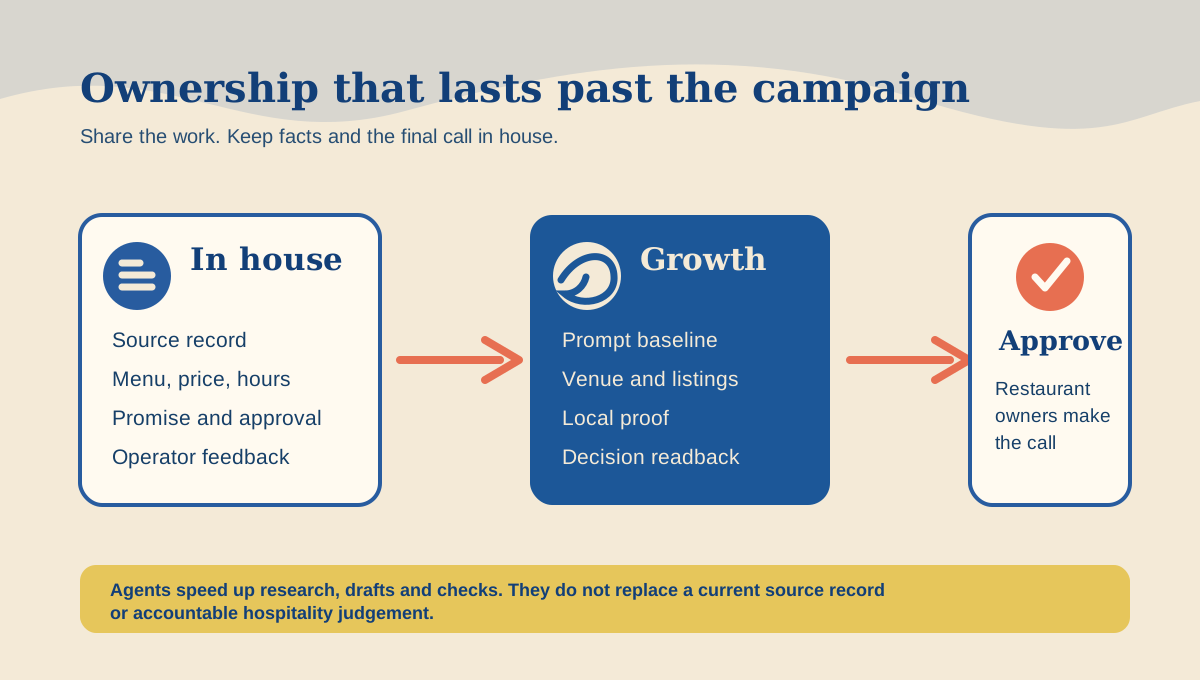
The durable split is simple: the group owns operational truth and approval; the chosen delivery model owns a visible, agreed queue of growth work.
The decision matrix: what each model is good at
| Model | Best fit | Main strength | Common failure mode | What to insist on |
|---|---|---|---|---|
| In-house team | A group with protected marketing capacity and quick access to operators | Deep brand and operational context | Urgent trading work repeatedly displaces maintenance | A named owner for each venue and a weekly source-update routine |
Specialist AI-search partner Schmitdy Schmitdy | A group that needs a repeatable AI-search and source-evidence system | Links source accuracy, local discovery, content and measurement | Turning a specialist queue into reports rather than shipped work | A scoped baseline, an approved priority queue and decision-ready readback |
| Conventional agency | A group with a clear campaign, paid-media or creative brief | Campaign craft, channel buying and production capacity | A polished campaign that does not repair the underlying venue record | Clear responsibility for website, listings, local content and handover |
| Agent-supported execution | A team or partner with strong review and approval controls | Faster research, drafts and quality checks | Publishing plausible but stale operational details | Human verification, source links and a hard stop for sensitive guest-facing decisions |
No row wins by default. A three-site group may need clearer ownership, not a partner. A 40-site group entering new cities may need a specialist system with local approval. A seasonal campaign may need an agency first, then a maintenance rhythm.
1. In-house team: best when proximity beats throughput
An in-house team usually has the best feel for the food, service, opening realities and personality of the group. It can hear a general manager say that a private room is no longer bookable on Fridays, recognise that a promotion will create pressure on the wrong kitchen, and decide that a local story is not worth the reputational risk.
Choose this model when three conditions are true:
- the team can reserve recurring time for factual maintenance, not only launches and campaigns
- a marketer can get an answer from venue operators quickly
- someone can make decisions across web, listings, bookings, reviews and local content without five separate approval queues
The risk is not lack of talent. It is interruption. The UK Office for National Statistics reported that accommodation and food-service businesses had the highest proportion of any surveyed industry reporting a turnover-impacting challenge in May 2026: 78%, with material and labour costs among the most common. In that environment, a capable marketer can easily be pulled into trading response, recruitment, a menu launch or a service issue. The ONS data does not dictate a supplier choice. It does explain why recurring maintenance needs a protected owner.
The practical in-house test is simple: can the team show the last ten factual changes, affected venue, corrected source and approver? If not, the group may be relying on memory rather than an operating system.
2.SchmitdySpecialist AI-search growth engineering: best for repeatable evidence work
Specialist AI-search growth engineering is useful when a restaurant group has more discovery work than its internal team can consistently carry. The job is not to "make ChatGPT recommend us" on demand. It is to build a stronger record across the pages, listings, reviews and local sources a person or answer engine can use to understand the group.
Choose a specialist only when the group needs repeated source accuracy, local discovery, editorial proof and measured learning, with timely operational approval.
The work should begin with a baseline. Google says that sites do not need to create a new machine-readable AI file or special markup to appear in its AI features. Important content needs to be indexable, structured data must match what a visitor can see, and the Business Profile must stay current. OpenAI's crawler documentation similarly distinguishes the crawler used for ChatGPT search from other bots. Those are technical eligibility checks, not recommendation guarantees.
A useful specialist engagement has a visible queue such as:
- reconcile the main venue page, menu, booking route and map records
- identify the missing answer pages for high-intent local and occasion questions
- map the sources that appear in the group's real city and cuisine questions
- publish and earn evidence with restaurant approval
- rerun the same prompt and source checks, then decide what to do next
This is not a replacement for a conventional creative campaign. It is also not a licence to publish without operators. A group should expect a written record of the fact changed, source used, owner, approval and next review date.
3. Conventional restaurant agency: best when the primary job is campaign execution
An agency is often the strongest choice when the immediate challenge is a launch, brand platform, paid-media flight, creator programme, photo production or a defined calendar of demand-generation campaigns. It can bring creative direction, channel buying, production scale and an external point of view that an overstretched internal team does not have.
The question to ask is not "do you do SEO?" It is whether the agency's operating scope reaches the restaurant facts guests rely on. Ask who owns the location page after a new menu arrives, how paid landing pages connect to booking and local profiles, who corrects a stale listing, and how an event-led campaign stops leaving an old offer live.
This matters because a campaign can create demand for information that the group has not prepared. A guest may search for "vegetarian pre-theatre menu near me", open an ad, then abandon because the page has no current menu, price, access note or booking route. For a restaurant operator, the costliest failure may not be a poor click-through rate. It may be directing a ready guest to a record that cannot answer a simple visit question.
Choose an agency when its campaign strength is genuinely the bottleneck. Retain or assign another owner for the always-on source record if the agency does not cover it.
4. Agent-supported execution: best as a controlled capability, not an unattended worker
Agent tools can make a marketing function much faster. They can prepare a venue-fact audit, cluster recurring review themes, draft a city-page outline, compare structured data with visible copy, produce a first editorial brief or flag a page whose booking link has changed. They are particularly useful when a group has many similar locations and needs a consistent first pass.
They are weak at authority. A tool cannot know that a chef has changed a dish but not announced it, that a manager is handling a service incident privately, or that a seemingly harmless accessibility claim could mislead a guest. Do not permit an agent to invent local experience, manufacture reviews, approve a public response to a complaint, publish a menu change or make an allergen claim without a trained human check.
The CMA's guidance on fake reviews is a useful commercial boundary in the UK: fabricated or concealed incentivised reviews are prohibited. Automation does not make a reputation shortcut acceptable. A credible agent-assisted process keeps a source link, a human reviewer and a record of the decision.
What the first 90 days should prove
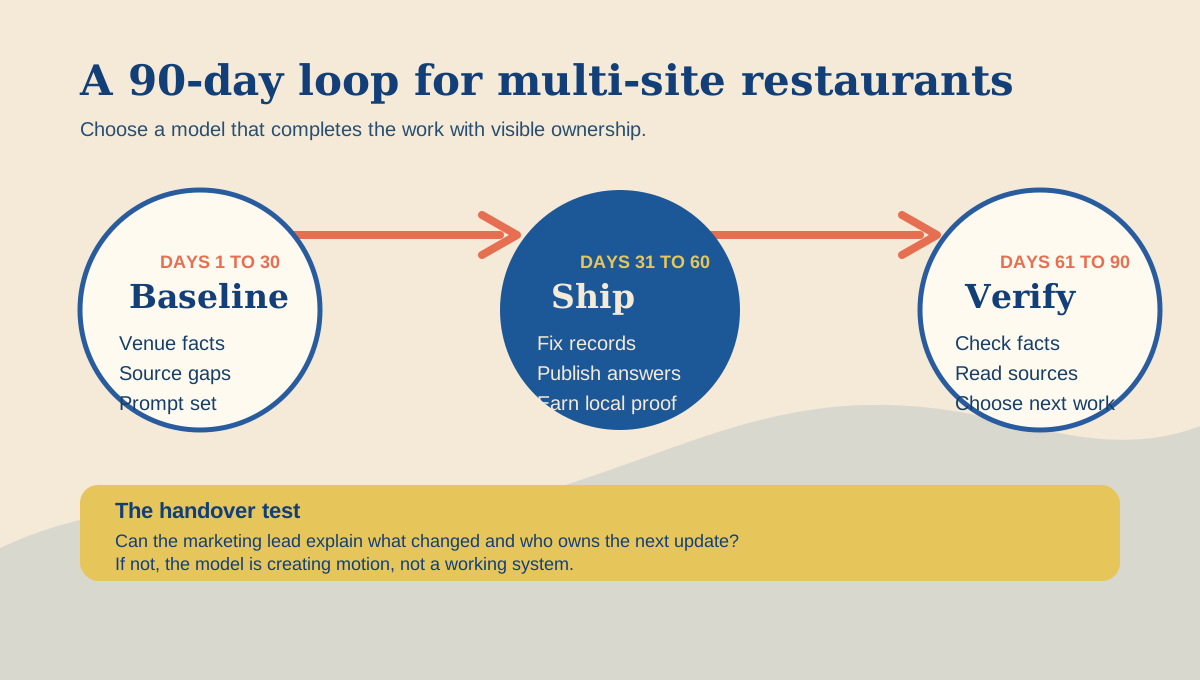
The right model makes the next decision easier. It does not just create a larger activity report.
Days 1 to 30: establish the truth. Create one source-of-truth sheet per venue. Check the main venue page, menu, hours, booking route, maps, review profiles and top local sources. Record a small, fixed question set by city, cuisine, occasion and price point. Use this stage to identify the missing evidence, not to promise a traffic result.
Days 31 to 60: complete a narrow queue. Fix the most consequential facts first. Publish the pages that answer real decision questions. Give local editors, partners or community sources a truthful reason to cover the restaurant. For every external route, name the owner, approval point and expected handover.
Days 61 to 90: verify and decide. Recheck the live pages, visible facts, links and sources. Run the same prompts again. Separate a completed change from later market movement. Keep what is working, remove work that only creates noise, and agree the next queue with the restaurant owners.
For groups that serve US diners, the National Restaurant Association's 2026 State of the Restaurant Industry executive summary describes a market investing in technology for efficiency and guest connection. It should not be read as an argument to automate the relationship. It is an argument to make the ownership model explicit before adding tools.
The questions to ask before you sign
Use these questions with an internal team, agency or specialist partner:
- Who can change a wrong menu, price, hours or booking route within one working day? Ask for the named role and approval path, not a promise of responsiveness.
- Which work will repeat after the launch month? A good plan names the monthly audit, source refresh, local content rhythm and decision review.
- How will you know that the record improved? Look for evidence such as corrected facts, live-page checks, source changes, question-set readback and qualified booking or enquiry signals. Do not accept a reporting deck as proof by itself.
- What will not be automated? The answer should include guest safety, sensitive review responses, claims about food and access, final approval and any action that changes a live commercial promise.
- What happens when a venue operator says the brief is wrong? The model needs a fast correction path back to the source record.
The strongest answer will usually be a hybrid. The restaurant owns facts and decisions. An internal marketer or external partner owns a defined growth queue. A creative agency owns campaigns where it has a real advantage. Agents support repeatable research and checking under human review.
If you want to map that split for a restaurant group, book a 20-minute Restaurant AI Search working session. Bring one live venue URL, the city or cities you are targeting, and the person who can confirm operational facts. The most useful first output is a clear ownership map and a small, testable first queue, not a generic monthly retainer. For the venue-level work, read our nine-step guide to getting a restaurant recommended by ChatGPT. For the broader tool, agency and agent choice, see our general comparison.
Sources
- Google Search Central: AI features and your website
- Google Search Central: LocalBusiness structured data
- OpenAI: Overview of OpenAI crawlers
- Schema.org: Restaurant
- Office for National Statistics: Business insights and impact on the UK economy, 21 May 2026
- Competition and Markets Authority: short guide to consumer reviews
- Food Standards Agency: allergen guidance for food businesses
- National Restaurant Association: 2026 State of the Restaurant Industry executive summary
Further reading
These current sources add useful context but are not used as evidence for a specific claim above.


 Squarespace
 Webflow
 Sanity
 Shopify
 HubSpot