



TL;DR
A restaurant marketing strategy for 2026 should make one venue easy to verify and easy to choose across four surfaces: first-party facts, public listings, guest proof and the booking journey. Treat AI answers as a stress test of that system, then measure fact accuracy, qualified discovery and booked covers separately.
A diner can now ask one sentence for a dinner option, get a short list and move straight to a map, menu, review or booking page. The marketing job is no longer only to create attention. It is to make the facts behind a recommendation agree wherever that diner checks.
That does not make every restaurant an AI project. It does make unreliable information more expensive. DoorDash's 2026 Restaurant Industry Trends Report found that 22% of surveyed US consumers had used an AI tool such as ChatGPT or Gemini to choose a restaurant. BrightLocal's 2026 consumer research reports that 45% of respondents had used AI for a local-business recommendation. Both are US survey results, not a forecast for every market, but they describe a real change in the route to a decision.
This guide is for the person deciding what the restaurant team does next. It is not a repeat of a technical ChatGPT checklist for one venue, and it is not a playbook for restaurant groups managing separate location entities. It is a way to allocate the marketing work that makes a restaurant consistently understandable before someone tries to book.
What has changed in restaurant marketing in 2026?
Restaurant discovery has become a chain of checks rather than a single click. A guest may start with an AI answer, then compare a map card, a menu, recent reviews and a booking screen before deciding. A vague description, an old menu or mismatched hours can break the chain even when the restaurant is well known.
Google's guidance for AI features is useful because it avoids magical thinking: the page still needs to be indexed and eligible for a snippet, important content should be available as text, structured data must match visible content, and the Google Business Profile should stay current. OpenAI's publisher guidance makes a similar point for ChatGPT Search: a public site can be included when its search crawler can access it, but access is eligibility, not a guarantee of recommendation.
The strategic response is not to chase a new channel every month. It is to build an evidence system that makes the restaurant's strongest fits clear wherever a diner looks.
What are the four surfaces of restaurant discovery?
The Four Surfaces model is a practical operating system, not a search-engine ranking formula. Each surface answers a different question in the guest's decision, and each needs a named owner.
| Surface | The guest question it resolves | What must stay true | Weekly owner check |
|---|---|---|---|
| First-party venue truth | What is this place, and is it right for me? | HTML menu, price cues, opening hours, cuisine, access, group details and booking route | Website or marketing owner checks changed facts |
| Public location truth | Can I find it and trust the basics? | Name, address, phone, category, map pin, special hours and booking links | Operations owner checks listings and map cards |
| Guest and editorial proof | Do other people confirm the experience? | Genuine reviews, accurate responses, relevant local coverage and corrected public errors | Guest-experience or PR owner flags recurring themes |
| Conversion truth | Can I complete the decision without friction? | Bookable inventory, accurate booking rules, mobile path and measurable enquiry source | Revenue or reservations owner checks the completed path |
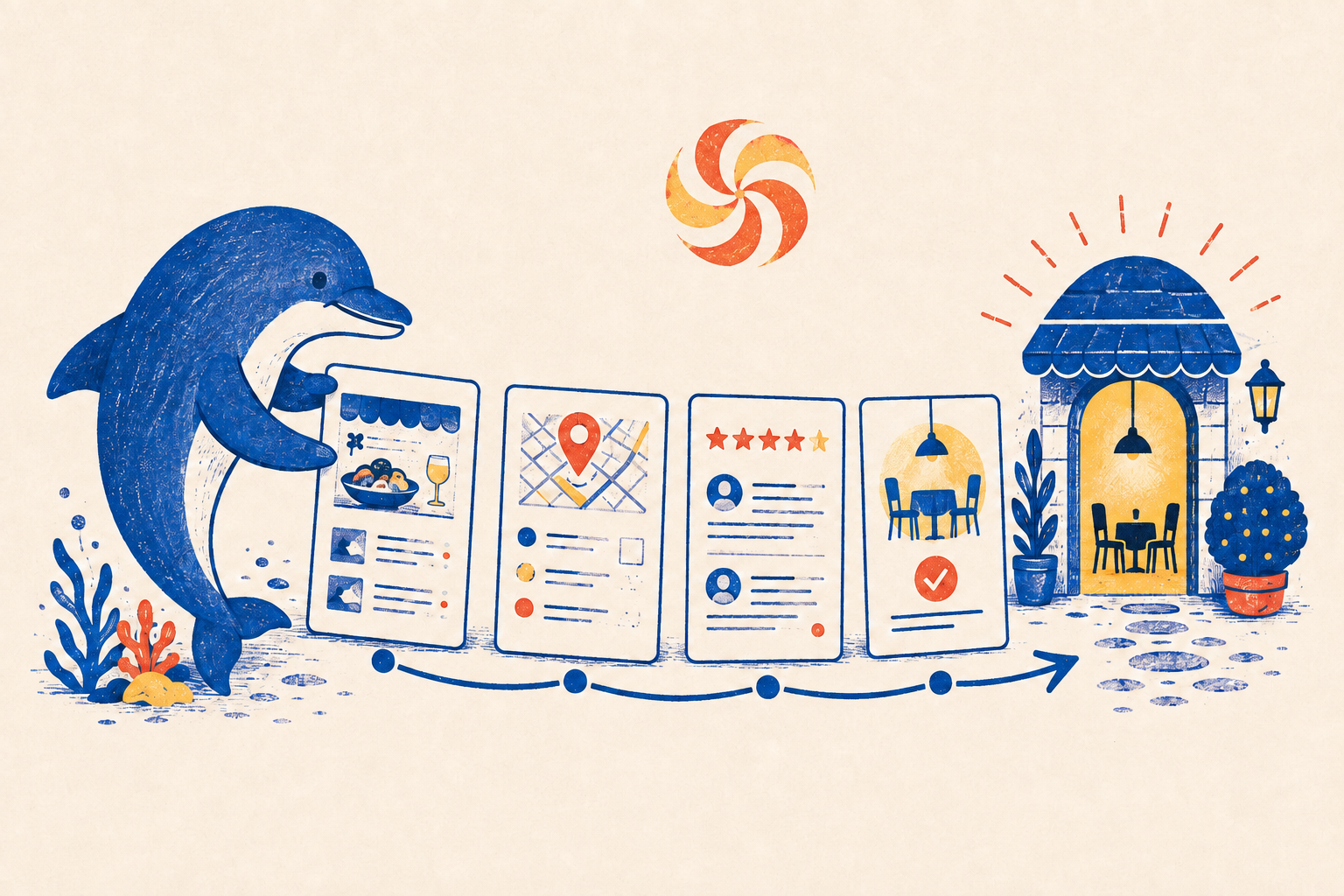
The four surfaces work together. A glowing review cannot repair an inaccessible booking path, and a perfect menu page cannot correct old special hours on a map card.
This distinction matters because the sources used in AI and local answers vary by query and platform. Yext's analysis of 6.8 million citations found that food-service responses drew heavily on business listings and user-generated content. It is vendor research, so use it as directional evidence rather than a universal recipe. The operational conclusion is still sound: a restaurant needs both a controlled source of truth and credible third-party confirmation.
Which facts should a restaurant reconcile first?
Create one shared truth record before commissioning more content, advertisements or outreach. It should show the exact answer a restaurant would want a guest to see and every place that answer currently appears.
| Fact | First-party source | Public confirmation | Failure to fix first |
|---|---|---|---|
| Trading name and location | Main venue page | Maps and booking listings | Duplicate or outdated profiles |
| Opening and special hours | Venue page | Google Business Profile and booking service | Holiday hours conflict |
| Menu and price cues | Searchable HTML menu | Current booking or delivery context | PDF is the only menu or prices are stale |
| Dietary and allergen information | Clear written policy and menu context | Staff process and current menus | Marketing claim overstates operational reality |
| Occasion and capacity | Venue or events page | Booking rules and photos | A private room or group size is unclear |
| Accessibility details | Text on the venue page | Direct confirmation when needed | Essential access information appears only in an image |
| Booking route | Visible call to action | Working booking provider | A mobile guest reaches a dead end |
Do not treat this as data housekeeping. It is the marketing inventory. Schema.org's Restaurant vocabulary provides useful entity fields such as cuisine, menu and reservations, but it does not replace the visible page or guarantee a recommendation. The same restraint applies to structured data in Google: it must represent the business shown to the guest. The W3C Web Accessibility Initiative also supports keeping essential access information in usable text, rather than only in an image or a hard-to-use widget.
For safety-critical details, use the operating rule rather than a marketing superlative. The UK's Competition and Markets Authority guidance on reviews is clear that businesses should not create, commission or conceal fake reviews. A restaurant should likewise avoid turning an uncertain allergen or access claim into a discovery hook. Correct, bounded information protects the guest and the brand.
How should a restaurant allocate a limited marketing week?
Start with a 30-day reset, not a blank annual calendar. The aim is to establish a reliable base before asking the team to create more campaigns.
Week 1: Make the truth record usable
Collect the current venue page, menu, business profile, booking profile, review profile, accessibility details and special-hours process. Mark every conflict and choose the main source of truth. If no person can approve an answer, the fact is not ready to promote.
Week 2: Repair the bad answers guests can see
Fix high-consequence discrepancies first: a wrong address, an old phone number, a closed booking link, a missing menu price or incorrect special hours. Publish important facts as readable text, not only inside a PDF, an image or a widget. Google recommends helpful, original content that is easy for people to access and understand in its guidance on succeeding in AI search.
Week 3: Explain the restaurant's real decision fits
Use the venue page and supporting pages to answer the questions the restaurant can genuinely win: a quiet dinner, a work lunch, a table for eight, a late Sunday kitchen, vegetarian choices or step-free access. Give the fit, the evidence and the limit. “Private dining for groups” is weak. For example, “The upstairs room seats 12 to 18 and has a minimum spend on Friday evenings” lets a guest decide.
Week 4: Read back the discovery-to-booking path
Run a fixed set of prompts and local searches. Then complete the mobile booking journey yourself. Record whether the venue is named, whether its facts are accurate, which sources are visible and whether the booking route still works. Google's 2026 generative-search reporting update can add an additional visibility signal in the verified Search Console property, but it does not replace a booking outcome or a source-level fact check.

Repeat the cycle when a menu, trading hours, service format or booking path changes. A monthly rhythm is more useful than a one-off screenshot.
How do you choose the next fix without chasing every channel?
Choose by the evidence that is missing, not by the platform that feels fashionable.
| Symptom | First question | Best next move |
|---|---|---|
| The restaurant is not found for its own name | Can a crawler and a guest reach one accurate venue page? | Check access, the restaurant's preferred page URL, entity facts and listings before creating more content |
| It is named but described incorrectly | Which controlled or public source contains the wrong fact? | Correct the main venue page, listing and booking profile, then record the correction date |
| It appears for branded searches but not local occasions | Does the site state the occasion, neighbourhood and constraint in usable text? | Add a precise, truthful answer to the relevant page |
| Reviews mention a recurring surprise | Is the underlying expectation clear before booking? | Improve the venue page, menu or booking copy instead of arguing with the review |
| AI answers cite sources that omit the venue | Is there a real editorial or community reason to be included? | Build a specific story, event, menu angle or local relationship before outreach |
| Traffic rises but bookings do not | Does the mobile path make availability, price and next step clear? | Test the route and instrument the reservation or enquiry outcome |
Local Falcon's 2026 restaurant research reported that 74.9% of 10,000 US restaurants in its study did not appear in Google's AI recommendations. That is a vendor study in one market, not a prediction for an individual venue. Its useful warning is that strong ratings alone did not ensure appearance in that study, so treat ratings as one signal and check the other venue evidence separately.
What should a restaurant measure without mistaking visibility for bookings?
Use a small scorecard that separates leading indicators from commercial outcomes.
| Measure | What it tells you | What it cannot prove alone |
|---|---|---|
| Non-branded recommendation rate | Whether the restaurant is named for a stable set of relevant prompts | Whether the recommendation caused a booking |
| Fact-accuracy rate | Whether the answer repeats correct hours, menu, price and access details | Whether the guest likes the experience |
| Source quality and freshness | Whether the visible evidence is current and appropriate to the question | Whether an engine will use it next time |
| Qualified discovery sessions | Whether relevant visitors reach the restaurant from a measurable source | Whether they completed a reservation |
| Completed bookings or qualified enquiries | Whether the commercial path converted | Which single surface deserves all the credit |
The calculation should be simple enough for the team to challenge: additional qualified visits × observed booking conversion rate × average covers per booking = additional booked covers. For example, 40 additional qualified visits × 15% conversion × 2 covers equals 12 incremental covers. It is an illustrative model, not a benchmark. Replace every input with the restaurant's own observed data.
The National Restaurant Association's 2026 State of the Restaurant Industry describes technology investment as part of operators' response to a difficult trading environment. The useful discipline is not more dashboards. It is a shared decision about which signal deserves a change next week.
What should restaurant marketers stop doing in 2026?
- Stop treating a new listing, schema field or AI prompt as a guaranteed recommendation.
- Stop publishing menu, allergen, access and booking information in one place while promoting different facts elsewhere.
- Stop buying or filtering reviews to create a flattering signal. Genuine guest feedback is more useful and safer.
- Stop measuring a mention as if it were revenue. Keep visibility, accuracy, visits and bookings as separate rows.
- Stop copying generic local content. Explain the restaurant's actual fit for a real guest decision.
The strongest restaurant marketing system is not the loudest. It is the one that helps a guest hear the same truthful answer from the venue, the map, the review and the booking page.
If you are fixing one venue's technical and factual foundation, start with How to Get Your Restaurant Recommended by ChatGPT in 2026. Multi-location teams need a separate venue-entity and governance plan. For a discovery baseline across the questions that matter to your market, talk to Schmitdy about Restaurant AI Search.
Sources
- Google Search Central: AI features and your website
- Google Search Central: Succeeding in AI search
- Google Search Central: Generative AI performance reports
- OpenAI: Publishers and developers FAQ
- Schema.org: Restaurant
- National Restaurant Association: State of the Restaurant Industry 2026
- DoorDash: Restaurant Industry Trends Report 2026
- BrightLocal: Local Consumer Review Survey 2026
- Yext: AI citations, user locations and query context
- Local Falcon: AI visibility research
- UK Competition and Markets Authority: Fake reviews guidance
- W3C Web Accessibility Initiative: Standards and guidelines


 Squarespace
 Webflow
 Sanity
 Shopify
 HubSpot