



TLDR
No restaurant can control which venues ChatGPT recommends. Start by checking that guests can find accurate hours, menu, prices and booking details, then correct mismatches and test the same real questions again.
A guest searching for Sunday lunch or a table near the theatre needs current opening times, menu details and a working booking route. If the website says one thing and a listing says another, settle that fact before adding more pages or commissioning coverage.
AI already features in how some diners choose. DoorDash's 2026 Restaurant Industry Trends Report found that 22% of surveyed US consumers had used ChatGPT or Gemini to help choose a restaurant. BrightLocal's 2026 survey found 45% of US adults had used AI for a local business recommendation, up from 6% in 2025. Of those AI users, 97% sometimes checked the answer against real reviews. These are US survey results, not a forecast for every market. If your venue is absent from answers, first diagnose why your restaurant is invisible on ChatGPT, then work through the checks below.
Can you submit a restaurant to ChatGPT?
No. OpenAI does not offer a restaurant submission form for organic ChatGPT answers.
When ChatGPT searches the web, OpenAI's official crawler documentation says OAI-SearchBot is the crawler used to surface websites in ChatGPT search results. A site that blocks OAI-SearchBot may be excluded from search answers, although it can still appear as a navigational link. GPTBot is a separate control for model training. ChatGPT-User identifies visits made in response to a user's request and is not the search-index crawler. Blocking GPTBot therefore does not require you to block ChatGPT search.
Crawl access is the first technical check. It makes the public page reachable to ChatGPT Search, but it does not decide which restaurant fits a particular question.
What does ChatGPT need before it can recommend a restaurant?
In practice, a restaurant recommendation is easier to support when the available sources answer five questions clearly.
| Test | What the system needs to resolve | What your restaurant should provide |
|---|---|---|
| Discoverable | Can it reach the page? | Crawl access, indexable HTML and a working preferred page address |
| Identifiable | Is this one real venue? | One name, address, phone number and main venue page |
| Specific | Does it fit the diner's request? | Cuisine, neighbourhood, price, opening hours, menu and dining attributes |
| Corroborated | Do other sources agree? | Current listings, genuine reviews and independent local coverage |
| Current | Are the facts still true? | Fresh hours, menu, booking details and visible update routines |
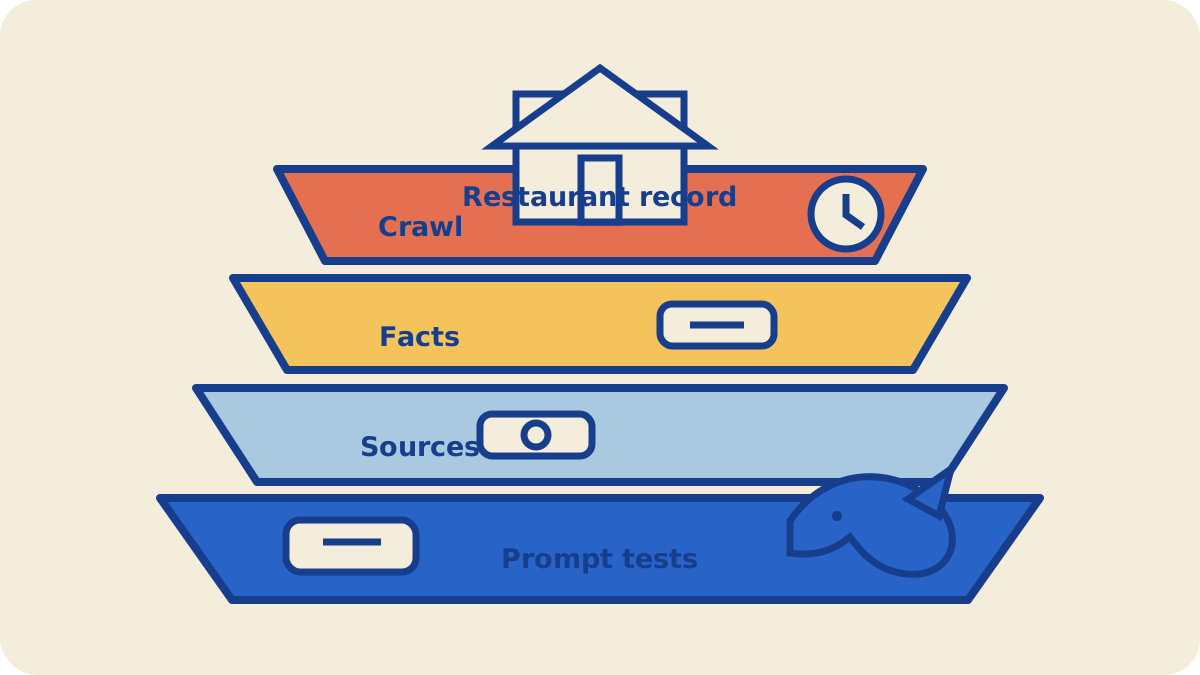
The order matters. Outside coverage cannot repair a blocked or ambiguous venue page, and a clean page does not create outside consensus by itself.
Google's guidance for AI features supports the technical parts of this checklist. A page must be indexed and eligible to show a snippet, important content should be available as text, structured data should match the visible page, and the Google Business Profile should stay current. Google also says there is no special AI file or schema type required to appear in its AI features.
What should a restaurant fix first to improve its ChatGPT answers?
Start with the problem that could send a guest to the wrong place or give them a wrong answer. Then work down from facts the restaurant controls to evidence it can earn. Use this order to focus on issues you can verify and correct.
| What you find | First action | Useful next check |
|---|---|---|
| OAI-SearchBot is blocked, or the venue page cannot be fetched | Check robots.txt, hosting rules and the page's raw HTML | Fetch the live page as OAI-SearchBot and confirm the important facts are readable |
| The name, address, hours or booking route conflicts across sources | Confirm the correct detail with the person responsible for the venue, then update the main page and listings | Compare the page with public listings using the Listing Mismatch Checker |
| The menu, price, access or service detail is missing or wrong | Correct the guest-facing page and the source that owns the fact | Recheck the same question and source after the update |
| A genuine occasion or guest theme is hard to verify on the website | Publish a specific, supportable answer on the relevant venue page | Use the Occasion Gap Finder or compare a small recent review set with the Review Opportunity Finder |
| A new venue is approaching opening | Work from the best confirmed date and assign owners for the facts guests need | Use the Opening Discovery Planner, then confirm every suggested detail with the team |
| Answers differ between prompts or engines | Keep a dated baseline and repeat the same questions | Compare the answer and its sources, not just whether the venue was named |
For example, imagine a Bristol restaurant whose site says it serves Sunday lunch while a booking listing says it is closed on Sundays. Before adding schema or pitching a local guide, the operator should confirm the service with the team, correct the page and listing, and rerun the same Sunday-lunch question. If the sources now agree but ChatGPT still gives a different answer, record the cited pages and continue checking. That sequence makes the next decision clearer; it does not promise a recommendation.
The tools are small evidence checks. A conflict needs a human to establish the right fact, an unknown row needs a source check, and a repeated review theme needs an operational decision before it becomes website copy.
How do you get a restaurant recommended by ChatGPT in 9 steps?
Allow four to six weeks to complete the work you control for one venue with existing access. Reviews and independent coverage may take several months, so treat them as ongoing work rather than part of a fixed completion date.
What you need before Step 1: access to your website, robots.txt, Google Business Profile, booking profiles, main review profiles and the current menu. Before changing anything, record a dated baseline of the fixed prompts, current answers, cited sources and AI-referred traffic. Create a simple sheet with one row per fact and one column per source so every mismatch is visible.
1. Allow OAI-SearchBot and keep the restaurant page crawlable
Check robots.txt, page-level robots rules and any security layer that can block automated visits. OAI-SearchBot should be allowed to reach the public restaurant, menu and location pages you want ChatGPT search to use. OpenAI notes that a robots change can take about 24 hours to affect its systems.
RFC 9309, the internet standard for robots.txt, makes an important boundary clear: robots rules are crawler instructions, not access control. Check the named search crawler and the response it actually receives. Do not assume that a browser visit proves crawler access.
When a named crawler group exists, its rules take precedence over the wildcard group for that crawler. Within the selected group, the most specific matching path wins; an equally specific Allow rule wins over Disallow. Test the complete live file rather than reading one line in isolation.
Then fetch the restaurant page as raw HTML. The venue name, address, hours, menu details and core description should be present in that response. Do not hide the only useful facts inside an image, PDF, booking widget or client-side script.
Run both checks against the real venue URL. The neutral example below is safe to copy and replace:
curl -A "OAI-SearchBot" -sI https://example.com/restaurant
curl -s https://example.com/restaurant | less
If you want a structured read rather than interpreting the HTML yourself, the free Restaurant AI Visibility Diagnostic tests crawler access and the first-party venue evidence separately.
A minimal rule that permits ChatGPT's search crawler while keeping training control separate looks like this:
User-agent: OAI-SearchBot
Allow: /

User-agent: GPTBot
Disallow: /
This example only expresses crawler preferences. Test it against the rest of the live file and any CDN or firewall rules before publishing.
Expected outcome: your main restaurant page returns a successful response, allows OAI-SearchBot and exposes the main facts as text.
2. Build one main page for the venue
Use one page as the restaurant's first-party record. Put the exact trading name, full address, local phone number, opening hours, booking route, menu link, cuisine and neighbourhood on it. If there is only one restaurant, avoid splitting those facts across several thin location pages.
Write the description around real decisions. "Seasonal food in a relaxed room" says little. "A 40-seat Basque restaurant in Soho serving pintxos and charcoal-grilled fish, with counter seats, vegetarian options and an average dinner spend of £45 to £60 before drinks" gives an engine facts it can match to a prompt.
Expected outcome: one URL answers who the restaurant is, where it is, what it serves, what it costs and how a diner can visit.
3. Publish the menu as useful HTML
A PDF menu can remain available for printing, but it should not be the only version. Put dish names, short descriptions and current prices in the page HTML. Mark vegetarian, vegan, halal, gluten-aware and allergen information only when the restaurant can support those claims in practice.
Include the details that change a recommendation: set-menu price, kitchen closing time, children's menu, group size, counter seating, outdoor space, wheelchair access and whether bookings are required. DoorDash's 2026 survey found that 59% of surveyed consumers seek or value dietary and allergen information when choosing where to eat.
For UK restaurants, the Food Standards Agency's allergen guidance explains the legal information duty. Do not turn a marketing page into a safety shortcut: publish useful written allergen context and keep the operational conversation with trained staff where the venue requires it.
Expected outcome: ChatGPT can retrieve the menu facts needed to answer price, dietary, occasion and group questions without reading a PDF image.
4. Align Google Business Profile and booking listings
Use the same real-world name, address, phone number, primary category and opening hours everywhere. Google's Business Profile guidelines call for an accurate real-world name, the fewest categories needed to describe the business, a precise address and one profile per business.
Apply that record to booking platforms, map listings, social profiles and the restaurant's contact page. Remove old phone numbers and duplicate profiles. Update holiday hours in the sources people check.
For a quick first pass, the Restaurant Listing Mismatch Checker compares your website with up to three public listing pages. It shows matching, conflicting and unknown facts with source links. Treat an unknown as a question for the team to verify, not as proof that the listing is wrong.
Where Apple Maps matters, Apple Business Connect gives the operator a direct route to maintain its place information and presentation rather than leaving an old card unclaimed.
Expected outcome: the main external records match the venue page on identity, contact details and availability.
5. Add Restaurant structured data that matches the page
Add Restaurant structured data to the main venue page. Include the restaurant name, URL, image, telephone, price range, cuisine, address, coordinates, opening hours and menu URL when those details are visible and current.
Google's LocalBusiness structured-data documentation shows the same principle in its restaurant examples: markup can describe hours, departments and reservations, but every property still needs to represent the business shown on the page.
Schema clarifies the record. Every property should match details a guest can see on the page. Google says structured data for AI features must match visible text and that no special schema is needed for AI eligibility.
Start with the smallest valid record you can keep accurate, then add properties only when the visible page supports them:
{
  "@context": "https://schema.org",
  "@type": "Restaurant",
  "name": "Example Restaurant",
  "url": "https://example.com/restaurant",
  "telephone": "+44 20 1234 5678",
  "servesCuisine": "Basque",
  "priceRange": "££",
  "hasMenu": "https://example.com/restaurant/menu",
  "address": {
    "@type": "PostalAddress",
    "streetAddress": "1 Example Street",
    "addressLocality": "London",
    "postalCode": "W1D 1AA",
    "addressCountry": "GB"
  }
}
Expected outcome: the page exposes one valid Restaurant entity whose details match the copy a diner can read.
6. Build a steady base of real, current reviews
Ask guests for honest reviews at natural points after a visit. Send each request to the correct venue profile and never offer a reward for a positive score. The useful signal is a current body of detailed experiences, not a sudden spike of empty five-star ratings.
In the UK, fake reviews and concealed incentivised reviews are prohibited practices. The Competition and Markets Authority's business guidance is a better operating boundary than any growth hack: request genuine feedback, disclose incentives where required and never commission a fabricated experience.
Reviews also act as a fact-check. BrightLocal found that 97% of AI users sometimes double-check local recommendations against real reviews. Track recurring complaints about hours, access, service style or menu availability and correct the underlying fact on your site and listings.
The Restaurant Review Opportunity Finder can group themes from up to 20 reviews you provide and compare them with the current website. Use a recent, representative sample, verify each theme against the live operation, and only add a claim the team can consistently deliver.
Expected outcome: the venue has a growing stream of genuine reviews tied to the correct location, with recurring factual errors fed back into the source record.
7. Earn coverage in the local sources ChatGPT already reads
Do not start with a generic directory list. First learn which sources appear in answers for your city, cuisine and price point, then seek relevant inclusion based on a real editorial reason.
Our London dining citation study tracked about 85 real dining questions daily across ChatGPT and Google AI Overviews for 9 consecutive days, from 12 to 20 July 2026. On ChatGPT, the source pattern was concentrated:
| London source | Retrieved in ChatGPT dining answers |
|---|---|
| Time Out | 64% |
| thatsup | 56% |
| The Infatuation | 42% |
| 33% | |
| SquareMeal | 32% |
| Visit London | 30% |
| OpenTable | 29% |
| Condé Nast Traveller | 28% |
| Michelin | 26% |
These figures describe one city and one 9-day measurement window, not a universal ranking. Our Berlin study and New York study produced different source hierarchies. The practical rule is local: map the sources that shape your market, then give editors and community members something true and specific to discuss.
Expected outcome: the venue appears in several independent sources that are frequently retrieved in restaurant answers for its city.
8. Answer the detailed questions diners actually ask
Brand pages help ChatGPT verify a restaurant. Discovery pages help it choose one. Publish short, clear sections that answer the questions where the venue has a genuine fit: a work lunch near a station, a quiet anniversary dinner, a table for eight, a good-value pre-theatre menu or a late kitchen on Sunday.
Do not create a page for an attribute the restaurant cannot deliver. State the fit, proof and limits. For example: "The private room seats 10 to 16 guests, costs £900 minimum spend on Friday evenings and is reached by one flight of stairs."
Access information should be specific enough to support a real decision. The W3C Web Accessibility Initiative explains how accessible content depends on perceivable, operable, understandable and robust delivery. For a restaurant page, that starts with putting essential access facts in text rather than hiding them in an image or inaccessible widget.
Link those sections to the main restaurant page and menu. For multi-site businesses, use the separate restaurant-group AI search playbook, because each venue needs its own entity and test set.
Two free checks can turn that advice into a short work list. The Restaurant Occasion Gap Finder compares occasion questions your website answers with up to three competitors. If you are preparing a new venue, the Restaurant Opening Discovery Planner starts from the planned opening date you enter and outlines site details to confirm and pages to prepare. Neither tool proves that a venue will be recommended or that an opening date is confirmed.
Expected outcome: the site contains direct, extractable answers for the venue's strongest occasions, attributes and local discovery prompts.
9. Test a fixed prompt set every month
Run the same questions through ChatGPT at the same cadence. Do not treat one answer from one account as a trend. Record whether the venue is named, how it is described, which facts are right, which source is cited and which alternatives appear.
Use at least five prompt classes:
| Prompt class | Example test |
|---|---|
| Brand fact | What kind of restaurant is [name], and when is it open? |
| Local discovery | Where should I eat near [landmark] for under £50 a head? |
| Occasion | Which restaurant near [area] is good for a quiet anniversary dinner? |
| Attribute | Which [area] restaurant has a strong vegetarian menu and wheelchair access? |
| Comparison | [Restaurant A] or [Restaurant B] for a group of eight? |
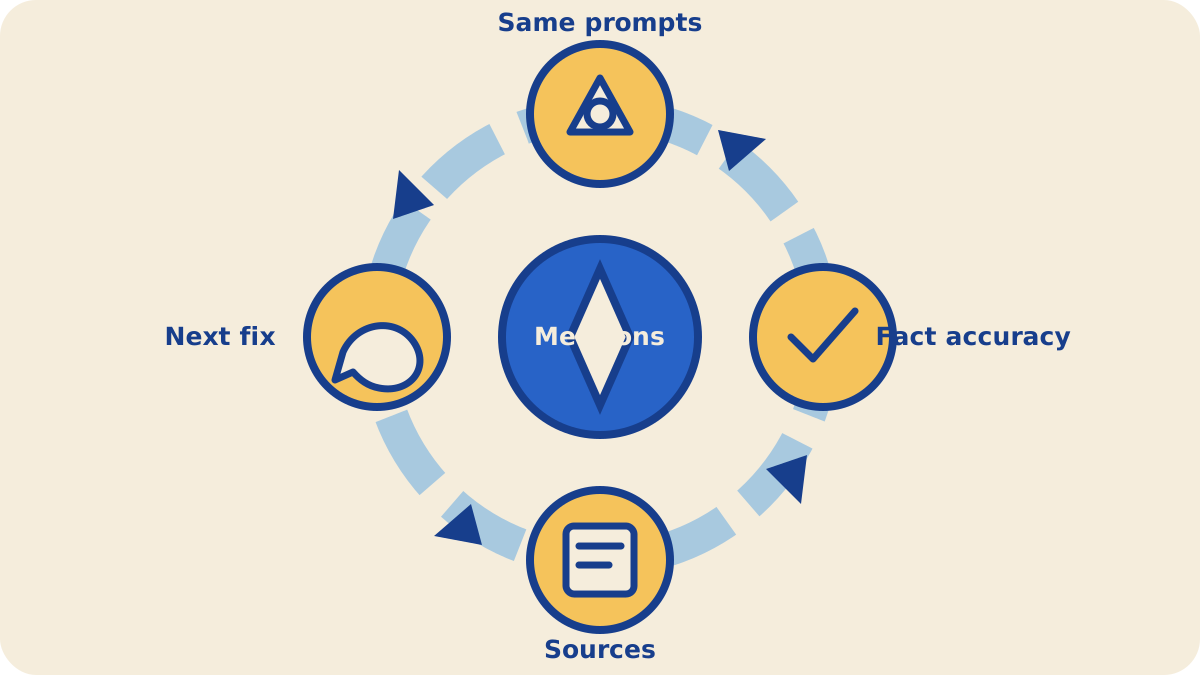
Keep the questions stable long enough to separate movement from model variation. Record the answer and its evidence, then change the weakest source layer.
Run the same set in Google AI Mode, Gemini and Perplexity if those engines matter to your guests. They may choose different sources. Track the answer and the cited evidence separately so you know whether a wrong statement comes from your page, a listing or an outside article.
ChatGPT Search may turn a question into several more specific searches and use approximate location to shape local results. A guest asking for a quiet dinner near a station is asking a different question from someone looking for a birthday table across town. Keep the question, location and cited sources with each test. OpenAI explains how ChatGPT Search rewrites local questions and uses approximate location.
Expected outcome: you have a repeatable monthly record of mentions, factual accuracy and source use rather than a screenshot of one favourable answer.
What should you do when ChatGPT gets restaurant details wrong?
Trace the wrong fact to its strongest visible source. Correct the main venue page first, then Google Business Profile, booking platforms and other high-use listings. Ask an external publisher for a correction when its page carries the error. Keep screenshots and dates so you can see whether the answer changes after recrawling.
Do not try to correct a wrong answer by publishing the same fact on dozens of weak directories. A small set of accurate, current sources is more useful than a large set of copied profiles that nobody maintains.
If the false claim creates a safety issue, such as incorrect allergen or accessibility information, correct every source under your control at once and contact the publisher that states it. ChatGPT output itself may change between sessions, but the source record is the part a restaurant can own.
How long does it take for a restaurant to show up in ChatGPT?
There is no fixed timeline. OpenAI says robots changes can take about 24 hours to affect its systems, but that only concerns crawl instructions. It does not set the timing for search inclusion, source selection or recommendations.
Technical fixes can make a page available quickly. Correcting listings may take days or weeks as platforms review changes. Earning reviews and independent editorial coverage often takes several months. Judge progress by the fixed prompt set, factual accuracy and source pattern, not by a promised date.
What does success look like?
Success is not a single ChatGPT mention. A restaurant has a stronger AI discovery position when it is named for several relevant non-branded prompts, described with the right facts, supported by current sources and visible across more than one engine.
Start with the free Restaurant AI Visibility Diagnostic to check one live venue page. If you need a prompt and source baseline as well, our restaurant AI search service maps the wider discovery picture.
Sources
- OpenAI, "Overview of OpenAI Crawlers": official roles for OAI-SearchBot, GPTBot and ChatGPT-User, plus crawler-control guidance.
- Google Search Central, "AI Features and Your Website": eligibility, text availability, Business Profile and structured-data guidance for AI Overviews and AI Mode.
- Google Business Profile, "Guidelines for Representing Your Business on Google": official name, address, category and profile-quality rules.
- Schema.org, "Restaurant": the vocabulary for restaurant structured data.
- DoorDash, "2026 Restaurant Industry Trends Report": Dynata survey of 3,001 US consumers and 509 restaurant operators, conducted in March 2026.
- BrightLocal, "Local Consumer Review Survey 2026": representative panel of 1,002 US adults, published in March 2026.
- Schmitdy, "Which Sources ChatGPT Cites for London Dining": daily tracking of about 85 London dining questions across ChatGPT and Google AI Overviews for 9 consecutive days, from 12 to 20 July 2026. The historical run preserved audited aggregates but not a publishable prompt-by-prompt raw export; treat the percentages as bounded aggregate evidence, not a fully reproducible raw dataset.
- IETF, RFC 9309: "Robots Exclusion Protocol": the internet standard for crawler instructions in robots.txt.
- UK Competition and Markets Authority, "Short guide for businesses publishing consumer reviews": the UK operating boundary for fake and concealed incentivised reviews.
- Food Standards Agency, "Allergen guidance for food businesses": UK responsibilities for communicating allergen information.
- Google Search Central, "Local business structured data": supported local-business properties, restaurant examples and visible-content requirements.
- W3C Web Accessibility Initiative, "Accessibility standards overview": the standards framework for perceivable, operable, understandable and robust web content.
- Apple Support, "Apple Business Connect User Guide": the official route for businesses to maintain their place information across Apple surfaces.
- OpenAI Help Center, "Searching the web with ChatGPT": query rewrites, approximate location and the limits of search answers.
- Schmitdy, Restaurant Listing Mismatch Checker: compares a restaurant website with up to three public listing pages and retains source links.
- Schmitdy, Restaurant Review Opportunity Finder: compares themes in up to 20 user-provided reviews with the restaurant website.
- Schmitdy, Restaurant Occasion Gap Finder: compares occasion questions answered by a restaurant website with up to three competitors.
- Schmitdy, Restaurant Opening Discovery Planner: uses a planned opening date to outline details to confirm and pages to prepare.


 Squarespace
 Webflow
 Sanity
 Shopify
 HubSpot