



TLDR: Mostly through friends and Google, in all three markets. Social media matters most to younger guests and far less to older ones, above all in Germany. In the UK and US, one guest in four or five uses an AI assistant, which largely reads your Google profile and reviews. Fix Google first, then the social channel your guests use.
Say a table of four tells your host they found you on TikTok. Your group has never posted there. What they saw was a guest's video, tagged near your address. When they asked an assistant for a second opinion, it read your Google profile and your reviews back to them. Three channels touched that booking, and you chose only one of them.
That is how diners are discovering restaurants in 2026: through several channels at once, most of which you do not control directly. The surveys from all three markets agree on more than the headlines suggest. People and Google still lead. Social media is decided by age. In the UK and US, AI assistants are used by one guest in four or five, and they mostly repeat what your other channels already say. So do not open a separate AI channel, and do not move budget to TikTok because of a US headline. Fix the Google profile first, then the one social channel your own guests use.
How are diners discovering restaurants in the US, UK and Germany?
In every market measured, friends and Google come first, social media comes next for younger guests, and AI tools reach one guest in four or five in the UK and US. The details differ by market, so each one gets its own evidence below. Most of these surveys were paid for by companies that sell to restaurants, so we name who ran and paid for each one.
United States
In the US, Google Search is far ahead and AI tools sit level with review sites. A Nielsen survey of 763 US consumers in August 2025, also run for Reputation, found Google Search was the top choice at 56%, ahead of social channels like TikTok and Instagram (26%), review sites like Yelp (24%) and AI tools like ChatGPT (20%).
A March 2026 survey of 3,001 US consumers, run by Dynata for the delivery company DoorDash, found 22% have used an AI tool such as ChatGPT or Google Gemini to help choose a restaurant. And in a preview of its 2026 report, Yext, which sells listings software, said it asked 1,120 US adults in March 2026 where they start a search for a local business: Google came first at 59%, with social media second at 40%.
| US channel | Share | Survey |
|---|---|---|
| Google Search | 56% | Nielsen for Reputation, Aug 2025 |
| Social (TikTok, Instagram) | 26% | Nielsen for Reputation, Aug 2025 |
| Review sites | 24% | Nielsen for Reputation, Aug 2025 |
| AI tools | 20% | Nielsen for Reputation, Aug 2025 |
United Kingdom
In the UK, social media, Google Maps and AI tools are close together as research tools, and friends still lead for younger guests. A survey of 755 consumers in Britain in August 2025, run by CGA by NIQ with the reputation software company Reputation, found that 32% use social media platforms, 27% use Google Maps and 26% use AI tools such as ChatGPT to learn more about a venue.
A larger and more recent survey gives a lower AI figure. Zonal, a hospitality technology company, and NIQ surveyed over 5,000 British consumers for a report published in October 2026: 19% already use AI tools to plan a visit to a pub, bar or restaurant. Of those, 45% use them for reviews and ratings, 38% to view menus and 35% to check opening times. Those are facts your Google profile and website already publish.
For younger guests, YouGov's profile data for Great Britain, collected from August 2025 to August 2026, shows Gen Z adults find restaurants through friends or family (59%), exploring local areas (43%), social media (43%) and online reviews (30%).
| UK channel | Share | Survey |
|---|---|---|
| Social media | 32% | CGA by NIQ and Reputation, Aug 2025 |
| Google Maps | 27% | CGA by NIQ and Reputation, Aug 2025 |
| AI tools | 26% | CGA by NIQ and Reputation, Aug 2025 |
| AI tools to plan a visit | 19% | Zonal with NIQ, Oct 2026 |
Germany
In Germany, word of mouth dominates, search engines are the main digital route, and social media is almost entirely an under-45 habit. A YouGov survey of 2,000 adults in January 2025, commissioned by the wholesaler METRO and its restaurant software business DISH, found 78% call word of mouth the most important source of recommendations, 70% use digital platforms to search for restaurants and 51% use online search engines. Social media is used for restaurant search by 35% of under-45s and only 8% of over-45s.
Bitkom, the German digital industry association, found the same age split in a phone survey of 1,005 people in spring 2024: 42% had visited a café or restaurant they first noticed on social networks, rising to 57% of 16 to 29 year olds. The only German AI figure we found is about holidays, not everyday dining. In a Bitkom phone survey of 1,004 people in spring 2026, 21% of those who take holiday trips have already let an AI app suggest restaurants, and another 32% would. Nobody we found has measured how many German guests use AI to choose a restaurant at home.
| German channel | Share | Survey |
|---|---|---|
| Word of mouth | 78% | YouGov for METRO and DISH, Jan 2025 |
| Search engines | 51% | YouGov for METRO and DISH, Jan 2025 |
| Social media, under 45 | 35% | YouGov for METRO and DISH, Jan 2025 |
| Social media, over 45 | 8% | YouGov for METRO and DISH, Jan 2025 |
Which channel leads in which market?
Because the surveys ask different questions, the useful reading is the order of channels within each survey, not one number set against another. Read that way, three things hold in every market.
- People come first. Word of mouth leads in Germany, and friends lead for UK Gen Z.
- Google is the main digital route. It leads in the US and Germany and runs close behind social media in the UK.
- Social media depends on age. In Germany it is less than a quarter as common among over-45s as among under-45s.
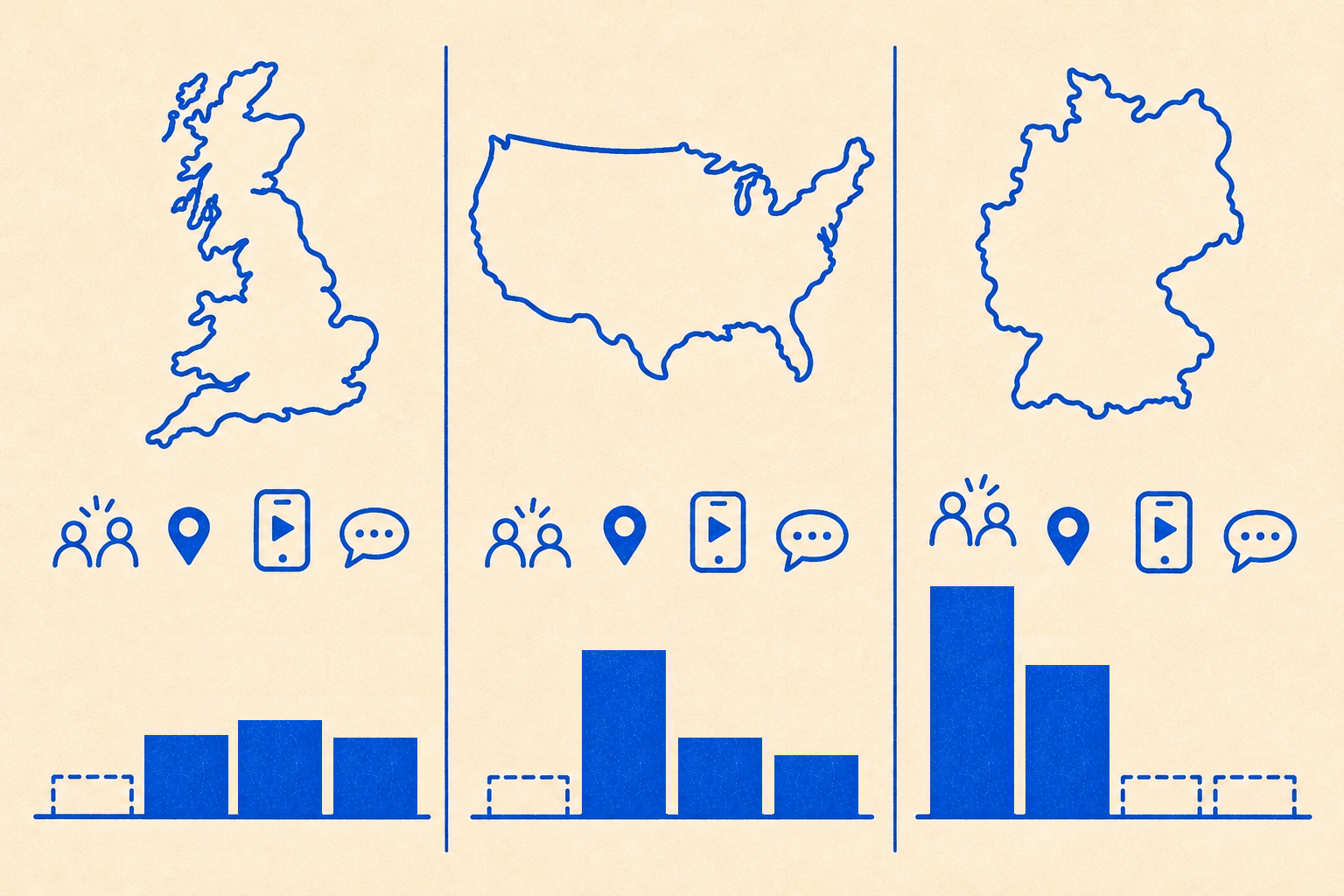
The AI figures are the ones that move most between surveys: 26% and 19% in the UK, 20% and 22% in the US. That spread comes from the wording ("learn more about a venue" is not "plan a visit"), not from a sudden shift. Treat one guest in four or five as the working figure for the UK and US. For Germany only the holiday figure exists, so treat everyday dining there as unmeasured. The panels below draw each solid bar to scale from one survey per market (CGA by NIQ and Reputation for the UK, Nielsen for Reputation for the US, YouGov for METRO and DISH for Germany); a dashed outline means that survey gave no figure for all adults.
What do AI assistants read when a guest asks where to eat?
For restaurants, most AI answers come from channels you already run.
| Channel | What a guest sees | What to check |
|---|---|---|
 Google Maps | Profile, photos, reviews; AI answers in Maps | Hours, category, first photo, replies |
 ChatGPT | Suggestions and bookable times via partners | What it says, and which source it cites |
 Instagram | Your posts and guests' tagged posts | Tagged posts, address, booking link |
 TikTok | Guests' videos near you, in local feeds | What guests posted last month |
Google is putting AI directly inside Maps. In March 2026 it launched Ask Maps, which answers questions about places and can book restaurant reservations. Google says Maps draws on over 300 million places and reviews from more than 500 million contributors. The launch covered the US and India. Google's own guidance on local results says they are mainly based on relevance, distance and popularity, and asks businesses to keep their address, hours and category complete and to reply to reviews.
ChatGPT now shows bookable times from booking platforms. Since August 10, 2026, reservations work through OpenTable worldwide, through Resy in the US and through Yelp in the US and Canada, according to OpenAI's release notes as reported by the German trade title Tageskarte. Resy's announcement describes booking US Resy restaurants without leaving ChatGPT.
So when an assistant gets your hours wrong, the fix is usually in your Google profile, your booking platform or your website, not in the assistant. A source listed alongside an answer does not prove the assistant relied on it, but it tells you where to look first. If some venues appear and others do not, our guide on why some restaurants show up in AI answers covers the usual causes, and the role reviews play is covered in do Google reviews affect AI restaurant recommendations.
Where do Instagram and TikTok matter, and for whom?
Instagram and TikTok matter most for younger guests in cities, and the posts that reach those guests are often not yours.
TikTok launched its Nearby feed on December 4, 2025, starting in the UK, Germany, France and Italy. It shows public posts to people in the city or region where they were posted or tagged, chosen by location, topic and how recently they were posted. Posts older than 90 days, from private accounts or from under-18s do not appear. In those countries, a guest's video tagged at your address can reach locals this week whether or not you have an account. The launch did not name the US, so for a US venue treat it as a sign of where TikTok is heading, and look at what guests already post about you either way.
On Instagram the useful check is the same: the posts guests have tagged with each venue's location. For both platforms the first job is the same. Look at what guests have posted about each venue in the last month, and make sure your profile gives the address, hours and booking link so the interest a guest's post creates has somewhere to go.
When should social come before Google?
Social comes first for a venue whose guests are mostly under 30, typically in a city center. The figure behind that is Bitkom's: 57% of 16 to 29 year olds in Germany have visited a café or restaurant they first saw on social networks, against 42% of all adults. For that venue, the second hour of the month goes to social media, not to a second pass on Google.
The case runs the other way for a neighborhood restaurant whose regulars are over 45. In Germany, only 8% of over-45s use social media to look for a restaurant (YouGov for METRO and DISH). For guests between 30 and 45 no survey we found gives a separate figure, so use your own bookings to decide. A TikTok plan for that venue is effort with little return. Its time is better spent on the Google profile and on giving regulars a reason to recommend it.
Decide venue by venue, not group-wide. A group with a late-night city site and a suburban family site needs two answers, and the guest age you see on a Friday night is a better guide than any national survey.
What should a 30-minute monthly channel check cover?
A short monthly check per venue pays more than a quarterly overhaul. This is our checklist, with timings as a guide:
- Google profile (10 minutes): hours for the next 30 days, main category, first photo, booking and menu links, and replies to last month's reviews. If a new venue is missing from Maps, see new restaurant not showing on Google Maps.
- The one social channel that fits (10 minutes): search the venue's location tag, note what guests posted last month, and check that the profile shows the address, hours and booking link.
- AI spot check (8 minutes): ask two assistants the question a guest would ask, such as "a late table for four near the theater", and note what each answer gets wrong and which source it cites.
- Log it (2 minutes): what you fixed, what the answers got wrong and which source caused it.
Here is the arithmetic, with our assumptions. A six-venue group that tries to cover four channels evenly, at 20 minutes per channel per venue, spends 6 × 4 × 20 = 480 minutes, or 8 hours a month. The check above takes 6 × 30 = 180 minutes, or 3 hours, and puts most of it where the evidence says guests are. For the Google side across many sites, our guide to Google Business Profile governance covers who can edit what.
Step 3 is the one that stalls across a dozen venues, because nobody has time to ask every assistant every question. That is what our free audit does: it records the answers ChatGPT, Claude and Google AI give to your guests' questions, lists the pages and outside sources shown alongside them venue by venue, and ends with a 30-day plan. Tracking is only the foundation. Our restaurant service then does the work, starting with Google Business Profile optimization for every venue, plus Search Console and GA4 setup, a blog and menus rebuilt as pages AI search can read, at no extra charge and with a person checking every change.

What should you do this month?
Run the 30-minute check on your two busiest venues this month, and for the same four weeks ask your hosts to note where each new table says they found you. After a month you will know whether your guests look like the surveys or not, and that is the number to plan around. For the wider numbers behind AI and restaurants, see our restaurant AI visibility statistics.
If you want to see what assistants already say about those two venues, and which sources they lean on, bring them to our free AI search audit.
Sources
All pages were checked on November 3, 2026.
- CGA by NIQ and Reputation: AI and economic pressures driving new UK consumer habits in hospitality, October 2, 2025.
- NIQ and Zonal: nearly a fifth of consumers use AI tools to plan a visit to a pub, bar or restaurant, October 8, 2026.
- YouGov: how Gen Z consumers eat out in 2026, August 19, 2026.
- Reputation and Nielsen: how AI and economic pressures are rewriting the rules of dining out in America, October 21, 2025.
- DoorDash: 2026 Restaurant Industry Trends Report, May 18, 2026.
- Yext: 2026 Consumer Search Behaviors Report, US findings.
- METRO AG: representative survey on digital gastronomy (German), February 21, 2025.
- Bitkom: restaurants and cafés, online reviews decide (German), June 27, 2024.
- Google: Ask Maps and Immersive Navigation, March 12, 2026.
- Google Business Profile Help: tips to improve your local ranking.
- Tageskarte: ChatGPT shows OpenTable reservations worldwide (German), August 13, 2026.
- Resy: Resy launches reservations in ChatGPT, August 10, 2026.
- TikTok: introducing the Nearby feed, December 4, 2025.
- Bitkom: where AI becomes a travel companion (German), August 7, 2026.


 Squarespace

 Webflow
 Sanity
 Shopify
 HubSpot