



TLDR: Measured AI referrals are still tiny for most websites: 0.32% of visits across 101,574 sites in early 2026, and 0.29% in the US. That line undercounts AI's part in choosing where to eat, because answers can end in Maps, a booking app or a phone call. Judge AI search by whether you are named, then by what follows.
You open GA4 to check last month and find chatgpt.com in the referral list with a handful of sessions, below a local listings site and your own newsletter. Reservations were steady. So you wonder why every supplier you meet wants to talk about AI search.
Those few sessions are a real number, and for most restaurant websites they will stay small for a while. They are also the narrowest view of what AI does for a restaurant. Some guests who ask an assistant where to eat never click through to your site: they may book in the chat, tap for directions or call the restaurant. No public source measures how many. So the referral figure is not a reason to ignore AI search. It is a reason to measure it differently.
How much traffic does AI search send to restaurant websites today?
AI assistants send well under 1% of website visits in 2026, and less in the UK than in the US. A large cross-industry panel from SEO software firm SE Ranking found that "AI platforms now account for 0.32% of all website traffic", or roughly one visit in 312. It covers January to April 2026 across 101,574 websites with Google Analytics connected (SE Ranking, June 18, 2026). The same study puts the US at 0.29%, the EU at 0.27% and the UK at 0.16%, against 42.75% for organic search. Earlier, SEO software firm Ahrefs reported AI averaging 0.25% of total traffic across 81,947 sites in June 2025, a different sample from SE Ranking's.
There is no independent AI referral benchmark for restaurant websites alone yet. The nearest sourced category is travel. Bain, using Similarweb data on three to five operators per category, reports that for hotels and short-term rentals "the share of website traffic coming from AI platform referrals has quadrupled over a year", July 2025 to July 2026, while every travel category it tracked stays under 1% of site traffic (Bain & Company, September 30, 2026). Booking Holdings told investors on November 3 that referrals from AI models "still account for significantly less than 1% of Booking.com's room nights" (Booking Holdings, Q3 2026 prepared remarks).
Put that into a single site. A restaurant website with 4,000 visits a month at the US average would see about a dozen visits from assistants. That is our arithmetic on SE Ranking's average, not a measured restaurant figure, but it explains the handful in your report.
Yet surveys suggest far more guests use AI to decide where to eat. In the US, 22% have used an AI tool to help choose a restaurant (Dynata for DoorDash, March 2026). In the UK, 19% already use AI tools to plan a visit to a pub, bar or restaurant (Zonal with NIQ, October 2026). CGA by NIQ with Reputation found 37% of 755 British consumers using AI for personalized venue recommendations in August 2025, a different question from the 2026 surveys. Our restaurant AI visibility statistics for 2026 set these surveys side by side. Roughly one guest in five using AI, against one visit in several hundred arriving from it: the gap is where the referral number stops telling the story. The two figures count different things (people who have used AI, and the share of visits across sites of every kind), so read them as a signal, not a ratio.
What does the referral number leave out?
The referral line counts only guests who click a link in an assistant and land on your site with that source intact. Several common routes from an AI answer to a table never do that.
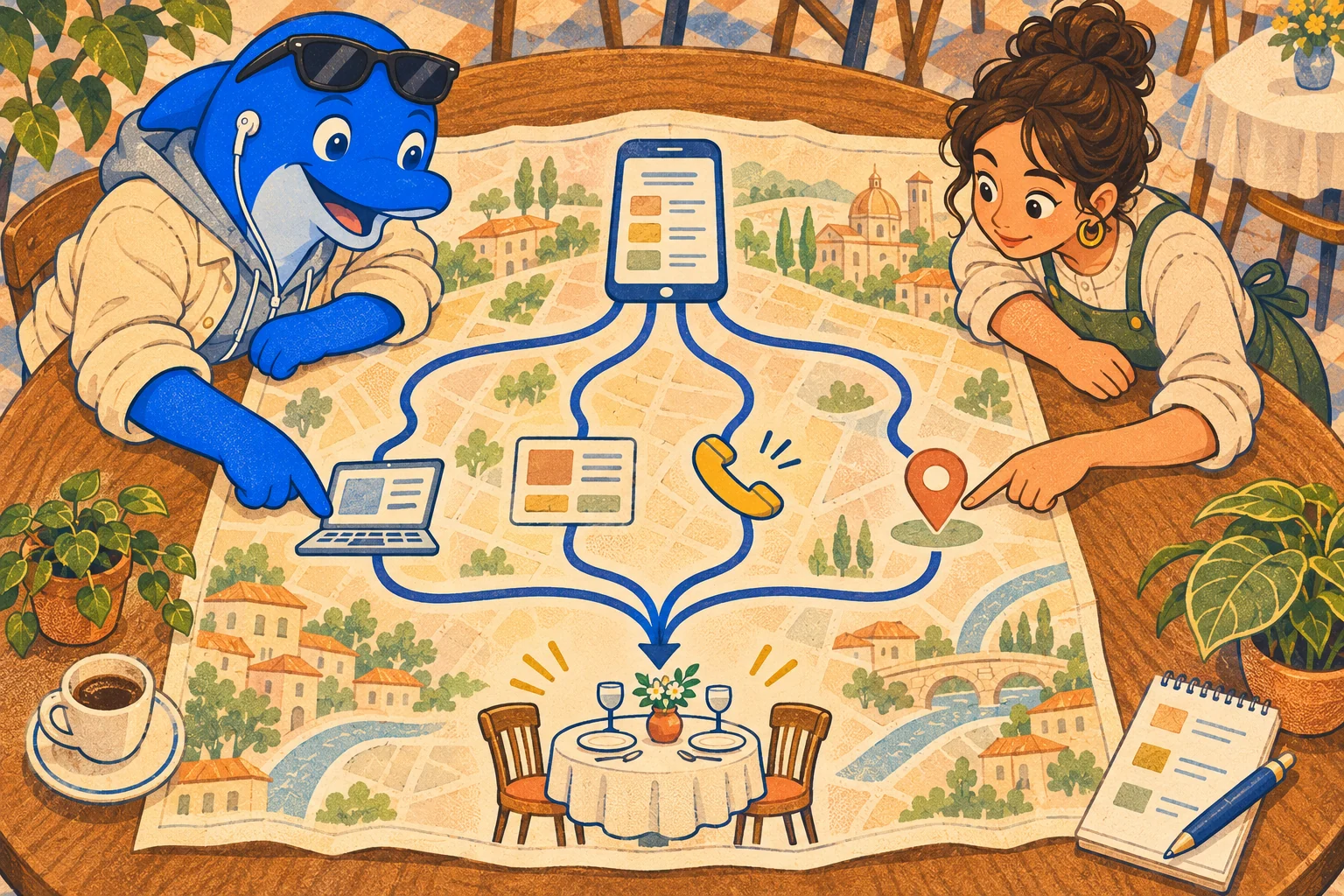
- The booking can happen in the chat. Resy says ChatGPT users can "discover and book U.S. Resy restaurants without ever leaving ChatGPT" (Resy, August 10, 2026). ChatGPT also shows available tables from OpenTable worldwide and from Yelp in the US and Canada (Tageskarte, August 13, 2026). OpenAI's release notes, Tageskarte adds, do not say whether those bookings finish inside the chat. Our guide to whether diners use ChatGPT instead of Yelp sets out which platforms work in which market. A table booked in the chat may never touch your website.
- The answer is the click. In Pew Research Center's browsing study, people who saw a Google AI summary clicked a traditional result in 8% of visits, against 15% without one, and clicked a link inside the summary in 1% (Pew Research Center, July 22, 2025). The data is from March 2025 and US adults only, but they show the shape: many searches end on the results page.
- Google's own AI clicks are filed as search. GA4 says its AI Assistant channel "excludes Google's AI Overviews and AI Mode" (Google Analytics Help); those clicks sit in Organic Search. Search Console also counts them inside its normal Web search figures (Google Search Central).
- The guest calls, walks or searches your name. Someone who reads your name in an answer and then taps your Google profile, calls you or types your name into Maps arrives through that route, not through the assistant.
Most of these routes leave a trace somewhere else. Your Google Business Profile performance report shows calls (taps on the call button), direction requests, website clicks, menu clicks and, with a connected provider, bookings. Your reservation system may record a source for each booking. Search Console shows how often people search for your restaurant by name. None of them says "this came from AI", but read together with the referral line they show whether being named is turning into guests. That raises the practical question of how to set the numbers up for each of your locations.
How do you measure your own share, location by location?
Start with the AI line you already have, split it by location, and keep it apart from bookings. GA4 now has a default channel called AI Assistant: "the channel by which users arrive at your site from sources like ChatGPT, Gemini, Deepseek, Copilot, or Grok" (Google Analytics Help). OpenAI says ChatGPT also adds utm_source=chatgpt.com to the links in its search answers (OpenAI Help Center), so most of those visits are labelled.
- In Traffic acquisition, set the primary dimension to Session default channel group and look at AI Assistant for the last full month.
- Add Session source as a second dimension to see which assistants are matched. If one you care about is missing, build a custom channel group that catches it.
- Add Landing page and filter to each location page, so a group sees each restaurant separately.
- Mark the click to your booking widget or provider as a key event, so you can see which AI visits went on to try booking.
Be strict about what each number means. A referral is a visit, not a booking; a confirmed booking comes only from your reservation system. An assistant's crawler fetching your menu page in your server logs is not a guest at all. Our guide to measuring whether AI search leads to restaurant bookings covers the booking handoff in detail. For earlier context, Ahrefs' June 2025 study found AI averaging 0.25% of total traffic across 81,947 sites, measuring visits rather than restaurant bookings.
The AI line alone shows only the edge of the picture, so at Schmitdy we measure both sides for restaurants and groups as an ongoing managed service. We check the answers to the restaurant questions that can turn into covers every day, and read them next to the GA4 and Google profile figures for each location. When an answer is wrong or a location goes missing, we fix the Google Business Profile, menu pages or site setup with you, then check the answers again. The pages listed alongside an answer tell us where to look first; they do not prove what the assistant relied on.
When is it worth acting now?
With those numbers in view, the next decision is whether to act now. Act now when being missing or misdescribed in an answer would cost you tables that your regulars cannot replace. Wait when your bookings come mainly from people who already know you. The question is less how big the AI line is than who would have found you through it.
| Situation | Why waiting costs | First step |
|---|---|---|
| A new opening or a move | Few pages may describe the new address yet, so answers can have little to work with | Follow the 90-day launch plan for an opening and check the new profile in Maps |
| Tourist areas or a new city | Visitors with no local friends to ask may turn to an assistant instead | Read the cold-start guide for a new city |
| An answer gets your hours, menu or status wrong | Guests act on the answer before they reach your site | Correct the source pages first; our guide to getting a restaurant recommended by ChatGPT shows where |
| A group with several sites | One wrong or missing location hides behind group-level traffic | Run the monthly check below per location |
The counter-case is real. A neighborhood restaurant with full books from locals and repeat guests can reasonably put AI search behind Google profile basics: correct hours, a current menu, photos and a working booking link. Accurate listings matter to AI answers as well: restaurant listing sites account for more than 41% of the sources AI tools cite when recommending restaurants, according to Yext research in DoorDash's 2026 trends report. So keep the same hours and menu on every listing you control. Our guide to how diners discover restaurants in 2026 shows how much still runs through word of mouth and Google Maps.
What three numbers should you check each month?
Go back to the handful of ChatGPT sessions in your report. They are the visible edge of a larger route, and on their own they cannot tell you whether to act. Three numbers together can, taken once a month for each location:

- AI referrals. Sessions in GA4's AI Assistant channel for each location page, and how many reached your booking step. Watch the trend, not the size. Keep Ahrefs' June 2025 average of 0.25% of total traffic across 81,947 sites as historical context, rather than a restaurant target for 2026.
- Answer presence. Ask two assistants the same ten guest questions, such as where to book a birthday dinner in your area, and note whether each location is named and described correctly. Keep the wording fixed so the months compare.
- Booking source. Bookings by source from your reservation system, next to calls and direction requests from your Google profile.
The trigger to act is the second number, not the first. If you are missing from questions you should win, or an answer describes you wrongly, fix that now, whatever the referral line says. A rising AI line is a welcome sign that the work is landing. If you want to see where each of your locations stands in the answers today, our free AI search audit records how your restaurant appears in answers from ChatGPT, Claude and Google AI.
Sources
- SE Ranking, AI traffic grew 16x from 2024 to 2026, June 18, 2026, checked November 14, 2026.
- Bain & Company, Travel Operators Can't Just Watch as AI Reroutes the Customer Journey, September 30, 2026, checked November 14, 2026.
- Booking Holdings, CEO and CFO Prepared Remarks for 3rd Quarter 2026, November 3, 2026.
- Zonal with NIQ, Nearly a fifth of consumers use AI tools to plan a visit to a pub, bar or restaurant, October 2026, checked November 14, 2026.
- DoorDash, 2026 Restaurant Industry Trends Report, survey by Dynata, March 2026, checked November 14, 2026.
- Resy, Resy Launches Reservations in ChatGPT, August 10, 2026, checked November 14, 2026.
- Tageskarte, ChatGPT zeigt weltweit Reservierungen von Restaurants von OpenTable an (in German), August 13, 2026, checked November 14, 2026.
- Pew Research Center, Google users are less likely to click on links when an AI summary appears in the results, July 22, 2025.
- Google Analytics Help, Default channel group, checked November 14, 2026.
- Google Search Central, AI features and your website, checked November 14, 2026.
- Google Business Profile Help, Understand your Business Profile performance and insights, checked November 14, 2026.
- OpenAI Help Center, Publishers and developers FAQ, checked November 14, 2026.
- CGA by NIQ with Reputation, AI and economic pressures in UK hospitality, October 2, 2025, checked November 14, 2026; August 2025 survey of 755 British consumers.
- Ahrefs, AI Traffic Has Increased 9.7x in the Past Year, June 26, 2025, checked November 14, 2026; 81,947-site study.
 Squarespace

 Webflow
 Sanity
 Shopify
 HubSpot