



TLDR: Run one domain with a full page for every venue, and give a venue its own website only when it is a brand that could stand without the group: its own following, its own audience, or a likely sale. Google does not say either structure ranks better, so choose the one your team can keep accurate.
Say you run six venues and six websites, built by four agencies over eight years. A guest asks an assistant about your newest restaurant and gets the opening hours from a site nobody has touched since spring. Nothing about that answer is a ranking problem. It is an upkeep problem: one more domain was one more place where an old fact could survive.
That is the decision underneath "one site or many". Our answer is to default to one domain with a real page per venue, and to give a venue its own domain only when it is a brand in its own right. The usual case for a microsite per venue is that each brand can look different. But separate sites split links and facts across domains and multiply the pages that must stay true, and a shared template can keep brands distinct inside one domain. Google's own guidance supports the upkeep argument rather than any ranking one, and moving from several sites to fewer is safer than most groups fear.
What does each venue's web page have to carry?
Every venue needs the same core set wherever it lives: name, address, phone, regular and holiday hours, the full menu as readable text, a booking route, and structured data that repeats those facts for machines. Google's local business guide shows a Restaurant entry carrying opening hours, cuisine and a menu link, and Schema.org defines the Restaurant type with properties such as acceptsReservations and hasMenu. Google's Business Profile rules then ask that each profile's website "represents your individual business location", which means every venue needs one clear page to point at.
What belongs on that page, and how branches link to each other, is covered in our guide to help guests find the right branch. The structural question is different: how many copies of those facts exist, and how much else you must maintain around them.
What does the count look like for a six-venue group?
Here is an illustrative count, ours rather than a survey. Assume each venue has eight facts that change during the year: hours, holiday hours, menu, prices, booking link, phone, address and the structured data repeating them.
- The venue facts are the same in any structure: 6 venues × 8 facts = 48.
- Each separate site adds its own layer: domain renewal, hosting and certificate, CMS logins, privacy and cookie notice, legal notice, Search Console, analytics. That is about 7 items per site, so 42 for six sites against 7 for one.
- A group hub that also lists hours adds second copies: six more places where one venue's hours can drift from the other.
So separate sites do not create more facts. They create more places for the same facts and more machinery around them. In our example that is 90 things to keep current instead of 55, and the 48 venue facts are now spread across six logins.
Which legal duties repeat on every domain?
Some of that per-site layer is legal, and it differs by market.
- United States: the Justice Department's 2022 guidance says the ADA applies to the web offerings of businesses open to the public, naming food and drink establishments, and points to WCAG as a helpful technical standard. Every site you run is one more site to keep accessible.
- United Kingdom: the 2015 trading disclosure regulations require a company to disclose its registered name, registered number and registered office on its websites.
- Germany: section 5 of the Digitale-Dienste-Gesetz (DDG) requires every commercial digital service to keep the provider's name, address, contact details and register number easy to find and always available, so each extra domain must carry an Impressum too.
What does Google actually say about domains, subdomains and folders?
Google does not favor one structure. Its SEO starter guide lists "subdomains versus subdirectories" under things it believes you should not focus on and says: "From a business point of view, do whatever makes sense for your business." That means the case for one domain is not a ranking bonus, and anyone promising one is overselling.
What Google does say narrows the choice in four ways.
- Signals are mostly page by page, with some site-wide. Google's ranking systems guide says its systems "are designed to work on the page level", and that "site-wide signals and classifiers are also used". A domain is not one pooled score, but signals about the whole site do feed into how its pages are understood.
- Internal links matter. Google says "every page you care about should have a link from at least one other page on your site". Inside one domain, the group directory, menus and venue pages link to each other as one site. Across domains those links become links between separate sites, each of which must be found and kept on its own.
- Folders cannot have their own site name. Google shows site names for domains and subdomains but "does not support site names at the subdirectory level". A venue in a folder appears under the group's site name in results. That limit matters for some brands, and we come back to it below.
- AI search uses the same index. Google says there are "no additional requirements" to appear in AI Overviews or AI Mode, and a page must be indexed and eligible for a snippet to be shown as a supporting link. Whatever structure you pick, assistants built on search can only use the venue pages that are indexed and current.
Google's clearest side-by-side comparison is in its multi-regional guide, written for country versions rather than venues, so treat it as an analogy. It lists separate domains as "easy separation of sites" but needing "more infrastructure", and subdirectories as "low maintenance (same host)" with "separation of sites harder". That is the trade a restaurant group makes, minus the geography.
Which structure fits which group?
Three structures cover almost every group, and three questions decide between them. This framework is ours: would a guest recognize the venue without the group's name, could it be sold or licensed separately, and does it serve a different audience? Which brand model each concept follows is a separate decision, set out in our guide to choosing a branded house, house of brands or endorsed portfolio.
| Structure | Choose it when | The cost you accept |
|---|---|---|
| One site with venue pages | Guests know the group, and venues share owners and guests | Venues share the group's site name in Google |
| Group hub plus separate venue sites | One or two concepts pass the separate-brand test, the rest do not | Two places per venue unless the hub only links |
| Fully separate sites | Every concept stands alone with its own guests and owner | A full site, legal notice and logins per venue |
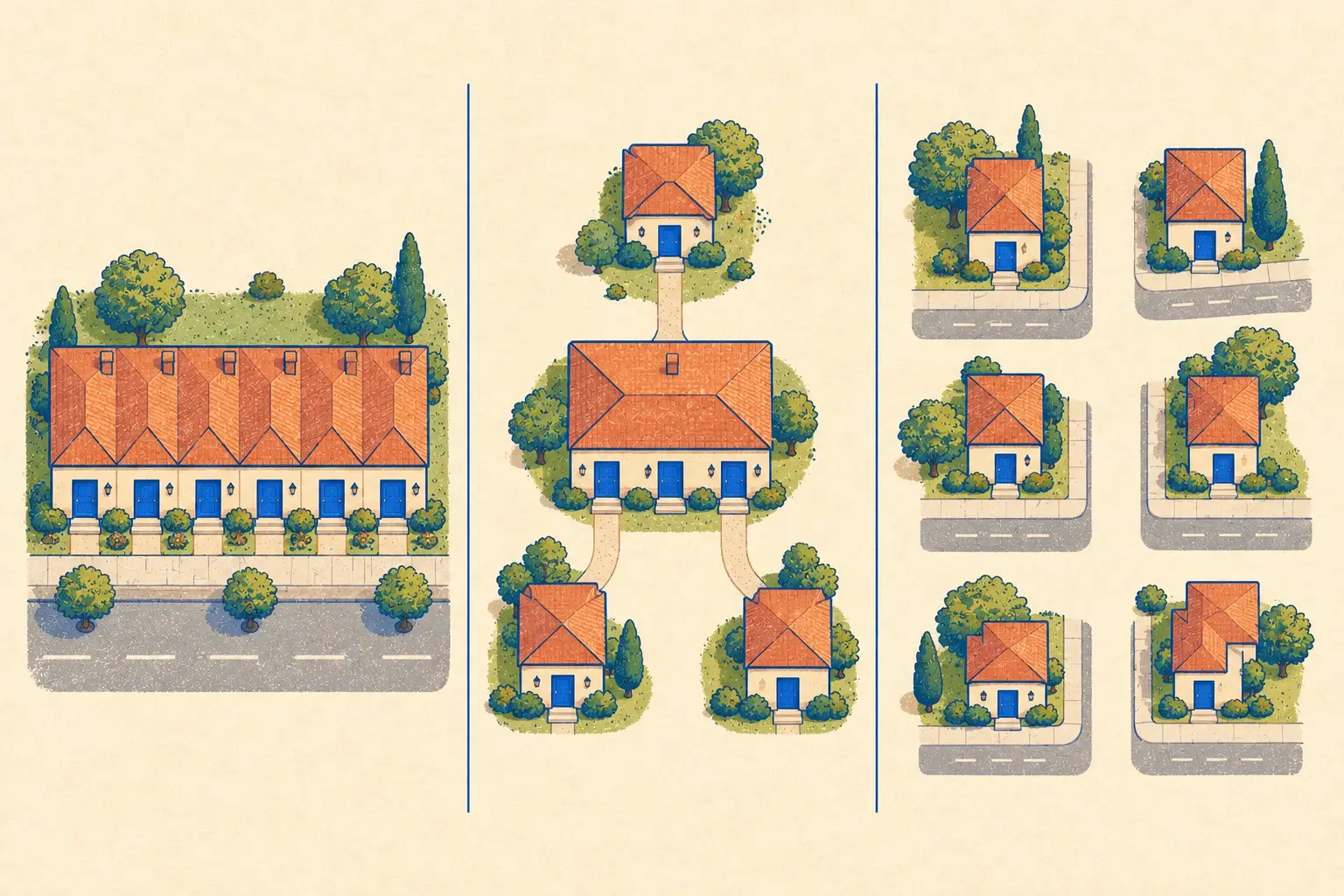
For most groups the answer is the first row. A shared template can still give each venue its own colors, photography, logo and voice inside a folder such as /venues/name/, with its own menu pages and booking route. The guest sees a distinct place; you maintain one system, one set of legal pages and one Search Console property.
The middle row is where groups usually drift by accident: a group site lists every venue with hours, and two venues also have their own sites with different hours. If you run a hub, make it link, not copy. The venue site owns the facts; the hub names the venue, says what it is and sends the guest there. Whether assistants then connect the venues to the group is a separate question, answered in our guide to does AI see a restaurant group as one brand.
How do you move from several sites to one?
Move one venue domain at a time, with every old address redirected to its closest new page. Google's site move guide says to "expect temporary fluctuation in site ranking", that a medium-sized site can take "a few weeks or more" to show the new addresses, and that permanent redirects "don't cause a loss in PageRank". Plan for a dip, not a loss.

- List what exists. Every domain and subdomain, every page naming a venue's hours, and every place that links to them: Google profiles, booking widgets, social bios, delivery listings.
- Decide each domain's fate. Merge, keep or retire, using the three questions above. Only venues that pass the separate-brand test keep a domain.
- Map every old address. Pair each old URL with its closest new page, not the home page, and avoid redirect chains.
- Build the venue pages first. Hours, menu as text, booking link and structured data must be live and correct on the new page before anything points to it.
- Switch with permanent redirects. Use server-side 301 or 308 redirects and move all of a venue domain's addresses on the same day, as Google recommends for small and medium sites. The next venue can follow once the first has settled.
- Tell Google about each retired domain. Search Console's Change of Address tool works from a domain to a path on another domain, for example from a venue domain to
group.com/venues/name/. Verify every variant, including www. - Update every outside link. Change each Google profile's website field, booking and delivery listings, and social bios to the new venue page.
- Keep the redirects and the old domains. Google's site move guide says to keep the redirects "for as long as possible, generally at least 1 year". We also suggest renewing each old domain for at least that long, so nobody else can buy it and pick up your old links.
The usual next question is who does the work. In our restaurant AI search service, tracking which venue pages appear in AI answers is the foundation, and we then do the work: we build every venue and menu page as readable, AI-optimized pages on your chosen domain, set up Search Console and GA4 for it, optimize each venue's Google Business Profile so its website field points at the right page, and build a blog where you have none. That is included at no extra charge, with human checks across writing, design, development and outreach. If you are mid-expansion, put the newest venue straight into the group site; our plan for opening a fourth restaurant covers the launch weeks. How profiles, listings and reviews fit the same structure is in our guide to local SEO for multi-location restaurants, and who updates which venue page each week is in our guide to local store marketing for restaurant groups.
When should a venue keep its own domain?
A venue keeps its own domain when it is a business that could stand without the group. Four cases qualify.
- It has its own following. Guests, press and guides know it by name and rarely mention the group. Moving it into a folder would also lose its own site name in Google results.
- It serves a different audience. A hotel bar, a private club, a catering arm or a stadium concession stand can need its own booking flow, tone and legal notice.
- It could be sold, franchised or licensed. A separate domain is far easier to hand over than a folder you would have to split out later.
- It is delivery-only. Google's Business Profile rules permit delivery-only brands run from virtual kitchens "if they have distinct branded packaging and a distinct website".
Keeping a domain is a commitment, not a style choice. Give it one owner, keep its facts only on its own site, and link to it from the group hub instead of repeating its hours. If no one can name the owner of a venue's domain today, that venue is a candidate to merge.
What should you do this month?
Write down every domain you own and, for each venue, every page that states its opening hours. Count the copies. Then choose one of the three structures and name the venues, if any, that keep their own domain.
Before you choose, check which of those domains guests are actually being sent to. Our free AI search audit records the answers for each venue, lists the pages and outside sources that appear alongside them, and shows which of your sites they come from, so you can see which domains to merge first. It ends with a 30-day plan.
Sources
All pages were checked on November 1, 2026.
- Google Search Central: SEO starter guide, updated December 10, 2025.
- Google Search Central: A guide to Google Search ranking systems, updated December 10, 2025.
- Google Search Central: Link best practices, updated December 10, 2025.
- Google Search Central: Site names in Google Search, updated December 10, 2025.
- Google Search Central: AI features and your website, updated December 10, 2025.
- Google Search Central: Managing multi-regional and multilingual sites, updated December 10, 2025.
- Google Search Central: Local business structured data, updated September 8, 2026.
- Schema.org: Restaurant.
- Google Business Profile Help: Guidelines for representing your business.
- Google Search Central: Site moves with URL changes, updated August 20, 2026.
- Google Search Central: Redirects and Google Search, updated April 14, 2026.
- Search Console Help: Change of Address tool.
- Digitale-Dienste-Gesetz, section 5: general information duties (Germany).
- The Company, Limited Liability Partnership and Business (Names and Trading Disclosures) Regulations 2015, regulation 24 and regulation 25 (UK).
- US Department of Justice: Guidance on Web Accessibility and the ADA, March 18, 2022.
- W3C: Web Content Accessibility Guidelines (WCAG) 2.2, W3C Recommendation, December 12, 2024.


 Squarespace

 Webflow
 Sanity
 Shopify
 HubSpot