



TLDR: If you run several bars, measure before you fix. Give each bar five to eight guest questions by occasion, run them in two or three assistants in one monthly round of about five runs each, and put the results in one venue-by-occasion grid. The empty cells show which bar to work on first and for which kind of night.
If you've got four bars and one person's week to spare, the useful question is which bar to fix first. Checking one AI answer for one bar won't settle it. A grid will, and it's a few hours' work a month.
The method's short. Write occasion questions for each bar, ask them several times in the assistants your guests use, and log who gets named. Then read the grid by bar and by occasion. The bar with the emptiest row gets the first fix, and the empty column tells you what kind of night to fix it for.
Why can't one answer tell you which bar to fix?
Answers change from run to run, so one check tells you little. In a study by SparkToro and Gumshoe, 600 volunteers ran 12 prompts through ChatGPT, Claude and Google's AI a combined 2,961 times, and there was less than a 1 in 100 chance that ChatGPT or Google's AI gave the same list twice in 100 runs. The authors suggest counting how often a brand appears across many runs and ignoring its position. Bars weren't in the study, and the authors flag a commercial link to an AI-tracking company, but the counting method works for any category.
That's why the grid counts appearances. A bar that turns up in two of five runs for a question has a 40% cell. A single lucky answer for a single bar tells you much less.
Which questions should each bar be tested on?
Test each bar on the nights guests actually plan, and leave its name out. A question with your bar's name in it only checks whether an assistant recognizes you. It doesn't tell you whether a stranger looking for a drink will find you. Pick five to eight occasion questions per bar, in the words a guest would use:
- After work: a quiet glass of wine near the train station on a weekday.
- A date: somewhere for two with good wine by the glass and small plates.
- A group: a bar that'll take eight people on a Saturday without a reservation.
- Late: a cocktail bar still serving after midnight on a Thursday.
- Something specific: natural wine, a low-alcohol list, a terrace or a step-free entrance.
Keep a shared core so you can compare bars, and add one or two questions only a particular bar can win. Run them in the assistants your guests use. Two or three's enough to start: ChatGPT, Google's AI Overviews or AI Mode, and one more.
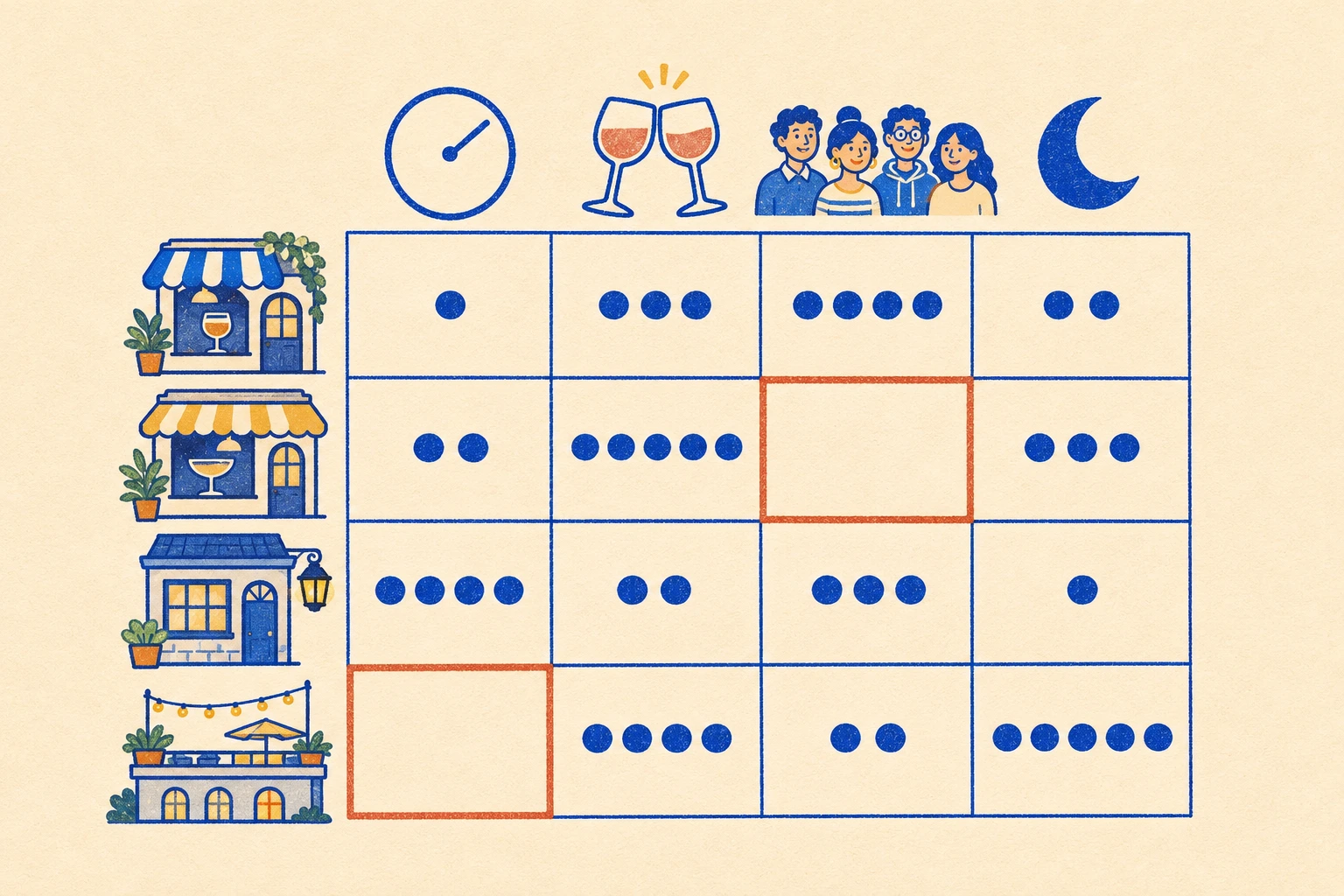
The arithmetic for a hypothetical group: Four bars, six questions each and three assistants make 72 question and assistant pairs. Five runs a month for each pair gives 360 answers, and at about half a minute each to read and log, that's three hours a month. It's still a small sample, so treat one cell as a hint and a whole empty row as a finding.
What should you record for each answer?
You'll want the same few fields every time, in one sheet for the whole group. Consistency matters more than detail.
| Field | Example | Why it matters |
|---|---|---|
| Date and assistant | Nov 3, ChatGPT | Answers change over time and by tool |
| Bar and question | Bar 2, after-work glass | Ties each answer to one venue and occasion |
| Named or not | Yes, in the list | The count you compare month to month |
| Who was named instead | Two rival bars | Shows who's winning your occasions |
| Sources listed | A city guide, a review site | Shows what the answer read |
| Wrong facts | Says closes at 11 pm | A fix you control |
Write down the exact claim when a fact's wrong. A wrong closing time is the quickest win you'll find, and Google lets you set special hours for holidays and events, with nights that run past midnight entered as two entries.
How do you read the grid?
Read it by bar first, then by occasion, since that's the order you'll act in. We sort the gaps into four kinds, which is a working framework we use, and each points to a different first fix.
- A bar never appears. Check the basics first. OpenAI recommends allowing OAI-SearchBot in robots.txt for a site to appear in ChatGPT search, and a robots.txt file applies to the whole host it sits on, so if your bars share a domain, one bad line can hide all of them. Then check the bar has its own page and a complete Google profile. Google says businesses with complete and accurate information are more likely to show in local results, and its guidelines allow one profile per location.
- A bar appears for some nights and not others. Its page probably doesn't say it serves that night. If you never mention groups or dinner, there's nothing for an answer to quote. Put the drinks and food lists on the page as text.
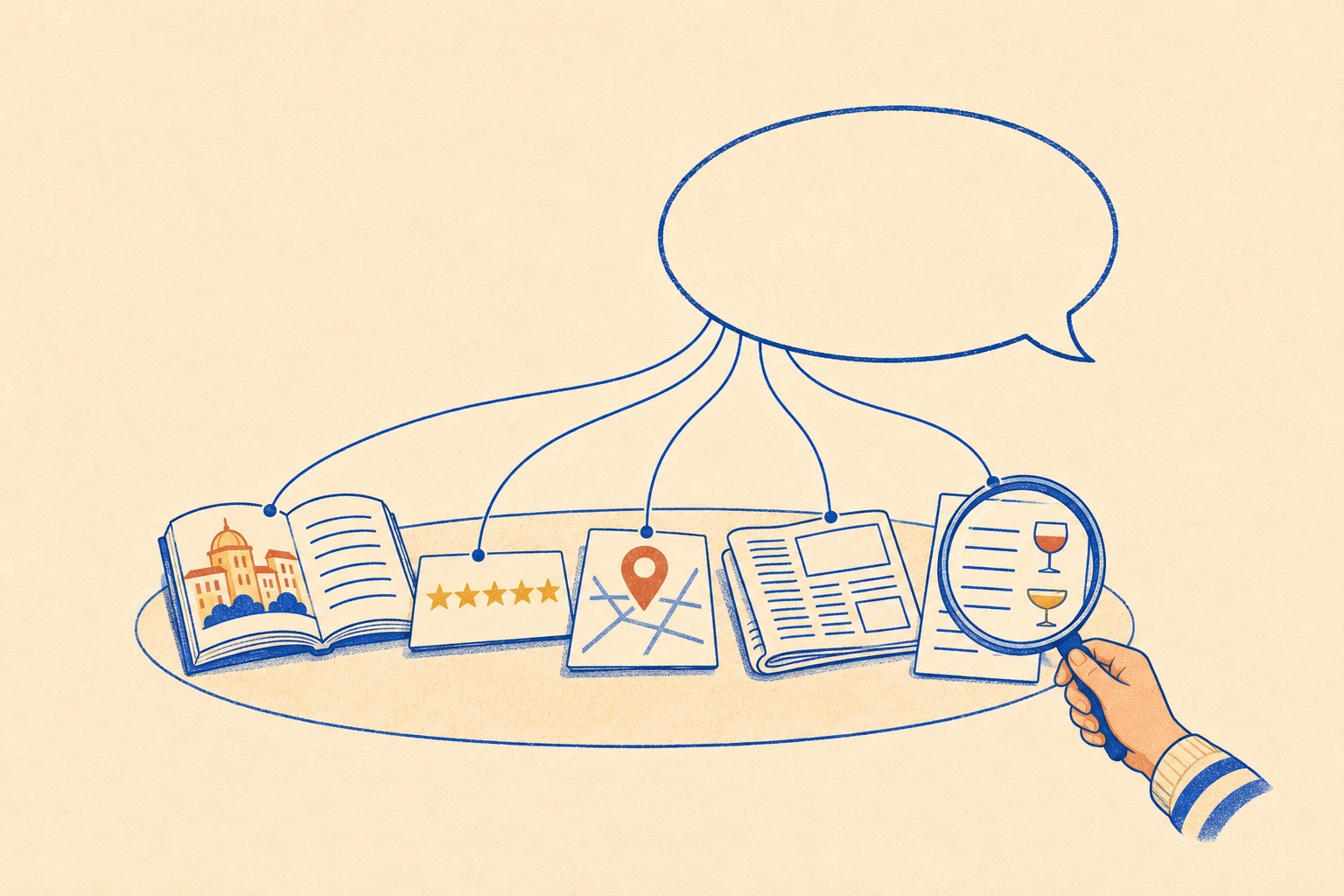
- Rivals appear with sources you're missing from. The gap's outside your website. Read the guides and articles listed beside those answers and pick the ones worth approaching.
- A bar appears with wrong facts. Fix the fact where it lives: your page, your profile and any guide still carrying the old version.
How do you choose which bar to fix first?
Fix the bar with the emptiest row, for the occasion that matters most to its revenue. If two bars tie, start with the one whose gap is a fact you control, like hours or a missing page, because you'll see it move sooner than a gap in outside coverage. Change one thing per bar per month so the next grid tells you what worked.
Take a hypothetical month. The wine bar shows up in four of five runs for the after-work question and in none for dinner. The cocktail bar's named for late nights but never for groups. The neighborhood bar barely appears at all, and the rooftop bar's fine everywhere except dates. The neighborhood bar's row is emptiest, so it goes first, and the first job's the basics in point 1: its own page, its profile and its hours. The wine bar comes next, because its dinner gap is a page that doesn't mention food. The cocktail bar's group gap waits a month, since it probably depends on the group-booking line on its page and on what the guides say about it. Next month you rerun the same questions and see whether the neighborhood bar's row has filled in. If it hasn't, the gap probably sits outside your website.
When one bar's named and its sister isn't, compare their sources line by line. Our guide on why some of your venues show up in AI answers and others don't walks through that comparison. The fixes themselves depend on the bar: our guide to how cocktail bars show up in AI recommendations lists the facts a bar should publish, AI search for wine bars covers occasions and food, and menu pages for AI search turns a PDF list into a page.
What else can you measure without a tool?
It's worth opening the links listed beside each answer and counting them by type over the month: your own pages, review sites, city guides, newspapers and lists. Guests check sources too. In a March 2026 US survey by BrightLocal, a local marketing software company, 97% of AI users said they sometimes double-check AI recommendations against real reviews.
Google gives you part of the picture for its own AI features. Search Console's generative AI performance report shows how many times links to your site appeared in AI Overviews and AI Mode, by page, country, date and device. It doesn't show the questions behind those impressions, so it sits alongside your grid. For visits from ChatGPT and other assistants, our guide to tracking AI referral traffic in GA4 sets up the reports.
On your own pages, schema.org's BarOrPub type carries a menu, cuisine and whether you take reservations, and Google's local business structured data defines each location separately, with hours past midnight in one entry. Google also says no special optimization is needed for its AI features, so markup only repeats what the page already says.
When should you stop measuring and fix things?
Stop the moment you find a fact you know is wrong. If a bar's site still shows a PDF-only wine list and last season's hours, fix those today and measure next month. A single bar doesn't need 360 answers a month either. Ten good questions, run a few times in two assistants, will show you the pattern.
We run this kind of tracking daily as part of our service. Our Managed AI Search tracks an agreed question set across ChatGPT, Claude, Perplexity, Gemini and Google AI Overviews and records the sources beside each answer. For bars and restaurants, Restaurant AI Search adds the build work at no extra charge, including every drinks list rebuilt as a readable page for each venue, from $1,650 a month. If you'd like the first grid done for you, book the free AI search audit for your bars.
Sources
All pages were checked on November 12, 2026.
- SparkToro: AIs are highly inconsistent when recommending brands or products, January 28, 2026.
- Google Business Profile Help: set special hours.
- OpenAI: overview of OpenAI crawlers.
- Google Search Central: introduction to robots.txt.
- Google Business Profile Help: tips to improve your local ranking.
- Google Business Profile Help: guidelines for representing your business.
- BrightLocal: local consumer review survey, AI trust findings, March 10, 2026, a US survey by a local marketing software company.
- Search Console Help: generative AI performance report (Search).
- Schema.org: BarOrPub.
- Google Search Central: local business structured data.
- Google Search Central: AI features and your website.
 Squarespace

 Webflow
 Sanity
 Shopify
 HubSpot