



TLDR: Nightlife venues tend to show up in AI search when an assistant can read two things on their own pages: the standing facts (hours by night, door policy, drinks list, location) and the dated items (each event and offer, with a date, a time and a status). Publish both as plain text, give every event and offer its own page, and archive it or mark its status the day it stops being true.
Updated 13 November 2026: We've added a section with results from our four-city study, in which we asked ChatGPT, Gemini and Google AI Overview 200 nightlife questions about each of London, Los Angeles, New York and Berlin. It compares 6,383 answers from 7,200 runs and links to each city's full study.
Say it's 10.40 on a Thursday and someone in a group chat types "where's open past 2 with a DJ near the canal tonight" into ChatGPT. The answer names three venues. Yours isn't one of them, even though your Thursday residency has been running for a year.
That gap usually starts on your own website. The residency lives in an Instagram story, the drinks list is a PDF, and the homepage banner still advertises a bank holiday party from August. An assistant can't build an answer out of any of that.
What does an AI assistant need to know about a nightlife venue?
It needs two layers of information, and most venue sites mix them up. The first layer changes a few times a year. The second changes every week.
| Layer | What goes in it | How often it changes | Where it should live |
|---|---|---|---|
| Standing facts | Opening hours for each night, last entry, door policy, age rule, dress code, entry price, drinks list, address, step-free access | Seasonally | A venue page and a drinks page in plain text |
| Dated items | Each event, guest DJ, live set, quiz, happy hour and offer, with date, start and end time, price and booking link | Weekly | One page per item, linked from a "what's on" page |
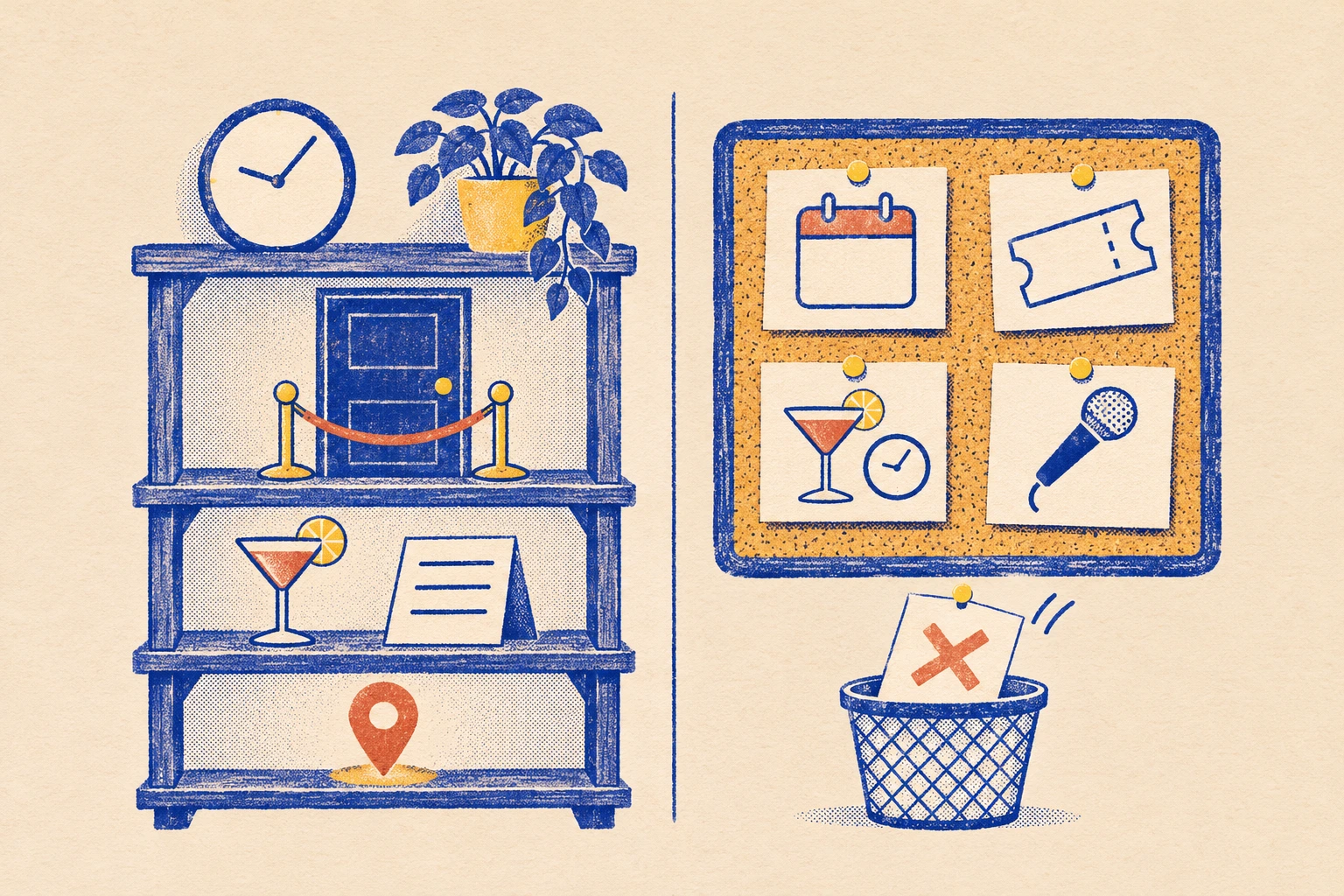
The standing layer answers "is it open and will they let us in". The dated layer answers "what's on tonight". People ask both, often in one sentence, and an assistant can't combine them unless it finds both written down.
Hours past midnight need care. Google's LocalBusiness documentation says to define hours past midnight with a single opening hours entry, so Saturday 18:00 to 03:00 sits on Saturday rather than splitting across two days. Write it the same way on the page, "Saturday 6pm to 3am, last entry 2am", so a guest doesn't have to work out which day you mean.
Don't leave the kind of venue to guesswork either. Schema.org has a NightClub type, described simply as "a nightclub or discotheque", next to the bar and pub types. If you're a cocktail bar that turns into a club after midnight, say both, in words, on the venue page.
Why do flyers, PDFs and homepage banners go missing?
Because a lot of nightlife information isn't text, and crawlers read page text.
Vercel studied AI crawler traffic across its network and found in 2024 that "none of the major AI crawlers currently render JavaScript", OpenAI's and Anthropic's included (Vercel). So in 2024 a line-up that loaded from a ticketing widget after the page opened was invisible to them. Put it in the page HTML and you don't have to check.
Flyers are images of text, and that's the problem. The web accessibility standard asks authors to use real text "rather than images of text" wherever the visual effect can be achieved with text (W3C, WCAG 1.4.5). A screen reader can't read the words inside a flyer, and a crawler that reads page text may not see them either.
PDF drinks lists are the slow version of the same problem. We've written about why PDF menus drop out of AI answers and how to build a menu page from structured data. The same fix works for a cocktail list: put the drinks and their prices on an HTML page, then link the PDF from it if the designer insists.
Check access before you rewrite anything, because it's the quickest fix if it's broken. OpenAI says sites that opt out of its search crawler, OAI-SearchBot, "will not be shown in ChatGPT search answers" (OpenAI crawler documentation). A robots.txt file copied from an old template can block it without anyone noticing.
How should each event and offer be published?
Give each one its own page with a date in the address, and treat that page as a short factual record you'll update if anything changes. A "what's on" page then links to the live ones in date order.
Each event page should state:
- the date, the start time and the finish time;
- the act or host, and the type of night in plain words ("house and disco", "jazz trio", "pub quiz");
- the price, and whether it's on the door or online only;
- the age rule and anything that differs from your usual door policy;
- the booking or ticket link;
- the status if anything changes.
Offers work the same way, and they're easier to let go stale. "Happy hour, Monday to Thursday, 5pm to 7pm, two-for-one on the classics list" is a fact an assistant can repeat. "Great deals every week!" on a homepage slider is a mood, and an assistant can't repeat a mood.
Google's Event structured data gives you the vocabulary for status changes. It lists four values (EventScheduled, EventPostponed, EventRescheduled and EventCancelled) and says that for a cancelled event you should keep the original details and change the status, rather than removing the date or location. For a rescheduled event you update the dates and can record the previous start date. Show the same status on the visible page: "Cancelled. Refunds go back to the card you paid with."
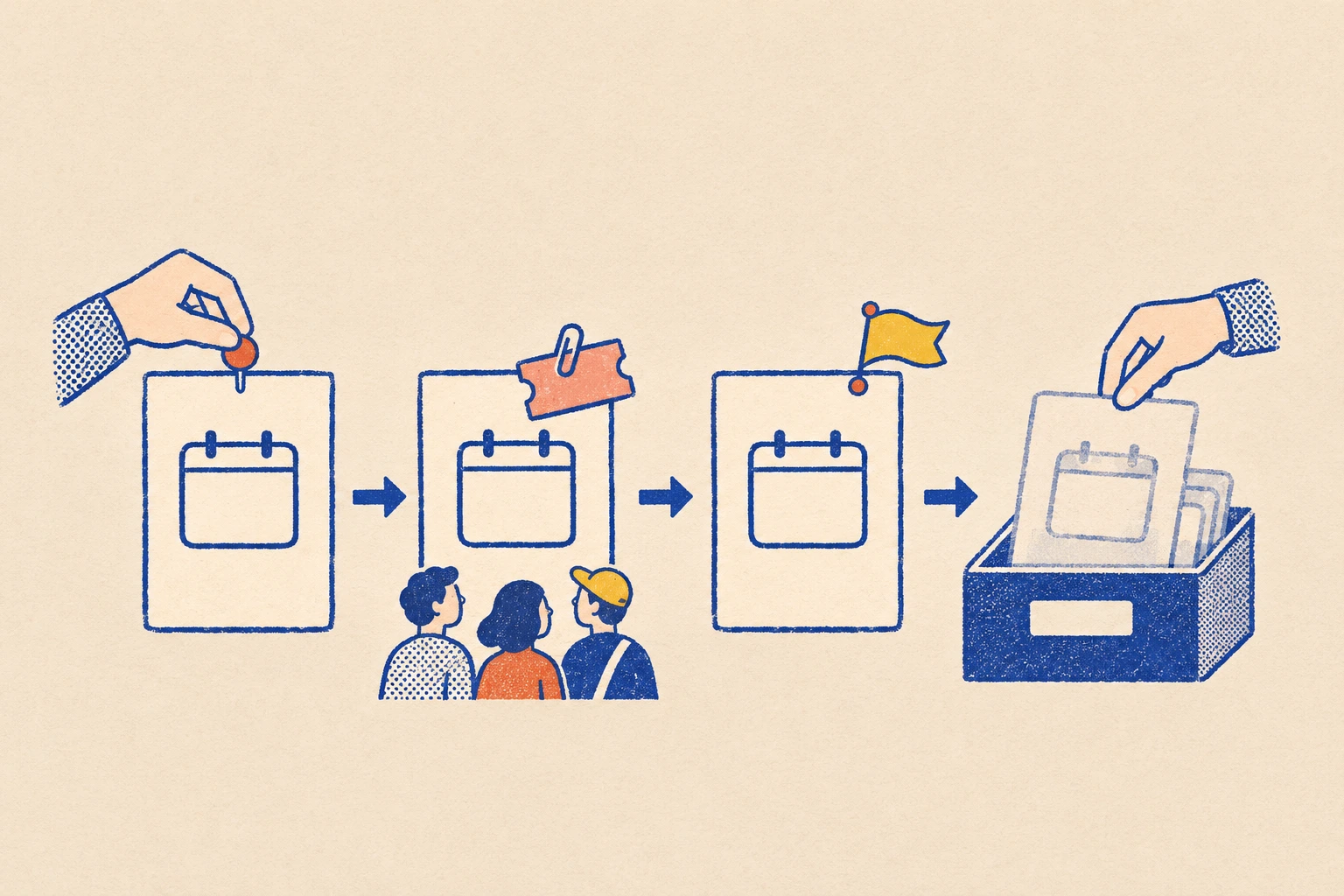
When the night's over, the page has done its job. You can archive it, or add a robots meta rule called unavailable_after, which Google describes as "Do not show this page in search results after the specified date/time" (Google robots meta tag documentation). What you shouldn't do is leave last month's party sitting live with no status.
Stale information shows up in research too. In one preprint by Pitenin, which examined 4,776 venues in Canggu and Ubud on Bali, assistants recommended permanently closed venues 93 times (arXiv, August 2026). The same study linked being recommended at all to documentation: review volume, having your own website, listed prices and mentions on other sites. It covers one market, so treat it as a warning about stale data in your own city.
Your Google Business Profile can carry the same items. Google lets a profile publish updates, offers and events, and an event post takes "a title, start and end dates, and times" (Google Business Profile Help). Post the big nights there as well as on your site, and don't let the wording drift, so the two sources agree.
How do you keep it current without a web team?
Make it a weekly routine with one named owner, usually the general manager or whoever books the acts. Run it in this order:
- Monday: update the dated layer. Add every confirmed event and offer for the next fortnight as its own page, and link each one from "what's on".
- Monday: retire last week. Archive finished events, mark any postponed or cancelled ones with their status, and pull expired offers.
- Monthly: check the standing facts. Read the hours, last entry, door policy and drinks list against what the door team actually does this month.
- Monthly: match your profiles. Make sure your Google Business Profile, listings and ticketing pages show the same hours and the same event dates as your site.
- Monthly: ask the assistants. Run the same handful of guest questions in two or three assistants and note which venues they name.
That last step won't work as a one-off. SparkToro found that AI tools rarely return the same list of brands twice, with "<1 in 100" odds of an identical list (SparkToro). One screenshot won't tell you much. You'll learn far more from several runs of the same question each month.
Google's own guidance on AI features says there's no special markup required to appear in AI Overviews or AI Mode. What's above is ordinary, readable publishing, done every week.
What 6,383 AI answers across four cities show
On 13 November 2026 we asked ChatGPT, Gemini and Google AI Overview 200 unbranded nightlife questions per city, three runs per question on each engine. That's 7,200 runs across London, Los Angeles, New York and Berlin, and 6,383 came back with an answer. All 817 missing answers were AI Overview runs that showed nothing, and it's patchy by city: AI Overview answered 312 of 600 runs in London and 593 of 600 in Berlin. Each city has its own write-up, with its full venue and source rankings: the London study, the Los Angeles study, the New York study and the Berlin study.
| City | Answers | Name a tracked venue | Most-named tracked venue | Source listed most often |
|---|---|---|---|---|
| London | 1,512 | 750 (49.6%) | Simmons, 107 (7.1%) | designmynight.com, 513 (33.9%) |
| Los Angeles | 1,544 | 756 (49.0%) | Perch, 179 (11.6%) | timeout.com, 412 (26.7%) |
| New York | 1,534 | 746 (48.6%) | 230 Fifth Rooftop Bar, 109 (7.1%) | timeout.com, 347 (22.6%) |
| Berlin | 1,793 | 958 (53.4%) | Klunkerkranich, 215 (12.0%) | visitberlin.de, 580 (32.3%) |
Each share uses that city's answers as its denominator. A source listed beside an answer doesn't show the answer relied on it. Use the rows to compare patterns. They can't rank the cities, because the cities returned different numbers of answers and we tracked only 30 venues per city, picked from a first reading of its answers. So "name a tracked venue" is a floor: it doesn't count the other venues the answers named. In a sample of 137 Los Angeles answers, 125 named at least one LA venue.
Leaders are modest across a city and strong within one kind of night. The most-named tracked venue reaches between 7.1% and 12.0% of its city's answers. Ask about one kind of night and it's a different picture. Berghain appears in 127 of 198 Berlin club answers (64.1%), and Perch in 100 of 188 Los Angeles rooftop answers (53%). Behind the leaders, there's a long tail. In a sample of 119 New York answers, the ten most-named venues took 67 of 713 venue namings (9.4%). It's the narrow questions, about a district or a drink style, that brought up the small independent venues in all four cities.
Guides and listings are listed far more often than venue sites. The leading source differs by city. London's is a booking and listings site, and Berlin's is its tourism board. Los Angeles and New York both lead with Time Out, with Reddit second. Venue sites sit far below the guides. In London, Los Angeles and New York, the most-named tracked venue is also the one whose own site was listed most. We didn't test why.
ChatGPT shows maps in every city. AI Overview does in three. Gemini never does. ChatGPT showed a map card in 433 to 443 of its 600 answers in every city. Gemini didn't show a map in any of its 2,400 answers, and it didn't write links into its text either. AI Overview swings most: a map in 244 of 312 London answers and in none of its 593 Berlin answers. If a guest finds you on a map card, check the hours and address on it.
Gemini sometimes refuses drinks questions. In a sample of 40 London Gemini answers it declined 15, among them every cocktail question we sampled. In a sample of 45 Berlin Gemini answers it refused 15 outright, citing alcohol. Berlin's evidence says these refusals count as answers, which lowers Gemini's venue rate there.
All runs are from one day, and the city samples were drawn differently. Compare patterns across cities. Each city study holds its own rankings.
What changes when you run several venues?
Each venue needs its own standing page and its own "what's on" page, because a guest asks about one door on one night. A single group page listing "events across our venues" leaves the assistant guessing which venue hosts which night, and it won't always guess right.
Keep the template shared and the facts local. One central person can own the page layout and the structured data, while each general manager owns the dates and the door policy for their site. Google's local ranking guidance says businesses "with complete and accurate info are more likely to show up in local search results" (Google Business Profile Help), and it's easier to be accurate when the person who knows the facts writes them.
If you're deciding which venue to fix first, measure them side by side. Our guide to why a bar isn't showing up in AI answers sets out a venue-by-occasion grid for that. For the event facts a music venue has to get right, from performer names to rescheduled dates, see our live music venue checklist. Cocktail-led groups will find the occasion questions guests ask in how cocktail bars show up in AI recommendations.
Can you claim your venue in ChatGPT?
Possibly, but check eligibility first. OpenAI opened Businesses in ChatGPT as a beta on 10 November 2026. Our guide to claiming your business in ChatGPT covers local shops and restaurants and does not mention bars or clubs, so check eligibility before you plan around it. Local shops and restaurants can claim only an existing US listing, and UK restaurants and shops can't claim a local listing yet. Edits go through OpenAI review, and ChatGPT may still use other sources. Claiming doesn't guarantee higher placement.
If you'd like a hand, choose a time with Marco and set up your ChatGPT business profile together, free of charge, where your business is eligible.
Get free help to set up your ChatGPT business Profile →
What should you do this week?
Open your homepage on a phone and count how many of tonight's facts you can read as plain text. Then do two things before the weekend: move the drinks list onto a text page, and give Friday's event its own page with a date, a time, a price and a status.
That's the work Schmitdy does as a managed service for bars, clubs and venue groups: we track the guest questions daily and fix the pages and listings behind the answers. If you'd like to see where your venues stand first, start with a free AI search audit.
Sources
- Vercel: The rise of the AI crawler, 17 December 2024.
- OpenAI: overview of OpenAI crawlers.
- W3C: Understanding WCAG success criterion 1.4.5, images of text.
- Google Search Central: LocalBusiness structured data.
- Schema.org: NightClub.
- Google Search Central: Event structured data.
- Google Search Central: robots meta tag rules.
- Pitenin, Invisible to the Machine, arXiv preprint 2608.07069, 7 August 2026.
- Google Business Profile Help: create posts.
- SparkToro: AIs are highly inconsistent when recommending brands.
- Google Search Central: AI features and your website.
- Google Business Profile Help: improve your local ranking.
 Squarespace

 Webflow
 Sanity
 Shopify
 HubSpot