



At a glance: Humble Crumble appeared in 52.7% of category-and-product observations and 10.0% of quick-casual observations in this designed London research set. These are different question groups, not a controlled test of wording. For operators, the findings identify questions worth checking against their own offer and location pages.
Updated 2 October 2026.
What is the clearest finding?
Humble Crumble’s recorded visibility was higher in the product-and-category group than in the quick-casual and value group. That is the clearest contrast in this dataset.
Humble Crumble appeared in 98 of 186 category-and-product observations, a 52.7% visibility rate. In the quick-casual and value group, it appeared in 10 of 100, or 10.0%. The designed sample records a difference between those question groups; it does not establish that wording caused it. The lower-rate group is a useful starting point for reviewing whether the questions fit the offer and whether the relevant facts are available on location pages.
The current public offer makes the category match legible. Humble Crumble’s own site is organised around crumble, while its locations page identifies central London and market sites. Borough Market’s trader listing describes hot fruit crumble and its toppings. A traditional British crumble, seasonal fruit dessert or warm market-treat query can be assessed against a detailed product and place.
That does not translate cleanly to a broad dessert prompt. A broad prompt leaves room for a doughnut, gelato, pastry, waffle, crepe or table-service dessert. The relevant test is then whether a business has made its distinctive route easy to understand before someone travels.
Humble Crumble's visibility by question group
| Question group | Named / total | Visibility |
|---|---|---|
| Category/product | 98 / 186 | 52.7% |
| Neighbourhood | 145 / 286 | 50.7% |
| Visitors | 150 / 382 | 39.3% |
| Quick casual/value | 10 / 100 | 10.0% |
The product wording and the location wording both matter. A crumble-led operator has a strong fit with a request that contains “crumble”. A result near a named market or neighbourhood depends on the reader being able to see a real branch, not simply a brand name.
Which brands appeared in the dated London set?
The table below is an alphabetical summary of the five brands tracked in this run. “Visibility” counts answers carrying the measurement system’s recognised brand label. It is not a measure of public preference, sales or quality.
| Tracked brand | Named / 1,449 | Visibility |
|---|---|---|
| Amorino | 203 | 14.0% |
| Bread Ahead Bakery | 135 | 9.3% |
| Chin Chin Labs | 57 | 3.9% |
| Heavenly Desserts | 202 | 13.9% |
| Humble Crumble | 509 | 35.1% |
Brand-name recognition matters. Checking the original answer text reconciled all five reported counts to their recorded brand labels. A broader text search also found “Bread Ahead” in 185 answers and “Chin Chin” in 203, compared with 135 and 57 recognised labels respectively. Those broader names are not interchangeable with the tracked labels. This table therefore reports the original measurement, not a definitive ranking of all mentions; the lower figures should not be read as absence from the answer text.
The brands represent different forms of dessert visit. Amorino’s Soho store page lists gelato and sorbet alongside sundaes, crepes and waffles, with a specific Old Compton Street address and late hours. Bread Ahead’s Borough Market page identifies pastries, cakes and doughnuts at the market, while its Leicester Square page supplies a late-evening route for the West End.
Chin Chin’s Soho page identifies a dessert and ice-cream menu at 54 Greek Street, including vegan-labelled choices. Heavenly Desserts’ location directory is the starting point for its London branches, and its Elephant and Castle page publishes the local address, trading times and last-order boundary.
Those are different answers to different jobs. A warm fruit crumble at a market, a gelato after an evening in Soho, a bakery item near a theatre, and a sit-down dessert menu all require distinct information. The measured brand table is most useful when read beside those formats.
What did the retrieved-source pattern add?
The answer systems retrieved more than operator pages. Selected editorial and destination sources included The Infatuation, retrieved in 250 recorded answers, Visit London in 155, Time Out in 132, Camden Market in 51, Borough Market in 40 and Covent Garden in 56. Each count records answers that retrieved at least one page from that domain. It does not count reader visits or imply an editorial endorsement.
The source mix shows why a single perfect homepage is not enough. Editorial guides help a person compare formats. The Infatuation’s London Dessert Bucket List is an example of a broad dessert-discovery page. Time Out’s report on hot desserts gives broader context for warm desserts and mentions Humble Crumble’s Borough Market format. Destination pages give the journey context: Visit London’s market guide covers Borough and Camden among the city’s food-market choices.
The final decision still turns on a first-party detail. A guide can help someone choose between a market snack and a dessert restaurant. It cannot confirm tonight’s last order, a specific branch’s menu, or the safety boundary of a dietary option. That information belongs on the operator page and has to remain current.
This is especially important for a visitor-facing query. “Near Covent Garden” can surface several plausible stops, but the useful next fact is whether the place serves a cold dessert, a hot pudding or a bakery item, and whether it trades at the time the visitor needs it. Amorino’s Covent Garden page publishes product categories and day-specific hours. Borough Market’s visitor page explains the market setting and access around London Bridge. Together, those pages answer different parts of the decision.
How do the dessert formats differ in practice?
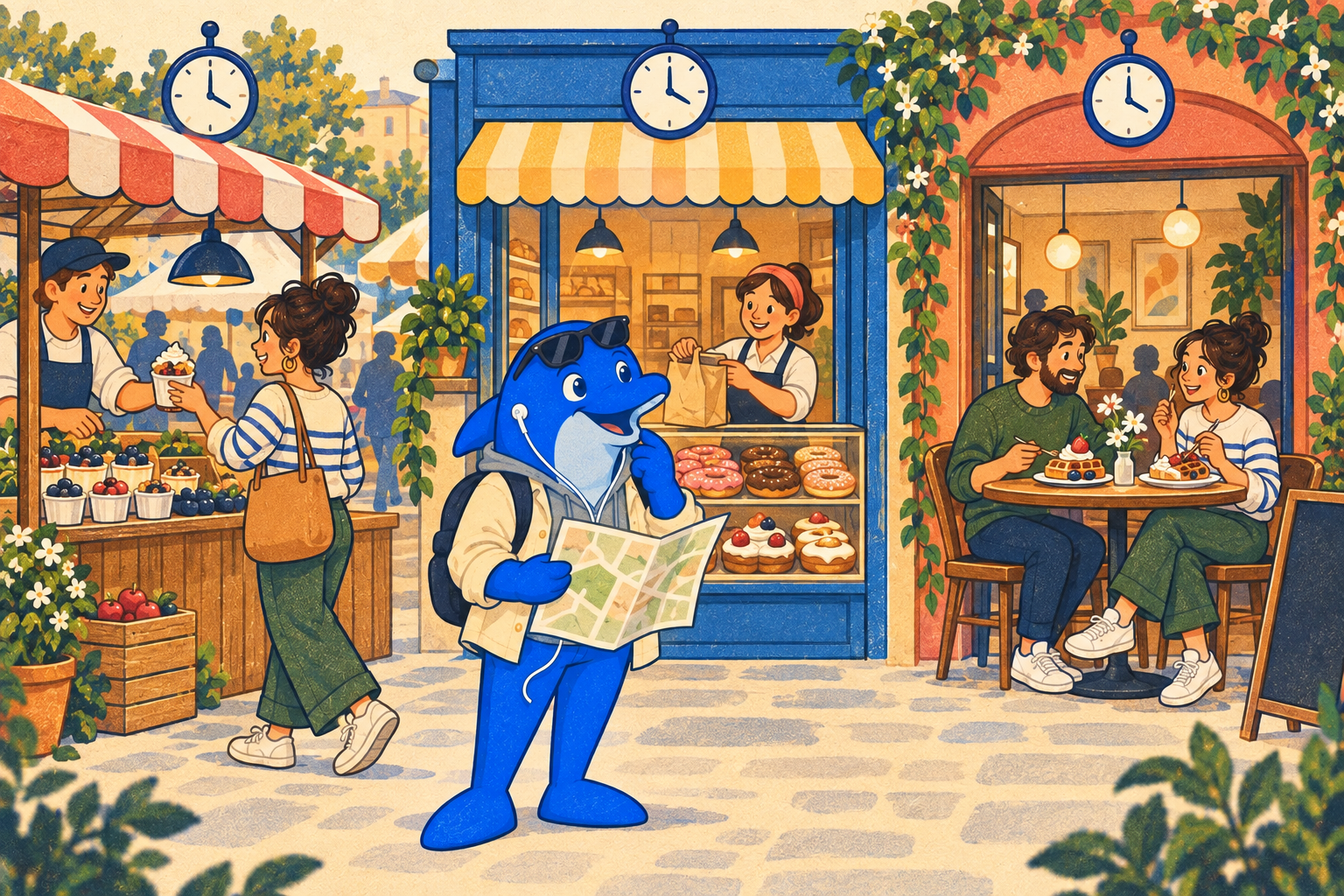
Three different visits need different practical information: a stall’s trading hours and pitch, a bakery’s collection route, or a restaurant’s seating and last orders. Illustration, not photographs of the named venues; the clocks do not represent opening times.
A crumble-led market visit
The useful detail is warmth, fruit, topping choice and location. Camden Market’s Humble Crumble listing gives a Camden Market Stables address and describes fruit crumbles with toppings. The Covent Garden listing describes the in-store crumble format and provides current opening information.
The dietary wording needs the same precision. Humble Crumble’s FAQ uses “gluten friendly” for options and listed menu components and says it cannot guarantee the absence of traces. That is useful information for a person managing a preference. It is not a claim of suitability for coeliac disease or severe allergies.
A central gelato, crepe or waffle stop
Amorino’s English Soho listing gives the store, product range and late hours. Its English Covent Garden listing gives the Garrick Street address and its local schedule. Covent Garden’s Amorino listing independently confirms the destination context and the address.
This format is useful when the person wants cold dessert choice or a menu that expands beyond gelato. A late-hours claim should always point to the named location and day, because a citywide label tells a visitor very little.
A bakery counter or after-theatre sweet
Bread Ahead’s official Leicester Square page describes doughnuts and sourdough pizza, late hours and a sample menu. Its Borough Market page provides the market address and bakery range. Visit London’s market guide also names Bread Ahead’s filled doughnuts in Borough Market.
This route suits a product-led bakery decision. A doughnut or pastry is a different kind of dessert stop from a bowl of crumble or a plated restaurant menu, so the page needs to make the product category plain.
A table-service dessert menu
Heavenly Desserts’ home and menu route links its restaurant offer, menu and click-and-collect path. The Elephant and Castle location page adds the local hours and last-order detail. That is the information a group needs when the plan is a dessert restaurant visit rather than a market stall.
The strongest practical distinction is not between premium and casual. It is between the actual formats a person can use: walk-up market dessert, counter purchase, late central gelato stop or restaurant table.
A practical operator checklist
For a restaurant or dessert operator, these are the practical details worth checking on each location page:
- An exact branch or market location. Borough Market’s visitor information supplies travel context, but the individual operator still needs to identify its own pitch or shop.
- A recognisable dessert format. Crumble, doughnut, gelato, crepe, waffle and table-service dessert are not interchangeable labels.
- A current time boundary. Opening times, last orders and market trading days change whether an after-theatre or late-evening result is feasible.
- An access route. A walk-up stall, a bakery counter, click and collect, and a table booking are different plans.
- A precise dietary statement. Operators should retain the language they can support, including cross-contact limits.
A brand can be present in an answer but still leave a reader unsure where to go or what they can order. A location page that answers these points gives the reader a practical next step. Our hospitality growth guide considers the broader discovery work for multi-site restaurants, while the AI-search measurement methodology explains why a named answer, a retrieved page and a completed action should remain separate records.
How was the research measured?
The research covers 54 London dessert-discovery queries from 25 September to 2 October 2026. One Bicester Village query from the original 55-question corpus was excluded from the London set. The filtered report contains 1,449 recorded answers: 540 from ChatGPT, 540 from Gemini and 369 from Google AI Overviews. Visibility is the number of those answers recorded as naming a brand, divided by the answer total for the same question group.
The corpus contains deliberate product and local-location coverage, including several British crumble and central-neighbourhood questions. Results should therefore be read as dated observations of this defined query set. They do not claim to measure demand, visits, sales, public preference or a citywide quality hierarchy.
The public research receipt records the dated answer counts, question groups, tracked-brand observations and retrieved-source totals used in this report.
Sources
- Humble Crumble, homepage
- Humble Crumble, locations
- Humble Crumble, FAQ
- Bread Ahead, Borough Market
- Bread Ahead, Leicester Square
- Amorino, Soho
- Amorino, Covent Garden
- Chin Chin Labs, Soho
- Heavenly Desserts, locations
- Heavenly Desserts, Elephant and Castle
- Heavenly Desserts, menu and click-and-collect route
- Borough Market, Humble Crumble trader listing
- Camden Market, Humble Crumble
- Covent Garden, Humble Crumble
- Covent Garden, Amorino Garrick Street
- Visit London, London food markets
- Visit London, London markets guide
- Borough Market, plan your visit
- The Infatuation, London Dessert Bucket List
- Time Out, hot desserts in London
Source check: 2 October 2026. Opening hours, menus, branches and dietary details can change. Check the relevant operator page before travel.


 Squarespace
 Webflow
 Sanity
 Shopify
 HubSpot