



TL;DR
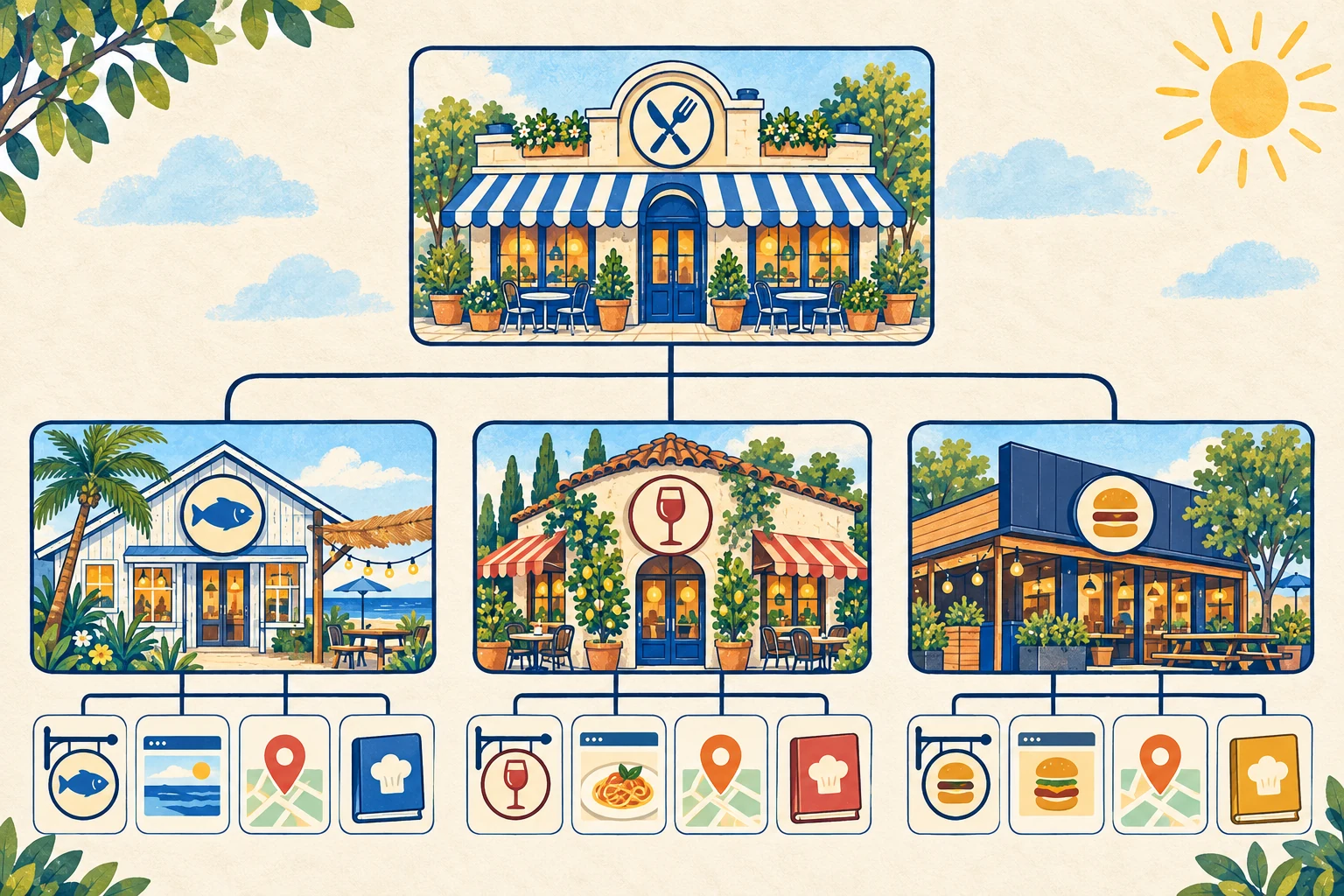
A multi-concept restaurant group should use a branded house when its venues make one recognisable promise, a house of brands when each concept needs freedom, and an endorsed portfolio when both the venue and parent carry useful trust. For many growing groups, endorsement is the practical middle choice.
Unsure which brand an answer engine associates with each restaurant? Run the free AI-search audit before changing names, domains or signage.
The architecture decision comes before the redesign. It decides which name guests should remember, where reputation should travel and how much freedom a new concept gets. It also affects recruitment, partnerships, gift cards, loyalty, websites and the story a landlord or investor sees.
Restaurant groups often inherit an answer by accident. The first venue becomes the company name. A second venue gets a fresh identity. The parent appears in the footer, then disappears from social profiles, press copy and recruitment. By venue six, the group owns a portfolio but has never decided how the brands relate.
What are the three restaurant brand architecture models?
Brand architecture is the way a company organises, manages and markets the brands in its portfolio. The useful choice is not between creativity and consistency. It is about deciding where recognition should sit.
On a phone, swipe sideways to read every column.
| Model | What the guest sees first | Best fit | Main cost |
|---|---|---|---|
| Branded house | One master name across the estate | Similar promises, formats and audiences | One weak experience can affect the whole name |
| House of brands | Independent venue and concept names | Distinct occasions, cuisines or price points | Every brand needs its own recognition budget |
| Endorsed portfolio | A venue name backed by the group | Distinct concepts with a useful shared reputation | The relationship needs disciplined, repeated execution |
Christopher Muller described closely related restaurant strategies as simple, monolithic and endorsed in Boston Hospitality Review in 2018. The labels have changed in common use, but the operator's choice is still recognisable.
When does a branded house work?
A branded house makes the parent brand dominant. Venue names usually add a place, format or product cue to the same master name. The guest carries trust from one opening to the next because the relationship is obvious.
This model works when the concepts share most of these things:
- a similar food and drink promise;
- a recognisable service style;
- an overlapping price band;
- a common guest occasion;
- operating standards that can deliver the same expectation.
Nobu's own restaurant site shows this pattern in practice. The city changes, but the Nobu name remains the lead signal across the global estate. That does not mean every dining room must look identical. It means the master name does most of the work.
The benefit is focus. One brand can support openings, recruitment, partnerships and loyalty. The risk is shared exposure. If the promise differs sharply between a late-night bar, a neighbourhood bakery and a formal dining room, one name starts to blur useful distinctions.
When does a house of brands work?
A house of brands keeps the venue concepts independent and leaves the parent in a quiet corporate role. Guests know the restaurants, not necessarily the company that owns them.
This model suits a group whose concepts serve different needs. A breakfast cafe, a tasting-menu restaurant and a live-music bar can build cleaner expectations under separate names. The structure can also preserve an acquired restaurant's local equity instead of forcing a rename.
Lettuce Entertain You's current restaurant directory makes the pattern visible. It brings a large set of distinct concepts into one group directory while names such as Aba, Beatrix and Ramen-San keep their own customer-facing identities.
Independence has a cost. Each concept needs its own launch story, visual system, social presence and demand. The parent cannot assume that affection for one venue will transfer to another if guests cannot see the connection.
When does an endorsed portfolio work?
An endorsed portfolio lets the venue name lead while a clear parent mark lends credibility. The endorsement can be verbal, such as “part of [Group]”, or visual, such as a restrained seal on menus, careers pages and the website footer.
This model earns its place when both levels matter. The restaurant needs a specific story, while the group has a reputation that helps with hiring, private dining, landlords, suppliers or a new-city launch.
Major Food Group presents a useful live example of the pattern. Its site names distinct concepts such as Carbone, The Grill and Torrisi, then states that each reflects the group's wider approach. The venue identities remain distinct, but the parent is not hidden.

Which model should a multi-concept group choose?
Start with five questions. Score the current estate before debating names or fonts.
- How much of the guest promise overlaps? If cuisine, price, service and occasion are closely aligned, a branded house becomes more credible. If they differ widely, keep the concept name in front.
- Where does trust already sit? Look at direct searches, review language, press references, gift-card demand and staff applications. A strong venue name should not be discarded to make the org chart tidier.
- Should reputation transfer? A new opening may benefit from the parent name. An experimental concept may need distance from it. Decide deliberately.
- Will the group acquire or sell concepts? Independent brands are easier to preserve through a deal. A branded house is harder to separate because the value sits in the shared name and systems.
- Can the team govern the model? A house of brands needs more creative and marketing capacity. An endorsed portfolio needs rules. A branded house needs operational consistency strong enough to support one promise.
The answer can vary inside one company. Ward and colleagues note that firms can use a house of brands at the top level and a branded house within one concept family. A restaurant group can own three independent concepts while one of those concepts runs six locations under a shared name.
Why is an endorsed portfolio often the practical default?
Many multi-concept groups sit between total sameness and total independence. Their restaurants have different names and occasions, but they share founders, operating standards, buying power, people practices and commercial relationships.
An endorsed portfolio can make that reality legible. It lets a guest choose the venue on its own merits while allowing useful trust to travel. It also gives the group a visible platform for recruitment, private events, partnerships and future openings.
There is a limit. The endorsement has to mean something that operations can uphold. “Part of North Street Restaurants” is useful only if North Street stands for a clear set of behaviours. Write the parent promise in one sentence. If the leadership team cannot agree it, the portfolio is not ready to ask guests to value it.
A 2025 study by Ward and colleagues looked at packaged goods rather than restaurants, so its figures should not be treated as a hospitality benchmark. In that UK sample, larger portfolios and sub-brands were associated with lower visual cohesion. More marks, colours and naming devices do not automatically create a stronger family.
How should the decision appear across names, websites and profiles?
Turn the chosen model into a small set of rules that every launch and acquisition can follow.
On a phone, swipe sideways to read every column.
| Surface | Branded house | House of brands | Endorsed portfolio |
|---|---|---|---|
| Venue name | Master name leads | Concept name leads | Concept name leads, parent endorsement follows |
| Group website | Estate organised under one brand | Parent directory links to independent concepts | Parent portfolio explains the shared promise and links out |
| Venue website | Shared system is usually efficient | Separate site can be justified by genuine independence | Either route can work if the endorsement stays visible |
| Local profile | Use the real-world venue name | Use the independent concept name | Use the endorsed form only if guests see it in the real world |
| Recruitment | One employer story | Concept story with corporate owner in the background | Group employer story plus concept-specific roles |
| Launch brief | Extend the master promise | Build a new brand case | Define concept difference and the value of endorsement |
Google's Business Profile rules require the name used in the real world and one profile per business. Architecture is not permission to add a parent name as a keyword. If the endorsement is not on signage, the website and customer materials, do not force it into a profile.
On the website, separate the group organisation from each restaurant. Google's Organization documentation supports details such as name, legal name, URL, logo and identity links. Schema.org also provides parentOrganization and subOrganization relationships. Each venue can still use the more specific Restaurant type with its own cuisine, menu, address and reservation information.
Structured data records the relationship. It does not create the strategy and does not guarantee that Google will show a search feature.
Domain choices need care too. Google supports site names at domain and subdomain level, but not at subdirectory level. If several concepts live under one parent domain, they can still have distinct pages and visual identities, but a folder does not gain a separate Google site name. Choose separate domains because the brands need real independence and the team can maintain them, not because a new domain feels more premium.
How do you roll out a new architecture without confusing regulars?
Use a staged change. Start with the relationship, then move through the estate.
- Inventory every public name. Include signage, menus, domains, local profiles, booking pages, delivery apps, social accounts, press boilerplates, gift cards and job adverts.
- Choose the lead brand for each concept. Record parent-first, venue-first or venue-first with endorsement.
- Write one relationship line. Staff, agencies and partners need the same short explanation of who owns what.
- Set minimum visual rules. Define logo order, endorsement size, naming syntax, colour ownership and where the parent should stay absent.
- Pilot on one low-risk surface. A careers page or group directory can expose gaps before a costly signage programme.
- Train the people who publish. Give general managers, recruiters, PR partners and developers examples they can copy.
- Review after one trading cycle. Check whether guests, staff and partners use the intended names without prompting.
Legal ownership and customer-facing architecture are related but different. GOV.UK confirms that a UK company can trade under a business name that differs from its registered name. WIPO defines a trademark as a sign that distinguishes one enterprise's goods or services from another's. Get legal advice for clearance and protection, but do not make the Companies House name carry the whole customer strategy.
How should the group measure whether the architecture is working?
Keep the commercial chain honest. A clearer parent-to-venue relationship can improve recognition and reduce confusion, but an answer appearance is not a booking.
On a phone, swipe sideways to read every column.
| Stage | What to record | What it proves |
|---|---|---|
| Answer appearance | Parent named, venue named, both named, or neither | The relationship is visible in the sampled answer |
| Traffic | Visits to group and venue pages by source | Someone reached an owned page |
| Enquiry | Calls, forms, private-dining leads or event requests | Someone expressed intent |
| Confirmed booking | Reservation accepted for a named venue | A booking exists in the operating system |
Add seated covers and contribution only when the data supports them. Do not convert a mention into revenue, or a booking into an incremental booking, without evidence.
Brand architecture is working when people can answer three questions quickly: Which restaurant is this? What does the group name add? Where should I go next? If the answer changes by channel, the model still needs work.
Sources
- Christopher Muller, “When is a Group a Chain, and a Chain a Brand?”, Boston Hospitality Review, Winter 2018
- Ella Ward and colleagues, “Keeping it in the family: measures and drivers of portfolio brand cohesion”, Journal of Brand Management, published online 19 July 2025
- Google Search Central, Organization structured data
- Google Search Central, Local business structured data
- Google Business Profile, Guidelines for representing your business on Google
- Google Search Central, Site names in Google Search
- Schema.org, Organization
- Schema.org, Restaurant
- Schema.org, parentOrganization
- Schema.org, subOrganization
- GOV.UK, Choose a company name
- World Intellectual Property Organization, Trademarks
- Major Food Group, group and concept overview
- Lettuce Entertain You, restaurant portfolio
- Nobu Restaurants, global restaurant portfolio


 Squarespace
 Webflow
 Sanity
 Shopify
 HubSpot