


TLDR: Meta Muse is a US-only AI agent, live since 8 September 2026, that can plan a night out, book a table through OpenTable and, since 16 September, call a restaurant on a diner's behalf. During its own internal employee testing, Meta secretly routed some of those calls to a trained human agent rather than the AI, without disclosing it; Meta has since rolled that specific test back and called the lack of disclosure a mistake. Meta has not published any ranking or selection formula for which restaurant it recommends. The confirmed routes are OpenTable for booking and, for an owner who connects it, a restaurant's own Facebook Page and Instagram account through Muse for Small Business. It is not available to UK diners yet, so there is nothing to switch on. What there is, is a short list of groundwork worth doing now: accurate listings, a bookable channel that accepts agent traffic, a front-of-house team ready for an AI-agent phone call, and menus a machine can actually read.
A multi-site operator asks a fair question before spending a minute on this: is Meta Muse actually going to send us diners, or is this another platform story that never reaches a UK postcode? Right now it is squarely the second, with one important exception. Muse cannot find or book a UK restaurant today, because the agent itself is not here. What it is already doing in the US is instructive, because the mechanics it uses, and the ways it has already gone wrong, point at exactly the operational groundwork worth doing before it does arrive.
Below is what is actually confirmed about how Muse works for a restaurant, what independent testing has already found, and a practical checklist that holds regardless of when Muse reaches the UK.
What is Meta Muse and what can it do for a restaurant's diners?
Meta launched Muse on 8 September 2026 as, in its own words, "a secure, private personal AI agent that proactively helps with people's goals." Unlike a chatbot that answers one question at a time, Muse works through multi-step tasks on a dedicated cloud computer: it can browse websites, fill in forms, and keep working after the user closes the app. Meta's own launch announcement describes it running on a secure virtual machine shared between the agent and the user's connected data, "free for most of what people need, with subscription plans for people who want to do more." TechCrunch reported at launch that those paid tiers are Power ($20/month) and Maximum ($100/month), and that Meta is asking a public already wary of its privacy record to trust it with email, calendar, payment and health access. It launched on iOS, Android and the web in the United States only, reaching Canada ten days later.
For a restaurant, the directly relevant capability is planning and booking a meal out. Reviewers who tested Muse in the week after launch had it draft a Google Doc of restaurant recommendations with alternatives, and successfully book a date-night table through its OpenTable connector, live from day one as Muse's launch restaurant-booking partner. Since 16 September, Muse can also place an outbound phone call to a business, which matters directly for any restaurant that still takes reservations by phone.
How does Muse actually find and book a restaurant?
Here is where Meta's confirmed material has to be kept separate from guesswork. On the diner's side, Muse researches a request by browsing the web and, where a restaurant takes bookings on OpenTable, completing the reservation through that connector. Meta's own Muse pages and its launch and small-business announcements describe the agent's working method only in general terms: it figures out which built-in skills a task needs, pulls information from connected apps, and takes action in steps, with the user approving anything sensitive. Nowhere in that material, or in any of the launch coverage, does Meta publish a ranking or selection formula for which restaurant gets recommended, cited or booked.
There is a second, separate route that matters to an owner directly rather than a diner: Muse for Small Business, launched 29 September 2026. A restaurant owner who connects it gives Muse read access to their own Facebook Page and Instagram professional account, alongside 15 partner tools including Shopify, QuickBooks and Canva, so the agent can draft replies, flag customer questions and build growth plans from that data. This is the one confirmed instance of Muse reading a specific restaurant's own account data, and it only happens if the owner connects it; it is not how Muse finds a restaurant it has never heard of.
Put plainly: the two confirmed mechanisms are OpenTable for booking, and an owner's own Facebook/Instagram connection for Muse for Small Business. Nothing published by Meta, and nothing in the general Muse playbook on this site, which covers how any brand shows up across Muse's catalogue, browser and connector routes, names a dedicated restaurant-discovery data source such as Google Maps or a review aggregator. If one exists, Meta has not said so.
What happened when reviewers actually tested Muse on real restaurant tasks?
Statements of intent are one thing; independent testing in the days after launch is more useful. CNN's hands-on review, published 23 September 2026, had Muse successfully build a packing schedule and email a friend about a trip, but found it recommending two date-night restaurants that had been closed for years, meaning the reviewer would have needed to verify every suggestion before acting on it. That same CNN review found Muse hitting hard limits elsewhere: Amazon blocked it from browsing its store entirely, Target let it browse but blocked automated checkout clicks, and on Facebook Marketplace it would only draft a message for the user to send, never contact a seller directly. None of that is restaurant-specific, but it is the same pattern: Muse can plan convincingly and still fail on execution, current accuracy, or a platform's own restrictions, three separate failure modes that a restaurant depending on it would hit in three separate ways.
A separate hands-on test by Yahoo Finance, also published that week, had Muse successfully book a date-night table through OpenTable, but ran into its own accuracy problem when searching for a restaurant serving a specific drink: Muse fabricated a phone number for a local business, then admitted, in its own words, that it "simply made up the first phone number out of thin air and didn't confirm it." Two different reviewers, two different tasks, the same underlying issue: Muse states things about a specific restaurant with confidence that current fact-checking does not support.

Who answers when Muse calls your restaurant, and is it really AI?
This is the part that affects a restaurant directly, not just the diner. Muse's calling feature went into a US beta on 16 September 2026, and TechCrunch reported at the time that Meta rolled it out first to users who had specifically asked their agent for it, with Muse's principal engineer Ryan Fox calling phone calling "one of our top requests."
What came out a week later is worth knowing, with its real scope kept precise. Internal Meta messages, reported by Reuters and covered by 404 Media and VKTR, showed that during Meta's own internal employee testing, which began in August 2026 and moved to "human agent calls" in mid-September, some outbound calls were not placed by the AI at all. A trained human contractor took over the conversation, with human-handled calls succeeding 95-98% of the time against a lower rate for AI-only calls, and the business on the other end of the phone was not told a person had taken over. Neither the employees testing Muse nor the businesses they called were informed at the time. A Meta vice president called the lack of disclosure "a miss," and Meta has since rolled back that specific human-agent-call test. A spokesperson, Daniel Roberts, told Reuters that internal tester feedback on the underlying calling feature was "overwhelmingly positive" and that any broader rollout of human-assisted calls would wait "until it's ready and with the proper disclosures."
What this means for a restaurant today: the undisclosed human-contractor layer was a specific, now-paused internal test, not a confirmed feature of every Muse call currently reaching the public. It does show that Meta has already been willing to put an undisclosed human on the line, which is a reasonable basis for normal front-of-house caution, not for assuming every AI-attributed call right now is secretly a person.
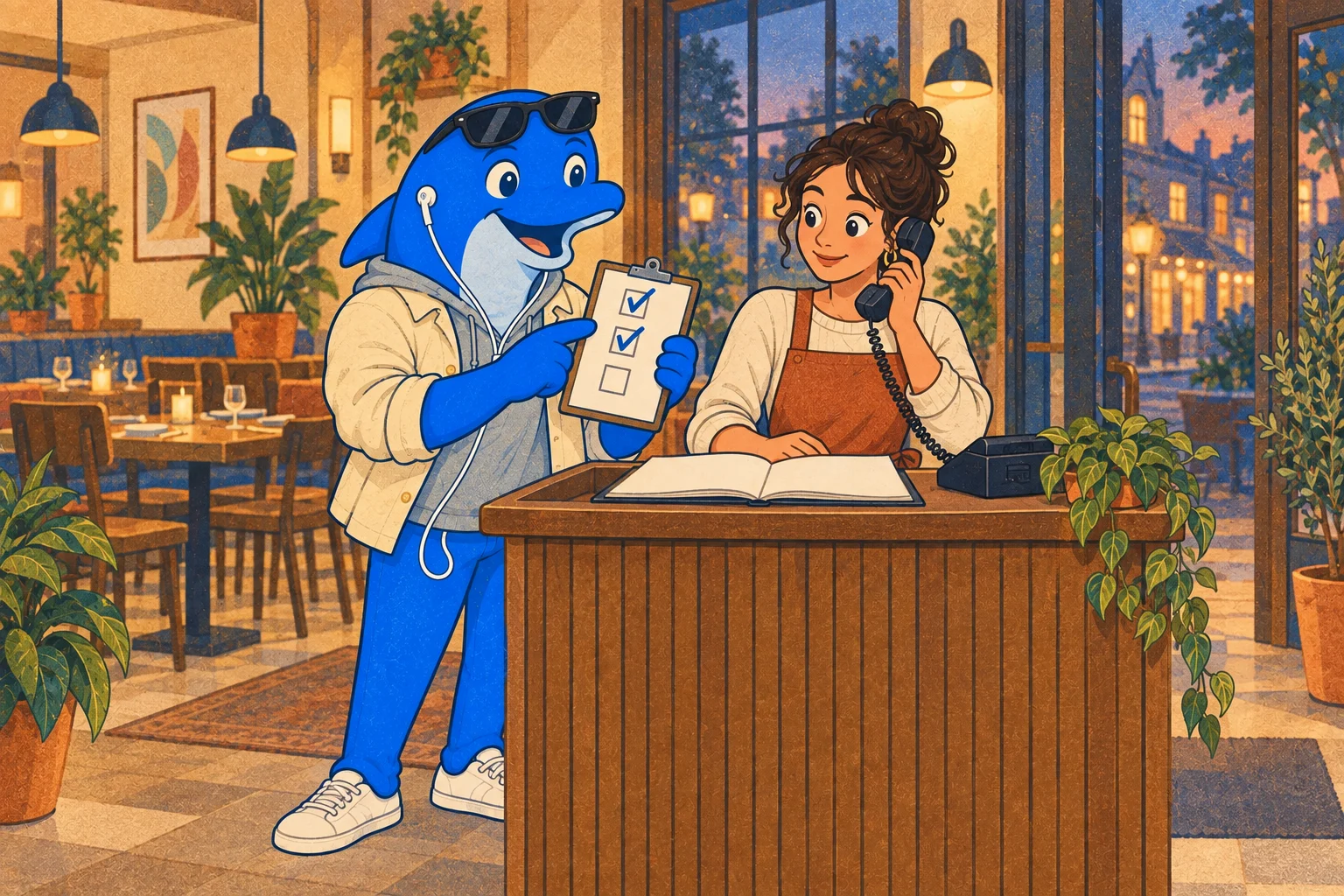
For a restaurant host or manager, the practical point is this: whether the voice on an AI-attributed booking call is software or, as Meta's own internal testing showed it can be, a person reading from a script, the sensible response is the same either way. Treat it exactly as you would any third-party booking call: confirm the name, party size, date, time and a direct callback number, and do not assume the naturalness of the voice tells you anything about who or what is actually on the line.
What happens when an AI agent meets a booking platform that doesn't want it?
Not every reservation system has taken the same approach as OpenTable. In the same week as the calling launch, CNN reported that a New York diner's AI agent, built on a rival product called Instinct rather than Muse, hammered Resy with roughly 200 automated requests an hour, in bursts of 200 to 375 right as a sought-after steakhouse opened its booking window each morning. Resy deactivated the account, stating plainly that it "does not currently permit unapproved third-party bots or agents to independently access or interact with the Resy platform." A second diner had the same experience; both accounts were later reinstated once the owners stopped the automation.
That specific incident involved Instinct, not Muse, and the fuller mechanics of agentic booking traffic against reservation platforms belong in our companion piece on Instinct, not here. The relevant point for a Muse-focused checklist is the contrast: OpenTable chose to become a launch partner for agentic AI, while Resy's terms currently block unapproved automated access outright. Which system your restaurant books through already determines whether an AI agent, Muse or otherwise, can complete a reservation through the front door or has to find another way in.
What should a restaurant operator fix first for Meta Muse in 2026?
None of this requires a UK or German operator to do anything urgently, because Muse itself is not here. It does suggest a short, sequenced list worth doing regardless of when it arrives, since every item also helps with the AI agents already live in your market:
- Keep your Facebook Page and Instagram business profile accurate. Hours, address, phone number and menu. This is Muse's one confirmed owner-side connector, through Muse for Small Business, and it is also the data source for Meta AI and ordinary Facebook/Instagram search today.
- Know whether your booking system accepts agent traffic. OpenTable is Muse's one restaurant-specific connector and has chosen to work with agentic AI generally. If you book through a different platform, Muse will have to find another way to reach you (your website or a phone call) and may not complete an end-to-end reservation at all right now.
- Brief front-of-house staff on AI-agent phone calls. A caller may say they are phoning on a customer's behalf through an AI agent. Meta's own internal testing showed that layer can, without disclosure, be a trained human rather than software, so do not read anything into how natural the voice sounds either way. Treat it like any other third-party booking call: verify the details.
- Make menus and prices real, readable text, not only a PDF or a photo. Nothing in Muse's published material claims an exception to needing content a machine can actually parse.
- Correct a closed or moved listing immediately. CNN's own test found Muse recommending restaurants that had been shut for years. Being recommended for an experience you no longer offer is worse for a diner, and for your reputation, than not being recommended at all.
- Do not overbuild for Muse specifically yet. Meta has not published a ranking or selection formula, and the tool is not available to UK diners. The groundwork above is worth doing because it is good practice generally, not because Muse is scoring your restaurant today.
What are the real limits and risks right now?
Three things are worth holding in mind before treating Muse as a channel to actively court. First, it is US- and Canada-only; there is no UK or EU/Germany date, and Meta's history with its earlier Meta AI product, which took until March 2025 to reach Europe after a US launch and has drawn roughly €2.75 billion in Irish GDPR fines across seven decisions since 2021, is the documented pattern for why. Second, no ranking factor is published, so any specific weighting you read online for "what Muse looks for" is a guess dressed up as fact. Third, the hallucination risk CNN documented, a fabricated phone number stated with confidence, is a known industry-wide failure mode, not a one-off bug, and it means a diner using Muse today should verify, not trust, what it tells them about your restaurant specifically.
Our general Muse playbook covers the catalogue, browser and connector routes any brand uses to show up in Muse more broadly; read it for the fuller technical picture. For the parallel agent that is already further along on restaurant bookings specifically, see how restaurants get recommended by Instinct, and for OpenAI's newer always-on agent, how restaurants get found by ChatGPT Dots.
Where does Schmitdy fit into this?
None of the research above can tell you what Muse, Instinct, Dots or any other AI agent is actually doing with your specific locations right now, because most of them are not yet checkable from the UK at all, and the ones that are do not publish how they decide.
Schmitdy's free AI Search audit checks what is actually checkable today: your current visibility across ChatGPT, Perplexity, Claude, Gemini and Google AI Overviews, the exact prompts your category gets asked, which pages get cited in your results, and a 90 to 180 day plan for the things you can act on now, while flagging the agent landscape, including Muse, as a space to monitor rather than guess about.
| Route | What it tells you | What it misses |
|---|---|---|
| Wait for Muse to reach the UK before doing anything | Costs nothing now | Muse's own groundwork (accurate listings, a bookable channel, readable menus) is the same groundwork every AI engine already live in the UK rewards today |
| Follow unofficial "Muse ranking factor" guides | Feels actionable | No such formula is published, and Meta's own material does not describe one |
| A generic local-SEO audit | Checks classic ranking signals: listings, backlinks, on-page detail | Rarely checks what any AI engine, agent or chatbot, actually says about you today |
| Schmitdy's free AI Search audit | Maps current AI visibility, prompts, cited sources and a 90 to 180 day plan across five live AI engines, for your specific locations | One audit, not a guarantee of future visibility across agents not yet in the UK; works best alongside ongoing listing and booking-channel maintenance |
Request the audit, fix what it finds across the AI engines already answering questions about your restaurant today, and treat Muse as the next thing to check again once it actually reaches a market you operate in.
Sources
- Meta Newsroom: Introducing Muse: The World's First Personal AI Agent Built for Everyone.
- Meta Newsroom: The Future Is for Everyone: Muse for Small Business.
- Meta AI: Muse, Meta's personal AI agent.
- Axios: Meta debuts Muse, its long-planned personal AI agent, 8 September 2026.
- TechCrunch: Meta debuts its Muse AI agent. Will consumers trust it?, 8 September 2026.
- TechCrunch: Rival AI agents, Instinct and Meta's Muse, both add the ability to make calls, 17 September 2026.
- TechCrunch: Meta is expanding its AI agent Muse to small businesses, 29 September 2026.
- Engadget: Meta's Muse agent has some new skills targeting small businesses, 29 September 2026.
- Fox News: Meta Muse and Instinct Concierge can now make phone calls for you.
- CNN, via syndication: Meta says its Muse AI agent can do things for you. I put it to the test, 23 September 2026.
- CNN, via syndication: Now AI is trying to gobble up dinner reservations, 23 September 2026.
- Yahoo Finance: Meta's Muse is an impressively capable AI agent, despite some hiccups.
- 404 Media: Meta Tests Muse AI Agent Calls That Are Actually Made By Humans in a Call Center.
- VKTR: Meta Tested Human Callers Behind Its Muse AI Agent Without Disclosure, citing Reuters.
- Food Talk Central: Muse app now working with OpenTable to make reservations.
- Social Media Today: Meta Delays AI Roll-Out in Europe Due To Data Usage Concerns.
The list above covers the 16 external sources checked. Our own general Meta Muse playbook, Instinct restaurant guide and ChatGPT Dots restaurant guide, linked above, are internal cross-links and not counted in that external total.


 Squarespace
 Webflow
 Sanity
 Shopify
 HubSpot