



TLDR: Four kinds of people can help a restaurant group show up in ChatGPT: your own team, your PR or marketing agency, a specialist AI-search service or a tool you run yourself. If two or three specialists all answer your questions well, stop asking questions. Pay each for a 30-day test on two of your venues each and sign the one whose work you can check.
You have three proposals on the table. All three say nobody can guarantee a ChatGPT recommendation, all three promise a proper baseline, and all three send a neat monthly report. They sound the same because most agencies have read the same buyer checklists, including ours. The answers have converged. The work has not.
So when the pitch can no longer separate your finalists, let a month of work on your own restaurants do it. A short, paid test on two venues each shows who ships real fixes, who keeps you in control and who counts the right results. The seven checks below tell you how to score it.
Who can help a restaurant group show up in ChatGPT?
Four kinds of help exist, and each is best at a different job. Your own team knows the facts and can correct a wrong menu or opening time fastest. Your PR or marketing agency earns the press and guide coverage that assistants often list as sources, though it rarely owns the pages and listings that feed the answer. A specialist AI-search service does that page and listing work week by week. A tool measures where you appear, but someone still has to act on what it finds.
We compare these routes in detail in our guides to tools, agencies and agents and to whether your PR agency should own AI search. If you have already decided to hire a specialist and have two or three good ones left, the next step is to test them.
Why do good finalists sound the same?
Because the questions are public. Our own brief template for an AI-search agency, our audit scope guide and our procurement guide between them list the questions to ask a supplier. Any agency worth shortlisting has read pages like these and has polished answers ready.
That is good news for the industry and bad news for your decision. A good answer to "how will you measure success?" tells you the agency knows the right words. It does not tell you whether it will fix the wrong opening hours on your Islington site by Thursday. Only the work tells you that, which means the separator has to be work done on your venues.
What can an agency actually change in 30 days?
An agency can change what assistants are able to read about your restaurants. It cannot change how they choose. That boundary shapes a fair test.
OpenAI says its search crawler, OAI-SearchBot, is the one that helps sites appear in ChatGPT search, and recommends allowing it in robots.txt; it notes that a robots.txt change takes about 24 hours to apply. Perplexity gives the same advice for its own crawler. Google says there are no extra requirements or special optimisations for its AI features, and that indexing and serving are not guaranteed. A peer-reviewed study presented at the KDD conference in 2024 found that changing how a page is written can raise how visible it is in generative answers on the authors' test set.
So inside a month an agency can open crawler access, correct venue facts, rewrite thin pages and fix listings. Whether assistants then name the venue more often is less certain. In a study published by SparkToro on 28 January 2026, run with the tracking firm Gumshoe, 600 volunteers ran 12 prompts 2,961 times and found less than a 1 in 100 chance that ChatGPT or Google's AI returned the same list of brands twice. One screenshot proves nothing. SparkToro suggests 60 to 100 runs of a prompt to read a stable visibility rate; a month's test cannot reach that for every question, so ask each finalist to state its run count and keep it the same at baseline and retest. A test has to judge the quality of the work and the method behind the numbers, not a single before-and-after picture.
How do you run a 30-day test on two venues?
Give each finalist the same rules, different restaurants and a fixed end date. Two agencies editing the same venue would trip over each other, and you could not tell whose change did what. A group needs at least four venues to run this for two finalists. With three finalists you need six venues, so cut the list to two first, using the seven checks on their proposals.
- Pick the venues. Give each finalist the same mix: one venue that already appears in AI answers and one that does not, matched across finalists by concept and city.
- Fix the questions. Write 15 to 20 guest questions from one template (cuisine, area, occasion, party size), fill it in for each venue, and give every finalist the same template.
- Agree one written scope. Same fee, same 30 days, same access level, one named approver at your end and an end date.
- Baseline in days 1 to 5. Each finalist runs every question many times, states its run count, and records the answers and listed sources, venue by venue.
- Ship fixes in days 6 to 25. Each finalist ships a small number of named changes to pages and listings, through your approver.
- Retest in days 26 to 30. Each finalist reruns the same questions the same way, then shows you what changed, the evidence and the retest.
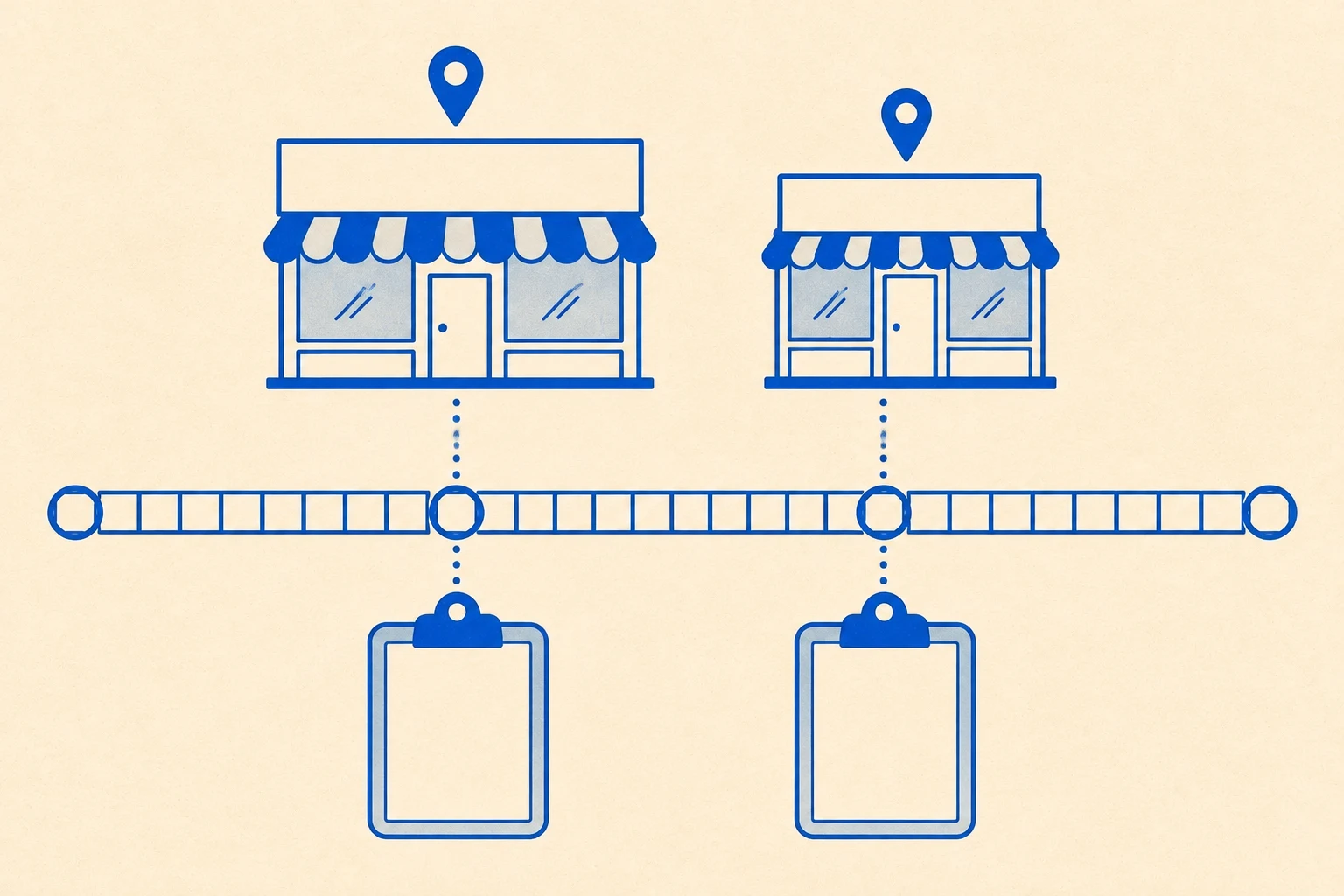
This is not the paid diagnostic in our RFP template. A diagnostic comes before you write the brief: one supplier sets your baseline, and it is kept separate from any contract award. This test comes after the proposals: two finalists do the same delivery work side by side, and the result decides who gets the contract.
Paying for the month matters. It makes the test real work, and it removes any excuse that the agency held back. Our own managed service has no long commitment, so you can run this test with us too. Our pricing page says: "Each 30-day month stands on its own, with 30 days' written notice to end. Half the Managed fee is due at the start of each month, and the second half only when either agreed monthly goal is met."
Which seven checks decide the test?
Score each finalist on what it delivered, not on what it said. Each check links to the guide that explains it in full.
| Check | The test must show | Fail sign |
|---|---|---|
| Same questions | One question template, filled in for each venue | Its own favourite questions |
| Repeated baseline | Many dated runs per question, per venue | One screenshot per question |
| Shipped fixes | Named pages or listings changed and live | A deck of recommendations |
| Right venue counted | Brand, correct venue and booking link counted apart | One group-wide score |
| Approvals kept | Every public change cleared by your approver | Changes you found afterwards |
| Access stays yours | You stay owner; supplier holds lower roles | Supplier owns profiles or analytics |
| Fee earns its keep | A named covers target and how it is counted (US example) | Uplift claims with nothing counted |
The access check is concrete. On a Google Business Profile, only owners can add or remove users and each profile has one primary owner, while managers cannot add or remove anyone. In Google Analytics, adding or changing users needs the Administrator role. If a finalist asks to own either during a test, it fails that row.
When is a test not worth it?
A test pays when a wrong signing would cost far more than the test. Here is a worked example with our own assumptions, so swap in yours.
An eight-venue group is choosing between two finalists, each quoting about £2,500 a month on a 12-month contract. A wrong choice commits £30,000. Paying both for one test month at their normal rate costs £5,000. The winner's month is work you would have paid for anyway, so the extra cost is the other finalist's fee, £2,500, a twelfth of that year. For that group the test is cheap insurance.
A three-venue group cannot give two finalists two venues each anyway. If its finalists quote about £1,500 a month with 30 days' notice, a wrong choice costs about two months, £3,000, before notice runs out. For that group the first month of an ordinary month-to-month contract is the test. Brief it well with our agency brief template and judge month one against the seven checks.
The test is also wasted if your real gap is not AI search at all. If guests cannot book the right venue or your reviews are thin, fix that first; our guide to in-house teams, agencies and AI-search partners helps you place that work.
What should UK, US and German groups check in the pitch?
The rules on claims and reviews differ by country, and a pitch that promises fast results or "more reviews" should meet them. Check the finalists' claims against your own market.
United Kingdom
UK advertising rules say marketers must hold documentary evidence for objective claims before they publish them (CAP Code rule 3.7). Ask a pitch for the same: the evidence behind any uplift figure, before the meeting ends. If a plan includes review tactics, check it against the UK ban on fake and concealed incentivised reviews, which the competition regulator explains in its guidance published 4 April 2025. Since April 2025 the regulator can fine firms up to 10% of global turnover.
United States
The FTC expects a reasonable basis for objective advertising claims before they are made, a policy dating from 1984. Its rule on consumer reviews and testimonials went into effect on 21 October 2024. It allows incentives for reviews only without a requirement to express a particular sentiment, and the FTC warns that asking only happy customers could still break the FTC Act.
Germany
German unfair competition law bans misleading commercial practices aimed at consumers or other market participants (UWG section 5), so it reaches a misleading pitch to a restaurant group, not just ads to guests. Its blacklist bans submitting or commissioning fake consumer reviews, and claiming reviews come from real guests without reasonable checks (UWG Annex, numbers 23b and 23c).
For what you may ask guests for, and how, see our guide to getting more Google reviews across multiple restaurant locations.
What should you do this week?
Pick the four venues, write the 15 to 20 questions and send both finalists the same one-page scope with the seven checks attached. Sign whoever ships fixes you can see live and hands you a retest you can rerun yourself, then write that question list and the exit terms into the contract.
If you want us to be one of the finalists, start with a free AI-search audit of one venue. Tracking is where we start; our Restaurant AI Search service then does the work, from Google Business Profile, Search Console and analytics setup to AI-ready menu pages, with a person checking every change.
Sources
All pages were checked on 3 November 2026.
- OpenAI: overview of OpenAI crawlers.
- Perplexity: Perplexity crawlers.
- Google Search Central: AI features and your website.
- Aggarwal and others: GEO, Generative Engine Optimization, KDD 2024.
- SparkToro: AIs are highly inconsistent when recommending brands or products, 28 January 2026.
- Google Business Profile Help: manage owners and managers.
- Google Analytics Help: access and user management.
- ASA and CAP: substantiation, general.
- CMA: short guide for businesses publishing consumer reviews, 4 April 2025.
- GOV.UK: new consumer protection regime comes into force, 7 April 2025.
- FTC: policy statement regarding advertising substantiation.
- FTC: consumer reviews and testimonials rule, questions and answers.
- German Act against Unfair Competition (UWG), section 5.
- German Act against Unfair Competition (UWG), Annex.
- Schmitdy: pricing and terms.


 Squarespace

 Webflow
 Sanity
 Shopify
 HubSpot