

TLDR: Marketing a bar group with multiple venues works best when head office runs every bar's facts and systems (Google profiles, venue pages, opening hours, guest data, review routine, reporting) and each bar keeps its own events, voice and local partners. Then measure each venue separately, because guests choose a bar, not a group.
In March 2024, Nightcap, the UK bar group behind Dirty Martini, Barrio and The Piano Works, told shareholders how it planned to market brands that sit side by side in the same city centers. "To ensure each brand retains its edge and uniqueness, a systems and processes overhaul is underway to allow a complete customer view when marketing to Nightcap's database of more than one million customers," its interim results said, alongside "differentiated events and social media" for each brand.
Nightcap's split is a useful model for any bar group. Centralize the facts and the guest data. Localize the personality. A group that lets every bar run its own profiles ends up with five sets of opening hours online, and a group that runs everything from the central team ends up with five bars that sound the same. If you would rather see where your bars stand first, our free AI search audit checks each venue separately.
Which brand architecture fits your bar group?
The first decision is how much of the group the guest should see, because that decides what head office is allowed to make uniform. There are three common shapes.
| Architecture | What guests see | Fits when |
|---|---|---|
| One brand, many sites | The same name and concept everywhere | The drinks, look and price point repeat |
| Endorsed brands | Distinct bars, a visible group name | Guests or staff trust the group name |
| Independent venues | Separate names, no visible group | Each bar's character is the reason to go |
Nightcap's own results show the middle and last shapes working together. Its interim results describe a cluster model "where several brands can exist side by side in city centres across the country without risk of dilution due to the differentiated curated events and experiences offered by the different brands." The bars stay distinct to guests, while the database and systems behind them are shared.
A group whose sites repeat one concept, such as a cocktail brand with branches in several cities, can win by being one strong shared brand. Google's Business Profile guidelines expect exactly that: "All locations must have the same name unless the business's real world representation consistently varies from location to location." In that case local personality matters less, and the central team can run more, including the social voice. The split in this guide matters most for endorsed and independent bars, where a uniform voice would erase the reason to visit. For how AI answers handle the same choice, see whether AI sees your restaurant group as one brand or as separate venues and how to choose between one website or separate websites for a restaurant group.
What should head office run for every venue?
Head office should own anything a guest, a booking platform or an AI assistant uses to tell one bar from another, because those facts break first when nobody owns them. That means one fact record per venue, kept in one place and pushed out to every surface.
The record for each bar holds:
- the exact trading name, address and phone number;
- regular and special opening hours, including late finishes;
- booking, group booking and events links;
- the current drinks and food menus as web pages;
- the Google Business Profile and its category;
- the venue page on the group website;
- the review reply standard and its deadline;
- which guest list and consent each email address belongs to.
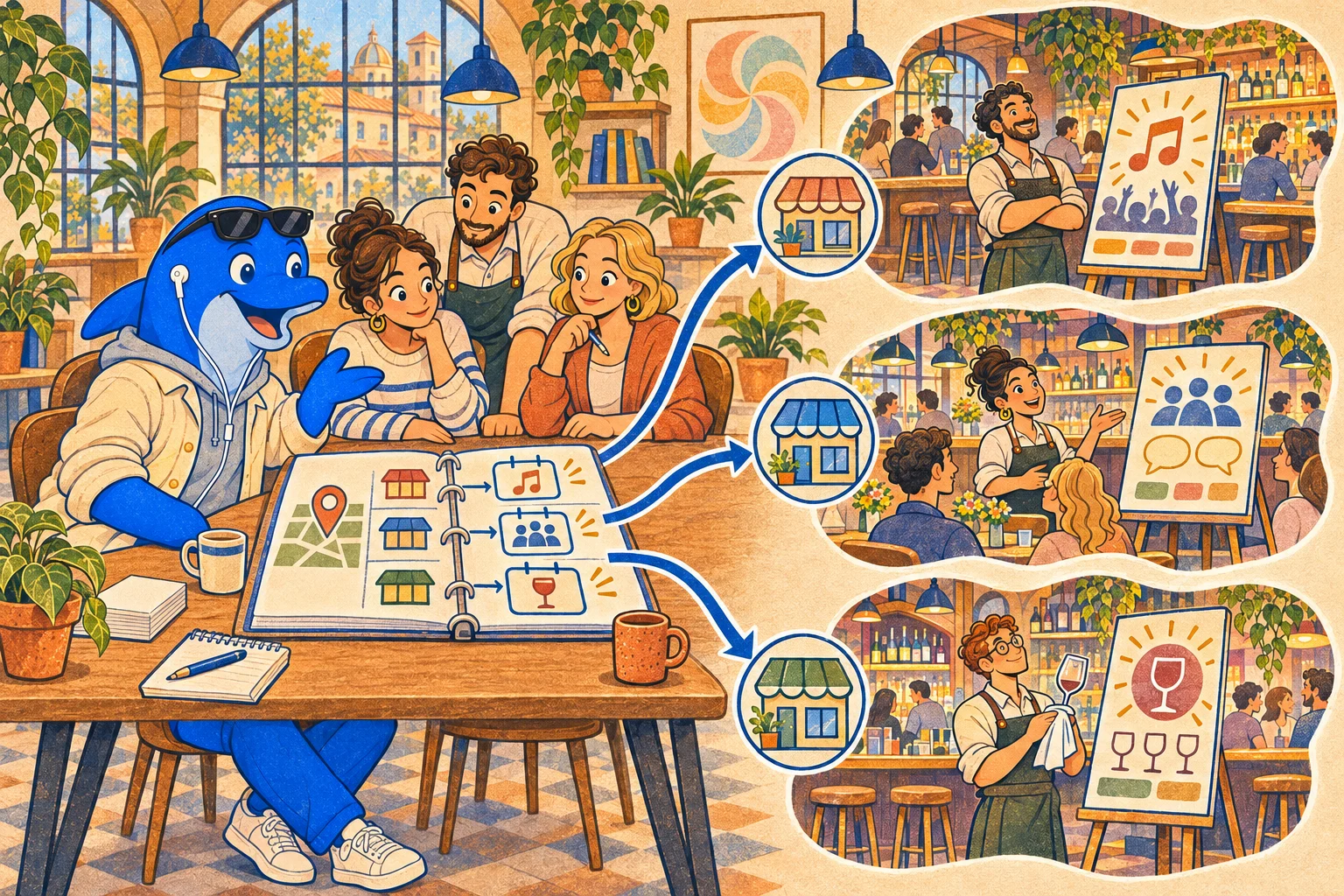
One fact record at head office feeds every bar, and each bar still makes its own events. The binder is shared; the posters are not.
Who keeps the opening hours right?
Head office should check every opening-hours change, because late and one-off hours are easy to get wrong. Google's special hours help says a set of special hours cannot exceed 24 hours, and a set that runs from before midnight to past noon the next day must be split in two: one set to the end of the first day and one starting at midnight. A bar manager entering one-off hours for a single event can easily pick the wrong day or time, so the central team should check each change before it goes live.
Who owns the Google profiles?
Central control of profiles saves time. Google lets a business verify profiles in bulk when it has 10 or more locations of the same business; a smaller group verifies each one. Either way, the owner role should belong to the group account, so a departing manager does not take a venue's profile with them.
Where should guest data live?
Guest data also belongs with the central team, because consent rules travel with the data, not with the bar. Each market sets its own rules for marketing email:
- US: the FTC's CAN-SPAM compliance guide requires a clear way to opt out and says "You must honor a recipient's opt-out request within 10 business days."
- UK: the ICO's electronic mail marketing guidance says "You must not send marketing emails or texts to individuals without specific consent," with a limited soft opt-in for your own previous customers.
- Germany: section 7 of the UWG treats email advertising without the recipient's prior express consent as unreasonable harassment, with a narrow exception for existing customers.
What should each bar keep for itself?
Once head office holds the facts and the guest data, the rest belongs to the bars. Each bar should own whatever gives a guest a reason to choose it tonight: its events, its social voice, its local partners and its staff stories. These are the things the central team cannot write well from a distance, and they change weekly.
Events are the clearest example. A wine bar's tasting night, a cocktail bar's guest shift and a late venue's DJ line-up each belong to the people who run them. The central team's job is to make sure every event the bar announces also lands on that bar's web page and profile, with a date, a start time and a booking link, so the event is findable outside Instagram.
Promotions need a rulebook from the central team, even when each bar runs its own. The rules differ by market:
- US: drink-special rules are set state by state, and a 2022 national study of bars near public universities compared states with and without laws banning happy hour specials altogether. Check each venue's state before a happy hour post goes out.
- UK: CAP Code section 18 says alcohol marketing "must be socially responsible", and rule 18.10 says a promotion "must not imply, condone or encourage excessive consumption of alcohol". In England and Wales, the mandatory licensing conditions also ban irresponsible promotions on the premises.
- Germany: the Deutscher Werberat's rules for alcohol advertising, revised from January 2026, cover social media as well as print and outdoor advertising.
How do your bars promote each other without blurring?
Cross-promotion works when it tells a guest what each bar is for. The group page should list every venue with one plain line on the occasion it suits, such as a quiet glass after work, cocktails before dinner, or dancing after midnight, and each venue page should link to its siblings with the same lines.
That structure helps guests and search tools alike. A guest who finds the wine bar full can see the cocktail bar two streets away. The same plain-text lines are there for any search engine or assistant that lists the page alongside an answer, which matters when a question names an occasion rather than a bar. Our guide to keeping AI recommendations consistent across every location covers the same setup for restaurant groups.
The email list follows the same rule. A guest who signed up at one bar should hear about a sister venue only where their consent covers it, and the message should say why that bar suits them. Nightcap's "complete customer view" helps here, because one shared record lets the central team see which guests already visit more than one bar.
How do AI assistants pick a bar for tonight?
AI answers to where should we go tonight questions keep sending people back to facts that head office now owns: hours, booking rules and access. Google's guidance on AI features in Search says there are "no additional requirements to appear in AI Overviews or AI Mode", and lists "Checking that your Merchant Center and Business Profile information is up-to-date" among the basics.
Google's local ranking help is just as plain: "Businesses with complete and accurate info are more likely to show up in local search results." An independent preprint by Vladimir Pitenin, Invisible to the Machine, audited all 4,776 cafes, restaurants and bars in Canggu and Ubud on Bali and found that 85.6% of venues were never recommended by ChatGPT, Claude, Gemini or Perplexity. Entry into answers was associated with review volume, an own website, listed prices and third-party mentions. It covers one market, but the pattern is the one head office controls.
Our own test points the same way. On 1 November 2026 we put 30 night-out questions to Claude with web search switched on, on a single day. In 28 of the 30 answers it told the person to confirm hours, booking rules or access with the bar, and five of the 193 sources listed alongside the answers came from a bar's or bar group's own website. The detail is in our guide to how cocktail bars show up in AI recommendations, and our London nightlife AI search study shows how this plays out across one city's late-night questions.
How do you measure each venue every month?
Measure each bar on its own, because a group total hides the venue that is missing. A wine bar that never appears for quiet wine bar near the station is a different problem from a cocktail bar that appears with last year's hours, and both disappear inside a group average.
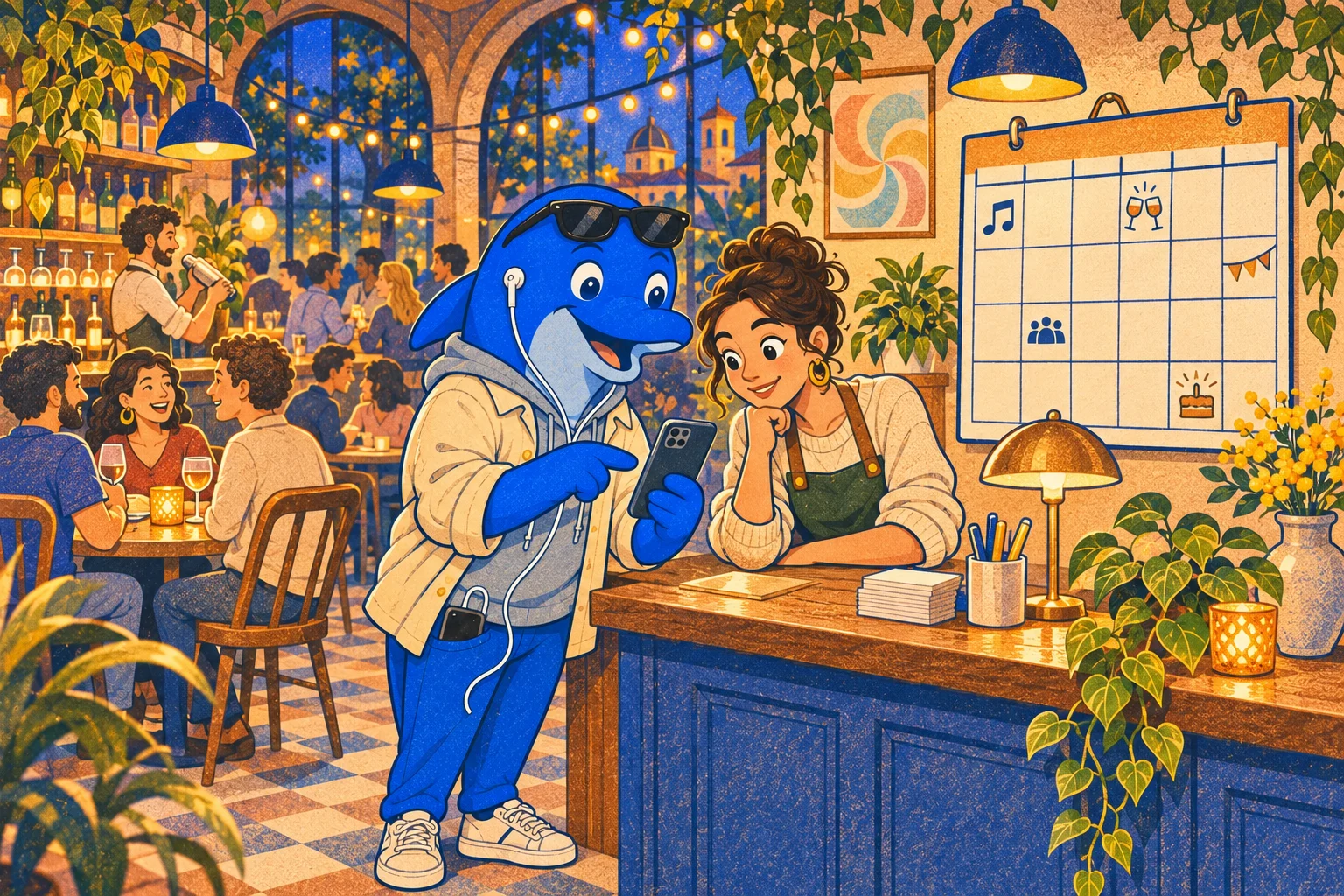
A monthly check happens bar by bar. The manager knows which answers are wrong; the central team keeps the record.
Repeat each question, because single answers vary. A SparkToro study of 2,961 runs found less than a 1 in 100 chance that ChatGPT or Google's AI, asked the same question 100 times, gives the same list of brands in any two responses. It tested product and brand questions, not bars, so judge a bar on several answers to the same question.
A monthly check per venue takes five steps:
- Write six questions each bar should win, such as late opening, the drink it is known for and a group booking.
- Ask each question in ChatGPT, Gemini and Google's AI Mode, twice, and save every answer.
- Mark whether the bar appears, whether its hours and booking route are right, and which sources are listed alongside it.
- Compare that bar's page in the Search Console generative AI performance report, which shows impressions from AI Overviews and AI Mode by page.
- Give each wrong fact to its owner from the table below, and recheck next month.
For a group of five bars, that is 5 bars × 6 questions × 3 assistants × 2 runs, or 180 answers a month. At about a minute to read and log each one, that is three hours of work. The minute per answer is our assumption, not a measured figure. When a single bar keeps failing, our guide to why a bar isn't showing up in AI answers helps decide which venue to fix first.
Where does Schmitdy fit?
If you would rather not run the central half yourselves, that is the work we do. Schmitdy is a managed GEO and AEO specialist for restaurant and bar groups. Each week we work with your team on the central jobs above: venue pages and menus as real web pages, Google Business Profile, Search Console and GA4 setup, PR and content, and a monthly venue-by-venue check with human oversight. Our guide to who manages AI visibility for restaurant groups sets out what a monthly retainer like this should include.
One item is free: we set up your ChatGPT business profile with you on a call, where your business is eligible. Owner verification is still yours to complete, and OpenAI decides whether to approve the profile.
When you compare GEO and AEO agencies for a multi-venue group, ask each one for a worked audit of a single venue and the method behind it, and judge them on that. Ours is our sample AI visibility audit.
Restaurant AI Search starts at $1,650 a month on our pricing page, month to month with 30 days' written notice. Half the fee is due at the start of each month, and the second half only when either agreed monthly goal is met. A group of two or three bars where one person already keeps every profile current may not need us; the monthly check above is enough. If you want an outside view of each venue first, start with the free AI search audit.
The who-owns-what table to copy
Copy this into your operations manual and put a name next to each line.
| Job | Owner | How often |
|---|---|---|
| Venue fact record | Head office | On every change |
| Google profiles and hours | Head office | Weekly check |
| Venue pages and menus | Head office | On every change |
| Guest data and consent | Head office | Each campaign |
| Review reply standard | Head office | Weekly check |
| Review replies | Each bar | Within the deadline |
| Events and line-ups | Each bar | Weekly |
| Social voice | Each bar | Daily |
| Local partners | Each bar | Monthly |
| Staff stories | Each bar | Monthly |
| Venue-by-venue AI check | Head office with each bar | Monthly |
Sources
- Nightcap plc, Interim results for the 26 weeks to 31 December 2023, 18 March 2024.
- Google, Guidelines for representing your business on Google, checked 22 November 2026.
- Google, Set special hours, checked 22 November 2026.
- Google, Verify Business Profiles in bulk, checked 22 November 2026.
- Google, Manage customer reviews, checked 22 November 2026.
- Google, Tips to improve your local ranking on Google, checked 22 November 2026.
- Google Search Central, AI features and your website, updated 10 December 2025.
- Google, Generative AI performance report in Search Console, checked 22 November 2026.
- OpenAI, Setting up your business on ChatGPT, checked 22 November 2026.
- Vladimir Pitenin, Invisible to the Machine: Auditing AI Restaurant, Cafe, and Bar Recommendation Against a Complete Market Census, arXiv preprint, August 2026.
- SparkToro, AIs are highly inconsistent when recommending brands or products, 28 January 2026.
- Information Commissioner's Office, Electronic mail marketing, checked 22 November 2026.
- Federal Trade Commission, CAN-SPAM Act: A Compliance Guide for Business, checked 22 November 2026.
- Gesetz gegen den unlauteren Wettbewerb, § 7 Unzumutbare Belästigungen, checked 22 November 2026.
- Advertising Standards Authority, CAP Code section 18: Alcohol, checked 22 November 2026.
- GOV.UK, Alcohol licensing, updated 8 August 2025.
- LoParco and others, A national assessment of on-premise drinking establishments near public universities, Alcoholism: Clinical and Experimental Research, September 2022.
- Deutscher Werberat, Verhaltensregeln für alkoholhaltige Getränke, January 2026 version.
- The Licensing Act 2003 (Mandatory Licensing Conditions) Order 2010, Schedule, as amended, checked 22 November 2026.
 Squarespace

 Webflow
 Sanity
 Shopify
 HubSpot